Makki Jaafar, Myint Ohnmar, Wynn Aye Aye, Samsudin Ahmad Toha, John Daisy Vanitha
Pathology Department, Queen Elizabeth Hospital, Kota Kinabalu, Sabah, Malaysia.
Department of Pathology, Faculty of Medicine and Health Science, University Malaysia Sabah, Kota Kinabalu, Sabah, Malaysia.
Clin Med Insights Pathol. 2015 Jan 7;8:1-16. doi: 10.4137/CPath.S19615. eCollection 2015.
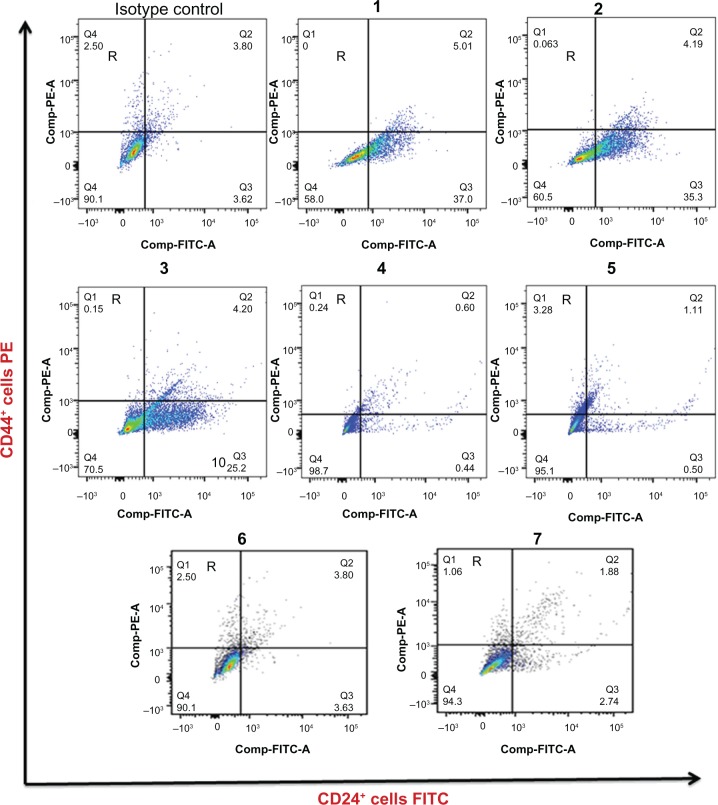
A total of 167 surgically resected primary invasive breast carcinomas and 63 metastatic lymph node lesions were analyzed for immunohistochemical (IHC) localization of the CD44(+)CD24(-low) breast cancer stem cell (CSC) markers, epithelial to mesenchymal transition (EMT) markers, and telomerase activity by double-staining IHC technique, in formalin-fixed, paraffin-embedded tissue, the results were validated by double-staining immunofluorescent and flow cytometry techniques. The results showed that CSCs with CD44(+)CD24(-low) phenotype were significantly increased in node-positive tumors, high-grade tumors, and ductal carcinoma in situ (DCIS). There was a high incidence of telomerase expression in metastatic lymph node lesion. There were considerably high number of tumor cells with EMT expression in metastatic lymph node lesion, and triple-negative tumor. The occurrence of EMT phenomena was usually accompanied by the co-existence of CSCs of CD44(+)CD24(-low) phenotype. There was no association between the existence of CSCs and detection of telomerase activity in tumor cells. Increased numbers of both CSCs of CD44(+)CD24(-low) phenotype and cells underwent EMT in DCIS lesion might be an initial step in the stromal invasion and propagation of breast cancer, and occurrence of EMT in the breast tumor associated with high prevalence of CSCs, promoting tumor invasiveness and metastasis.
采用双重免疫组化技术,对167例手术切除的原发性浸润性乳腺癌及63例转移性淋巴结病变进行分析,检测其福尔马林固定、石蜡包埋组织中CD44(+)CD24(-低表达)乳腺癌干细胞(CSC)标志物、上皮-间质转化(EMT)标志物的免疫组化(IHC)定位及端粒酶活性,结果通过双重免疫荧光和流式细胞术技术进行验证。结果显示,具有CD44(+)CD24(-低表达)表型的CSCs在淋巴结阳性肿瘤、高级别肿瘤及原位导管癌(DCIS)中显著增加。转移性淋巴结病变中端粒酶表达发生率较高。转移性淋巴结病变及三阴性肿瘤中有相当数量的肿瘤细胞表达EMT。EMT现象的发生通常伴随着CD44(+)CD24(-低表达)表型CSCs的共存。肿瘤细胞中CSCs的存在与端粒酶活性检测之间无相关性。DCIS病变中CD44(+)CD24(-低表达)表型CSCs及发生EMT的细胞数量增加可能是乳腺癌基质侵袭和扩散的起始步骤,且乳腺癌中EMT的发生与CSCs的高患病率相关,促进肿瘤侵袭和转移。