• 文献检索
  • 文档翻译
  • 深度研究
  • 学术资讯
  • Suppr Zotero 插件Zotero 插件
  • 邀请有礼
  • 套餐&价格
  • 历史记录
应用&插件
Suppr Zotero 插件Zotero 插件浏览器插件Mac 客户端Windows 客户端微信小程序
定价
高级版会员购买积分包购买API积分包
服务
文献检索文档翻译深度研究API 文档MCP 服务
关于我们
关于 Suppr公司介绍联系我们用户协议隐私条款
关注我们

Suppr 超能文献

核心技术专利:CN118964589B侵权必究
粤ICP备2023148730 号-1Suppr @ 2026

文献检索

告别复杂PubMed语法,用中文像聊天一样搜索,搜遍4000万医学文献。AI智能推荐,让科研检索更轻松。

立即免费搜索

文件翻译

保留排版,准确专业,支持PDF/Word/PPT等文件格式,支持 12+语言互译。

免费翻译文档

深度研究

AI帮你快速写综述,25分钟生成高质量综述,智能提取关键信息,辅助科研写作。

立即免费体验

宏转录组学揭示了龋损中总体活跃的细菌组成。

Metatranscriptomics reveals overall active bacterial composition in caries lesions.

作者信息

Simón-Soro Aurea, Guillen-Navarro Miriam, Mira Alex

机构信息

FISABIO Foundation, Center for Advanced Research in Public Health, Valencia, Spain.

FISABIO Foundation, Center for Advanced Research in Public Health, Valencia, Spain;

出版信息

J Oral Microbiol. 2014 Oct 24;6:25443. doi: 10.3402/jom.v6.25443. eCollection 2014.

DOI:10.3402/jom.v6.25443
PMID:25626770
原文链接:https://pmc.ncbi.nlm.nih.gov/articles/PMC4247497/
Abstract

BACKGROUND

Identifying the microbial species in caries lesions is instrumental to determine the etiology of dental caries. However, a significant proportion of bacteria in carious lesions have not been cultured, and the use of molecular methods has been limited to DNA-based approaches, which detect both active and inactive or dead microorganisms.

OBJECTIVE

To identify the RNA-based, metabolically active bacterial composition of caries lesions at different stages of disease progression in order to provide a list of potential etiological agents of tooth decay.

DESIGN

Non-cavitated enamel caries lesions (n=15) and dentin caries lesions samples (n=12) were collected from 13 individuals. RNA was extracted and cDNA was constructed, which was used to amplify the 16S rRNA gene. The resulting 780 bp polymerase chain reaction products were pyrosequenced using Titanium-plus chemistry, and the sequences obtained were used to determine the bacterial composition.

RESULTS

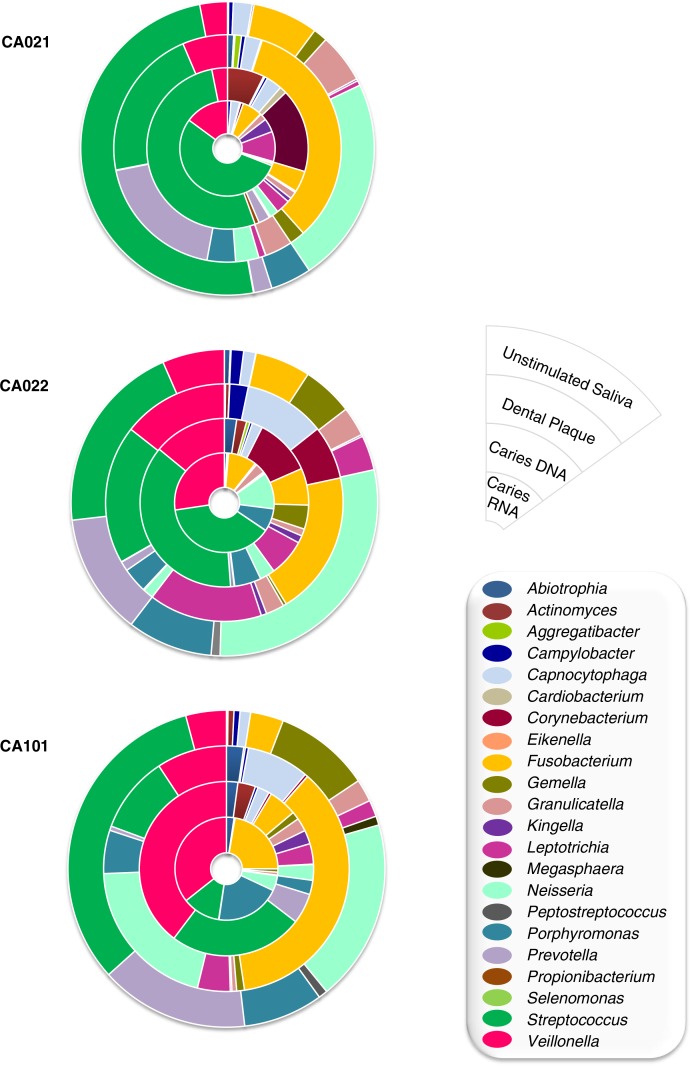
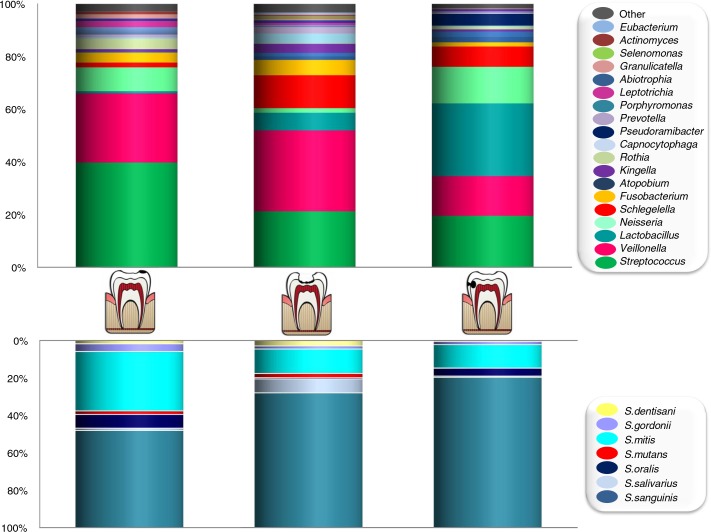
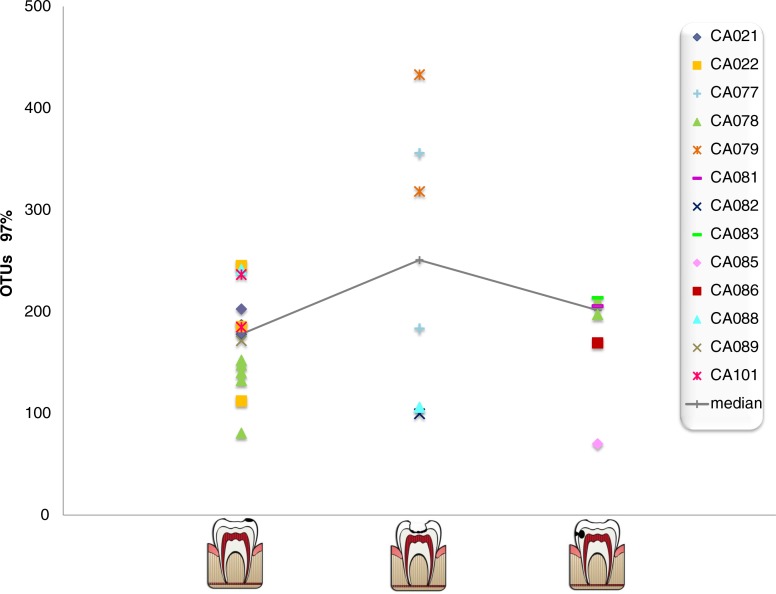
A mean of 4,900 sequences of the 16S rRNA gene with an average read length of 661 bp was obtained per sample, giving a comprehensive view of the active bacterial communities in caries lesions. Estimates of bacterial diversity indicate that the microbiota of cavities is highly complex, each sample containing between 70 and 400 metabolically active species. The composition of these bacterial consortia varied among individuals and between caries lesions of the same individuals. In addition, enamel and dentin lesions had a different bacterial makeup. Lactobacilli were found almost exclusively in dentin cavities. Streptococci accounted for 40% of the total active community in enamel caries, and 20% in dentin caries. However, Streptococcus mutans represented only 0.02-0.73% of the total bacterial community.

CONCLUSIONS

The data indicate that the etiology of dental caries is tissue dependent and that the disease has a clear polymicrobial origin. The low proportion of mutans streptococci detected confirms that they are a minority and questions its importance as the main etiological agent of tooth decay. Future experimental work should be performed to confirm the cariogenicity of the identified bacteria.

摘要

背景

确定龋损中的微生物种类有助于明确龋齿的病因。然而,龋损中相当一部分细菌尚未得到培养,分子方法的应用也仅限于基于DNA的方法,该方法能检测活跃的和不活跃或已死亡的微生物。

目的

确定疾病进展不同阶段龋损中基于RNA的、具有代谢活性的细菌组成,以便提供一份潜在的龋齿病原体清单。

设计

从13名个体中收集非龋洞性釉质龋损样本(n = 15)和牙本质龋损样本(n = 12)。提取RNA并构建cDNA,用于扩增16S rRNA基因。使用Titanium-plus化学方法对所得的780 bp聚合酶链反应产物进行焦磷酸测序,并利用获得的序列确定细菌组成。

结果

每个样本平均获得4900条16S rRNA基因序列,平均读长为661 bp,从而全面了解龋损中活跃的细菌群落。细菌多样性估计表明,龋洞中的微生物群高度复杂,每个样本包含70至400种具有代谢活性的细菌。这些细菌群落的组成在个体之间以及同一个体的不同龋损之间存在差异。此外,釉质和牙本质龋损的细菌构成不同。乳酸杆菌几乎仅在牙本质龋洞中发现。链球菌在釉质龋的总活跃菌群中占40%,在牙本质龋中占20%。然而,变形链球菌仅占细菌群落总数的0.02 - 0.73%。

结论

数据表明龋齿的病因与组织有关,且该疾病具有明确的多微生物起源。检测到的变形链球菌比例较低,证实它们是少数,这对其作为龋齿主要病原体的重要性提出了质疑。未来应开展实验工作以证实所鉴定细菌的致龋性。
https://cdn.ncbi.nlm.nih.gov/pmc/blobs/77eb/4247497/f4925d721620/JOM-6-25443-g003.jpg
https://cdn.ncbi.nlm.nih.gov/pmc/blobs/77eb/4247497/b803dbd5694c/JOM-6-25443-g001.jpg
https://cdn.ncbi.nlm.nih.gov/pmc/blobs/77eb/4247497/f6d4df948ef3/JOM-6-25443-g002.jpg
https://cdn.ncbi.nlm.nih.gov/pmc/blobs/77eb/4247497/f4925d721620/JOM-6-25443-g003.jpg
https://cdn.ncbi.nlm.nih.gov/pmc/blobs/77eb/4247497/b803dbd5694c/JOM-6-25443-g001.jpg
https://cdn.ncbi.nlm.nih.gov/pmc/blobs/77eb/4247497/f6d4df948ef3/JOM-6-25443-g002.jpg
https://cdn.ncbi.nlm.nih.gov/pmc/blobs/77eb/4247497/f4925d721620/JOM-6-25443-g003.jpg

相似文献

1
Metatranscriptomics reveals overall active bacterial composition in caries lesions.宏转录组学揭示了龋损中总体活跃的细菌组成。
J Oral Microbiol. 2014 Oct 24;6:25443. doi: 10.3402/jom.v6.25443. eCollection 2014.
2
Microbiomes of Site-Specific Dental Plaques from Children with Different Caries Status.不同龋病状态儿童特定部位牙菌斑的微生物群
Infect Immun. 2017 Jul 19;85(8). doi: 10.1128/IAI.00106-17. Print 2017 Aug.
3
A tissue-dependent hypothesis of dental caries.牙体病的组织依赖性假说。
Caries Res. 2013;47(6):591-600. doi: 10.1159/000351663. Epub 2013 Sep 25.
4
Identification of the microbiota in carious dentin lesions using 16S rRNA gene sequencing.使用16S rRNA基因测序鉴定龋损牙本质病变中的微生物群。
PLoS One. 2014 Aug 1;9(8):e103712. doi: 10.1371/journal.pone.0103712. eCollection 2014.
5
Comparison of bacterial culture and 16S rRNA community profiling by clonal analysis and pyrosequencing for the characterization of the dentine caries-associated microbiome.通过克隆分析和焦磷酸测序对牙本质龋相关微生物群进行表征时,细菌培养与16S rRNA群落分析的比较。
Front Cell Infect Microbiol. 2014 Nov 12;4:164. doi: 10.3389/fcimb.2014.00164. eCollection 2014.
6
Bacterial composition and red fluorescence of plaque in relation to primary and secondary caries next to composite: an in situ study.复合树脂边缘原发性和继发性龋损相关菌斑的细菌组成及红色荧光:一项原位研究
Oral Microbiol Immunol. 2008 Feb;23(1):7-13. doi: 10.1111/j.1399-302X.2007.00381.x.
7
Molecular detection of bacteria associated to caries activity in dentinal lesions.检测牙本质病变中与龋齿活性相关的细菌的分子学方法。
Clin Oral Investig. 2017 Jul;21(6):2053-2061. doi: 10.1007/s00784-016-1995-9. Epub 2016 Nov 12.
8
Development of multi-species consortia biofilms of oral bacteria as an enamel and root caries model system.作为牙釉质和根龋模型系统的口腔细菌多物种聚生体生物膜的开发。
Arch Oral Biol. 2000 Jan;45(1):27-40. doi: 10.1016/s0003-9969(99)00111-9.
9
DENTINE CARIES: ACID-TOLERANT MICROORGANISMS AND ASPECTS ON COLLAGEN DEGRADATION.牙本质龋:耐酸微生物及胶原降解相关方面
Swed Dent J Suppl. 2014(233):9-94.
10
Insights into the Virulence Traits of Streptococcus mutans in Dentine Carious Lesions of Children with Early Childhood Caries.对患有早期儿童龋的儿童牙本质龋损中变形链球菌毒力特征的见解。
Caries Res. 2016;50(3):279-87. doi: 10.1159/000445256. Epub 2016 May 3.

引用本文的文献

1
Oral microbiota in preschoolers with rampant caries: a matched case-control study.患有猖獗性龋齿的学龄前儿童的口腔微生物群:一项配对病例对照研究。
Appl Microbiol Biotechnol. 2024 Dec 11;108(1):533. doi: 10.1007/s00253-024-13362-5.
2
Oral Microbiome: A Review of Its Impact on Oral and Systemic Health.口腔微生物群:对口腔和全身健康影响的综述
Microorganisms. 2024 Aug 29;12(9):1797. doi: 10.3390/microorganisms12091797.
3
The Evolving Microbiome of Dental Caries.龋齿不断演变的微生物群落

本文引用的文献

1
Microbiota diversity and gene expression dynamics in human oral biofilms.人类口腔生物膜中的微生物群多样性和基因表达动态
BMC Genomics. 2014 Apr 27;15:311. doi: 10.1186/1471-2164-15-311.
2
Symbiotic relationship between Streptococcus mutans and Candida albicans synergizes virulence of plaque biofilms in vivo.变形链球菌和白色念珠菌之间的共生关系协同增强了菌斑生物膜在体内的毒力。
Infect Immun. 2014 May;82(5):1968-81. doi: 10.1128/IAI.00087-14. Epub 2014 Feb 24.
3
A tissue-dependent hypothesis of dental caries.牙体病的组织依赖性假说。
Microorganisms. 2024 Jan 7;12(1):121. doi: 10.3390/microorganisms12010121.
4
Human milk microbiota: what did we learn in the last 20 years?人乳微生物群:过去20年我们了解到了什么?
Microbiome Res Rep. 2022 May 25;1(3):19. doi: 10.20517/mrr.2022.05. eCollection 2022.
5
Hub genes and pathways related to caries-free dental biofilm: clinical metatranscriptomic study.与无龋牙菌斑相关的枢纽基因和通路:临床宏转录组学研究
Clin Oral Investig. 2023 Dec;27(12):7725-7735. doi: 10.1007/s00784-023-05363-x. Epub 2023 Nov 4.
6
The making of the oral microbiome in Agta hunter-gatherers.阿格塔狩猎采集者口腔微生物群的形成
Evol Hum Sci. 2023 May 22;5:e13. doi: 10.1017/ehs.2023.9. eCollection 2023.
7
Agta hunter-gatherer oral microbiomes are shaped by contact network structure.阿格塔狩猎采集者的口腔微生物群受接触网络结构的影响。
Evol Hum Sci. 2023 Feb 23;5:e9. doi: 10.1017/ehs.2023.4. eCollection 2023.
8
Pre-treatment oral microbiome analysis and salivary Stephan curve kinetics in white spot lesion development in orthodontic patients wearing fixed appliances. A pilot study.正畸患者固定矫治器佩戴中,白色斑点病变发展过程中的预处理口腔微生物组分析及唾液 Stephan 曲线动力学:一项初步研究。
BMC Oral Health. 2023 Apr 24;23(1):239. doi: 10.1186/s12903-023-02917-z.
9
Microbiome and metabolome associated with white spot lesions in patients treated with clear aligners.与使用透明矫正器治疗的患者中的白斑病变相关的微生物组和代谢组。
Front Cell Infect Microbiol. 2023 Apr 4;13:1119616. doi: 10.3389/fcimb.2023.1119616. eCollection 2023.
10
Dental caries and their microbiomes in children: what do we do now?儿童龋齿及其微生物群落:我们现在该怎么做?
J Oral Microbiol. 2023 Apr 10;15(1):2198433. doi: 10.1080/20002297.2023.2198433. eCollection 2023.
Caries Res. 2013;47(6):591-600. doi: 10.1159/000351663. Epub 2013 Sep 25.
4
Microbial geography of the oral cavity.口腔微生物地理学。
J Dent Res. 2013 Jul;92(7):616-21. doi: 10.1177/0022034513488119. Epub 2013 May 14.
5
Dental caries from a molecular microbiological perspective.从分子微生物学角度看龋齿
Caries Res. 2013;47(2):89-102. doi: 10.1159/000345367. Epub 2012 Nov 30.
6
Beyond Streptococcus mutans: dental caries onset linked to multiple species by 16S rRNA community analysis.超越变异链球菌:通过 16S rRNA 群落分析发现,多种细菌与龋齿的发生有关。
PLoS One. 2012;7(10):e47722. doi: 10.1371/journal.pone.0047722. Epub 2012 Oct 16.
7
Microbiome diversity in the bronchial tracts of patients with chronic obstructive pulmonary disease.慢性阻塞性肺疾病患者支气管内微生物组多样性。
J Clin Microbiol. 2012 Nov;50(11):3562-8. doi: 10.1128/JCM.00767-12. Epub 2012 Aug 22.
8
The human milk microbiome changes over lactation and is shaped by maternal weight and mode of delivery.人乳微生物组在哺乳期发生变化,并受到产妇体重和分娩方式的影响。
Am J Clin Nutr. 2012 Sep;96(3):544-51. doi: 10.3945/ajcn.112.037382. Epub 2012 Jul 25.
9
The oral metagenome in health and disease.口腔宏基因组学在健康与疾病中的研究
ISME J. 2012 Jan;6(1):46-56. doi: 10.1038/ismej.2011.85. Epub 2011 Jun 30.
10
UCHIME improves sensitivity and speed of chimera detection.UCHIME 提高了嵌合体检测的灵敏度和速度。
Bioinformatics. 2011 Aug 15;27(16):2194-200. doi: 10.1093/bioinformatics/btr381. Epub 2011 Jun 23.