Zhong Jia, Colicino Elena, Lin Xinyi, Mehta Amar, Kloog Itai, Zanobetti Antonella, Byun Hyang-Min, Bind Marie-Abèle, Cantone Laura, Prada Diddier, Tarantini Letizia, Trevisi Letizia, Sparrow David, Vokonas Pantel, Schwartz Joel, Baccarelli Andrea A
Department of Environmental Health, Harvard School of Public Health, Boston, MA (J.Z., E.C., A.M., A.Z., H.M.B., M.A.B., D.P., L.T., J.S., A.A.B.).
Department of Biostatistics, Harvard School of Public Health, Boston, MA (X.L., M.A.B.) Singapore Institute for Clinical Sciences, Singapore (X.L.).
J Am Heart Assoc. 2015 Jan 27;4(1):e001423. doi: 10.1161/JAHA.114.001423.
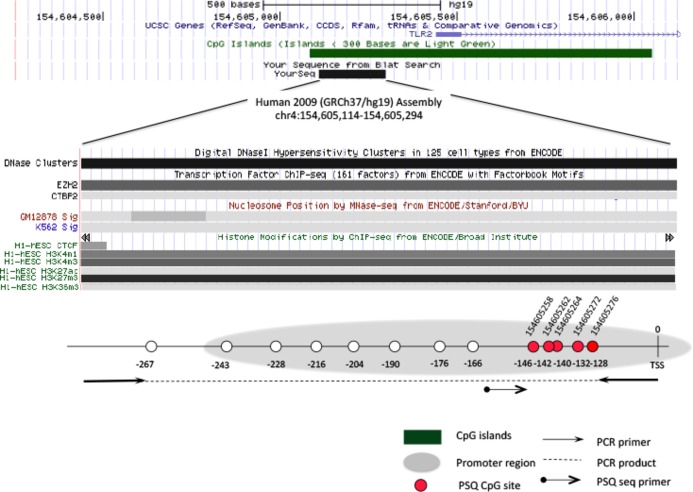
Short-term fine particles (PM(2.5)) exposure is associated with reduced heart rate variability, a strong predictor of cardiac mortality among older people. Identifying modifiable factors that confer susceptibility is essential for intervention. We evaluated whether Toll-like receptor 2 (TLR2) methylation, a reversible immune-epigenetic process, and its dietary modulation by flavonoids and methyl nutrients, modify susceptibility to heart rate variability effects following PM(2.5) exposure.
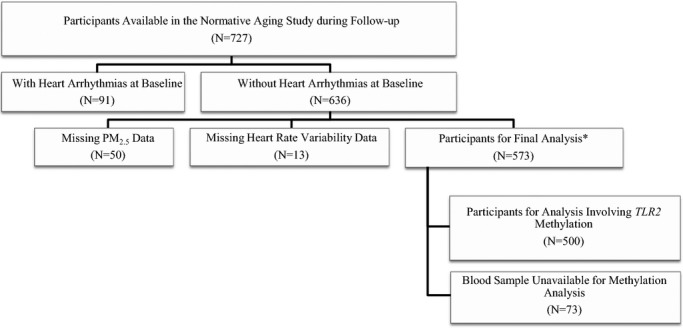
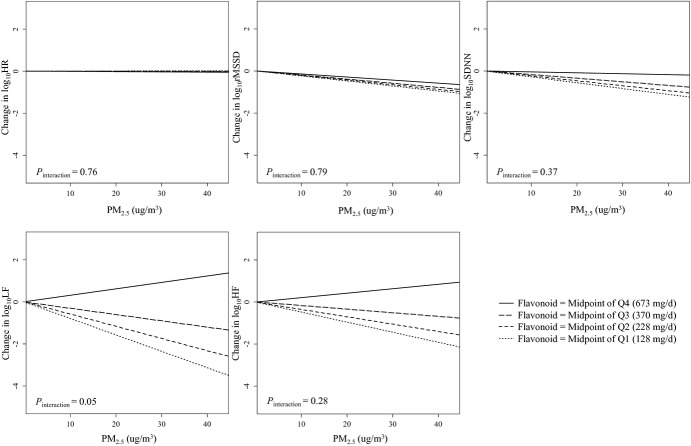
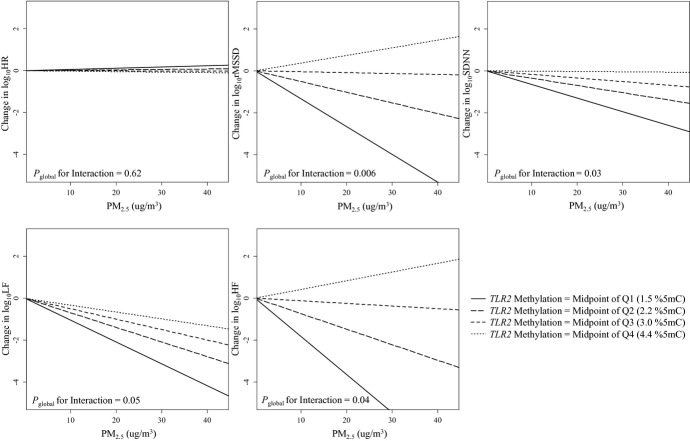
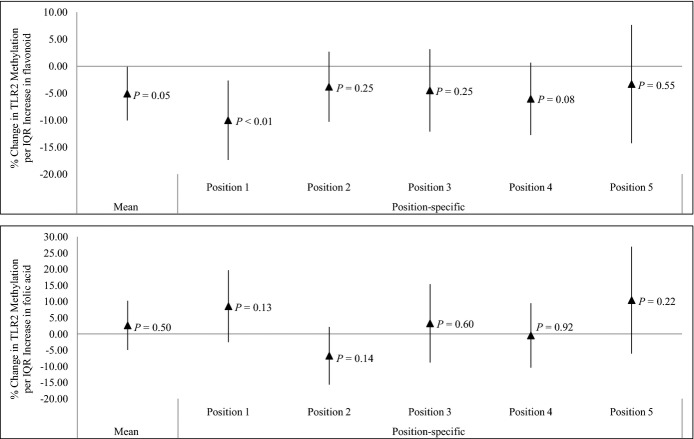
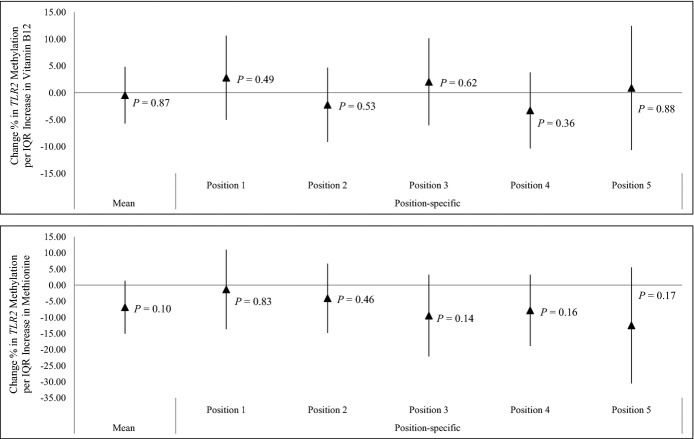
We measured heart rate variability and PM(2.5) repeatedly over 11 years (1275 total observations) among 573 elderly men from the Normative Aging Study. Blood TLR2 methylation was analyzed using pyrosequencing. Daily flavonoid and methyl nutrients intakes were assessed through the Food Frequency Questionnaire (FFQ). Every 10 μg/m(3) increase in 48-hour PM(2.5) moving average was associated with 7.74% (95% CI: -1.21% to 15.90%; P=0.09), 7.46% (95% CI: 0.99% to 13.50%; P=0.02), 14.18% (95% CI: 1.14% to 25.49%; P=0.03), and 12.94% (95% CI: -2.36% to 25.96%; P=0.09) reductions in root mean square of successive differences, standard deviation of normal-to-normal intervals, low-frequency power, and high-frequency power, respectively. Higher TLR2 methylation exacerbated the root mean square of successive differences, standard deviation of normal-to-normal intervals, low-frequency, and high-frequency reductions associated with heightened PM2.5 (P(interaction)=0.006, 0.03, 0.05, 0.04, respectively). Every interquartile-range increase in flavonoid intake was associated with 5.09% reduction in mean TLR2 methylation (95% CI: 0.12% to 10.06%; P=0.05) and counteracted the effects of PM2.5 on low frequency (P(interaction)=0.05). No significant effect of methyl nutrients on TLR2 methylation was observed.
Higher TLR2 methylation may confer susceptibility to adverse cardiac autonomic effects of PM2.5 exposure in older individuals. Higher flavonoid intake may attenuate these effects, possibly by decreasing TLR2 methylation.
短期暴露于细颗粒物(PM2.5)与心率变异性降低有关,心率变异性是老年人心脏死亡率的一个强有力的预测指标。确定可改变的易感因素对于干预至关重要。我们评估了Toll样受体2(TLR2)甲基化(一种可逆的免疫表观遗传过程)及其通过类黄酮和甲基营养素进行的饮食调节,是否会改变PM2.5暴露后对心率变异性影响的易感性。
在规范性衰老研究中,我们对573名老年男性在11年期间(共1275次观察)反复测量了心率变异性和PM2.5。使用焦磷酸测序法分析血液中TLR2甲基化情况。通过食物频率问卷(FFQ)评估每日类黄酮和甲基营养素的摄入量。48小时PM2.5移动平均值每增加10μg/m³,连续差值的均方根、正常到正常间期的标准差、低频功率和高频功率分别降低7.74%(95%CI:-1.21%至15.90%;P=0.09)、7.46%(95%CI:0.99%至13.50%;P=0.02)、14.18%(95%CI:1.14%至25.49%;P=0.03)和12.94%(95%CI:-2.36%至25.96%;P=0.09)。较高的TLR2甲基化加剧了与PM2.5升高相关的连续差值的均方根、正常到正常间期的标准差、低频和高频降低(交互作用P值分别为0.006、0.03、0.05、0.04)。类黄酮摄入量每增加一个四分位数间距,平均TLR2甲基化降低5.09%(95%CI:0.12%至10.06%;P=0.05),并抵消了PM2.5对低频的影响(交互作用P值=0.05)。未观察到甲基营养素对TLR2甲基化有显著影响。
较高的TLR2甲基化可能使老年人在暴露于PM2.5时更易受到不良心脏自主神经效应的影响。较高的类黄酮摄入量可能会减轻这些影响,可能是通过降低TLR2甲基化来实现的。