Jung Na-Yeon, Park Yeong-Eun, Shin Jin-Hong, Lee Chang Hun, Jung Dae-Soo, Kim Dae-Seong
Department of Neurology, Pusan National University Yangsan Hospital, Yangsan, Korea.
Department of Neurology, Pusan National University Hospital, Busan, Korea.
J Clin Neurol. 2015 Jan;11(1):97-101. doi: 10.3988/jcn.2015.11.1.97. Epub 2014 Nov 11.
Central core disease (CCD) is a congenital myopathy characterized by distinctive cores in muscle fibers. Mutations in the gene encoding ryanodine receptor 1 (RYR1) have been identified in most CCD patients.
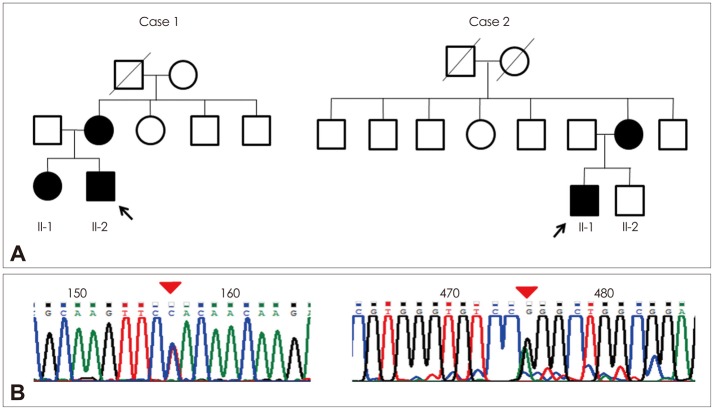
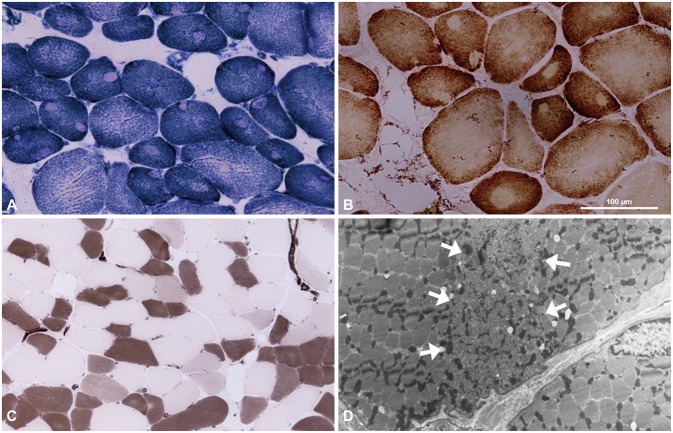
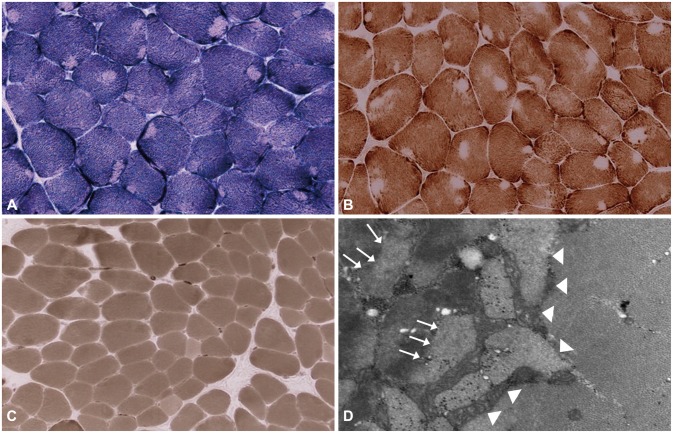
Two unrelated patients presented with slowly progressive or nonprogressive proximal muscle weakness since childhood. Their family history revealed some members with the same clinical problem. Histological analysis of muscle biopsy samples revealed numerous peripheral cores in the muscle fibers. RYR1 sequence analysis disclosed a novel mutation in exon 101 (c.14590T>C) and confirmed a previously reported mutation in exon 102 (c.14678G>A).
We report herein two families with CCD in whom missense mutations at the C-terminal of RYR1 were identified. Although it has been accepted that such mutations are usually associated with a severe clinical phenotype and clearly demarcated central cores, our patients exhibited a mild clinical phenotype without facial muscle involvement and skeletal deformities, and atypical cores in their muscle biopsy specimens.
中央轴空病(CCD)是一种先天性肌病,其特征为肌纤维中出现独特的轴空。大多数CCD患者已被鉴定出编码兰尼碱受体1(RYR1)的基因突变。
两名无血缘关系的患者自童年起出现缓慢进展或无进展的近端肌无力。他们的家族史显示一些家族成员有相同的临床问题。肌肉活检样本的组织学分析显示肌纤维中有大量周边轴空。RYR1序列分析揭示了外显子101中的一个新突变(c.14590T>C),并证实了外显子102中先前报道的一个突变(c.14678G>A)。
我们在此报告两个患有CCD的家族,其中鉴定出RYR1 C末端的错义突变。尽管人们普遍认为此类突变通常与严重的临床表型以及清晰界定的中央轴空相关,但我们的患者表现出轻度临床表型,无面部肌肉受累和骨骼畸形,且其肌肉活检标本中有非典型轴空。