Kim Yangjin, Powathil Gibin, Kang Hyunji, Trucu Dumitru, Kim Hyeongi, Lawler Sean, Chaplain Mark
Department of Mathematics, Konkuk University, Seoul, 143-701, Republic of Korea; Department of Mathematics, Ohio State University, Columbus, OH 43210, USA.
Division of Mathematics, University of Dundee, Dundee, UK; Department of Mathematics, Swansea University, Swansea, UK.
PLoS One. 2015 Jan 28;10(1):e0114370. doi: 10.1371/journal.pone.0114370. eCollection 2015.
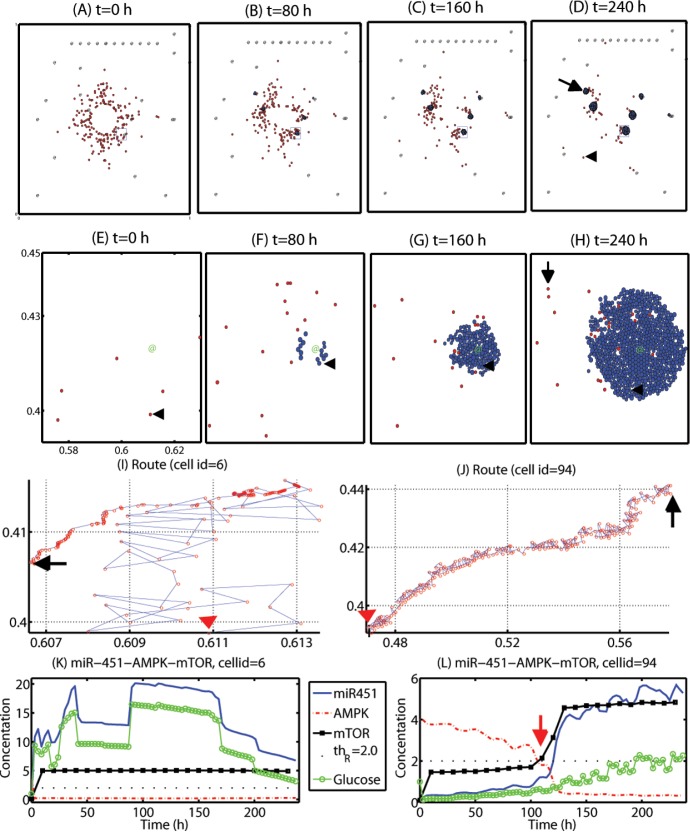
The cellular dispersion and therapeutic control of glioblastoma, the most aggressive type of primary brain cancer, depends critically on the migration patterns after surgery and intracellular responses of the individual cancer cells in response to external biochemical and biomechanical cues in the microenvironment. Recent studies have shown that a particular microRNA, miR-451, regulates downstream molecules including AMPK and mTOR to determine the balance between rapid proliferation and invasion in response to metabolic stress in the harsh tumor microenvironment. Surgical removal of main tumor is inevitably followed by recurrence of the tumor due to inaccessibility of dispersed tumor cells in normal brain tissue. In order to address this multi-scale nature of glioblastoma proliferation and invasion and its response to conventional treatment, we propose a hybrid model of glioblastoma that analyses spatio-temporal dynamics at the cellular level, linking individual tumor cells with the macroscopic behaviour of cell organization and the microenvironment, and with the intracellular dynamics of miR-451-AMPK-mTOR signaling within a tumour cell. The model identifies a key mechanism underlying the molecular switches between proliferative phase and migratory phase in response to metabolic stress and biophysical interaction between cells in response to fluctuating glucose levels in the presence of blood vessels (BVs). The model predicts that cell migration, therefore efficacy of the treatment, not only depends on oxygen and glucose availability but also on the relative balance between random motility and strength of chemoattractants. Effective control of growing cells near BV sites in addition to relocalization of invisible migratory cells back to the resection site was suggested as a way of eradicating these migratory cells.
胶质母细胞瘤是最具侵袭性的原发性脑癌,其细胞扩散和治疗控制关键取决于手术后的迁移模式以及单个癌细胞对微环境中外部生化和生物力学信号的细胞内反应。最近的研究表明,一种特定的微小RNA,即miR - 451,可调节包括AMPK和mTOR在内的下游分子,以确定在恶劣肿瘤微环境中对代谢应激作出反应时快速增殖与侵袭之间的平衡。由于正常脑组织中分散的肿瘤细胞难以触及,手术切除主要肿瘤后不可避免地会出现肿瘤复发。为了解决胶质母细胞瘤增殖和侵袭的这种多尺度性质及其对传统治疗的反应,我们提出了一种胶质母细胞瘤的混合模型,该模型在细胞水平分析时空动态,将单个肿瘤细胞与细胞组织和微环境的宏观行为以及肿瘤细胞内miR - 451 - AMPK - mTOR信号传导的细胞内动态联系起来。该模型确定了一个关键机制,该机制是响应代谢应激时增殖期和迁移期之间分子开关的基础,以及在血管(BVs)存在下响应葡萄糖水平波动时细胞间的生物物理相互作用。该模型预测,细胞迁移以及因此治疗效果不仅取决于氧气和葡萄糖的可用性,还取决于随机运动性与化学引诱剂强度之间的相对平衡。除了将不可见的迁移细胞重新定位回切除部位之外,有效控制BV部位附近生长的细胞被认为是根除这些迁移细胞的一种方法。