Department of Molecular Biology, University of Salzburg, 5020 Salzburg (Austria).
Angew Chem Int Ed Engl. 2015 Mar 2;54(10):2917-21. doi: 10.1002/anie.201409135. Epub 2015 Jan 28.
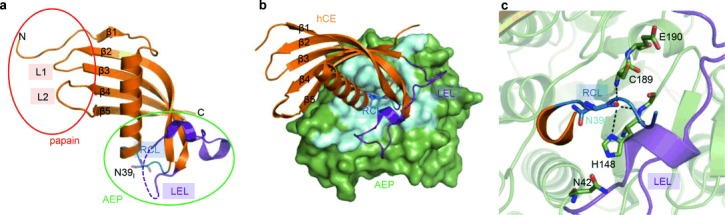
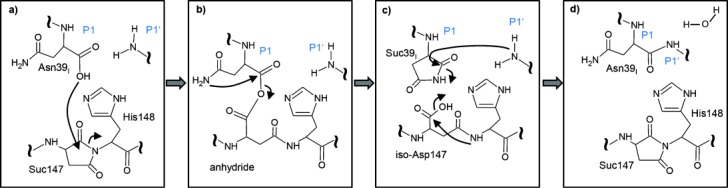
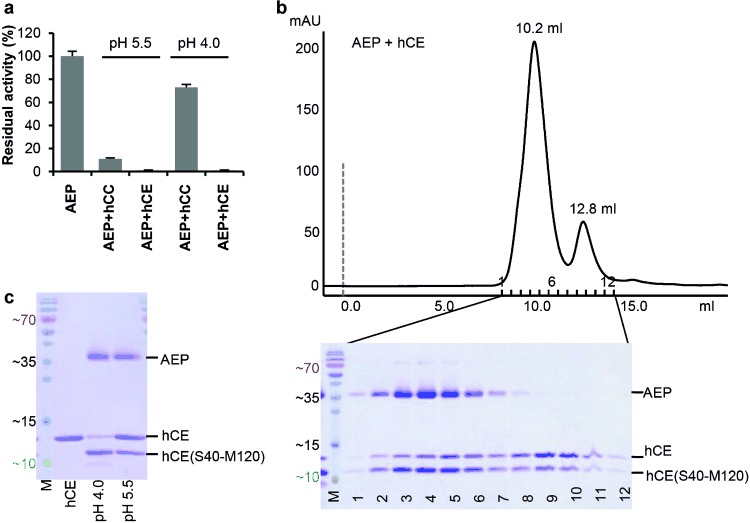
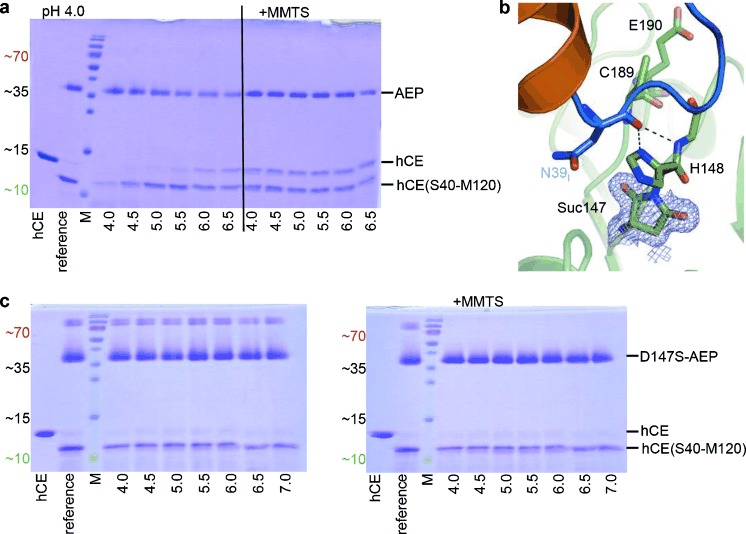
Peptide ligases expand the repertoire of genetically encoded protein architectures by synthesizing new peptide bonds, energetically driven by ATP or NTPs. Here, we report the discovery of a genuine ligase activity in human legumain (AEP) which has important roles in immunity and tumor progression that were believed to be due to its established cysteine protease activity. Defying dogma, the ligase reaction is independent of the catalytic cysteine but exploits an endogenous energy reservoir that results from the conversion of a conserved aspartate to a metastable aspartimide. Legumain's dual protease-ligase activities are pH- and thus localization controlled, dominating at acidic and neutral pH, respectively. Their relevance includes reversible on-off switching of cystatin inhibitors and enzyme (in)activation, and may affect the generation of three-dimensional MHC epitopes. The aspartate-aspartimide (succinimide) pair represents a new paradigm of coupling endergonic reactions in ATP-scarce environments.
肽连接酶通过合成新的肽键来扩展遗传编码蛋白结构的 repertoire,这一过程由 ATP 或 NTP 提供能量驱动。在这里,我们报告了在人组织蛋白酶 L(AEP)中发现了一种真正的连接酶活性,它在免疫和肿瘤进展中具有重要作用,这被认为是由于其已建立的半胱氨酸蛋白酶活性。与传统观念相反,连接酶反应不依赖于催化半胱氨酸,而是利用了一种内源性能量储备,这种能量储备来自于保守天冬氨酸向亚稳天冬酰胺的转化。组织蛋白酶 L 的双重蛋白酶-连接酶活性受 pH 值控制,因此受定位控制,分别在酸性和中性 pH 值下占主导地位。它们的相关性包括胱抑素抑制剂和酶的可逆开-关切换(失活),并可能影响三维 MHC 表位的产生。天冬氨酸-天冬酰胺(琥珀酰亚胺)对代表了在 ATP 稀缺环境中偶联吸能反应的新范例。