Hashimoto Naoki, Toyomaki Atsuhito, Honda Minoru, Miyano Satoru, Nitta Nobuyuki, Sawayama Hiroyuki, Sugawara Yasufumi, Uemura Keiichi, Tsukamoto Noriko, Koyama Tsukasa, Kusumi Ichiro
Department of Psychiatry, Hokkaido University Graduate School of Medicine, 060-8638, North 15, West 7, Kita-ku, Sapporo, Japan ; Child and Adolescent Psychiatry, Department of Psychiatry University of California, 401 Parnassus Ave, Box 0984-F, San Francisco, CA 94143 USA.
Department of Psychiatry, Hokkaido University Graduate School of Medicine, 060-8638, North 15, West 7, Kita-ku, Sapporo, Japan.
Ann Gen Psychiatry. 2015 Jan 22;14(1):1. doi: 10.1186/s12991-014-0039-6. eCollection 2015.
While the frequency and importance of antipsychotic switching in patients with schizophrenia, there is insufficient evidence with regard to switching strategy. Quetiapine is one of the drugs of choice for switch because of its unique receptor profile. However, there were no data on the long-term clinical and neurocognitive effect of quetiapine in patients who had responded inadequately to prior antipsychotics. The purpose of this study is to examine the long-term efficacy and tolerability of quetiapine in patients with schizophrenia who switched from other antipsychotics because of inadequate therapeutic response. We hypothesized that quetiapine would show long-term effectiveness in broad symptom dimensions including negative and neurocognitive symptoms while having good tolerability.
Twenty-nine subjects with schizophrenia who did not respond to their current monotherapy of antipsychotic or who could not tolerate the treatment were switched to quetiapine and assessed at baseline and at 3, 6, and 12 months. The outcome measures included the brief assessment of cognition in schizophrenia (BACS), the Positive and Negative Syndrome Scale (PANSS), the Clinical Global Impressions Scale (CGI), the Schizophrenia Quality of Life Scale Japanese version (JSQLS), the Athens Insomnia Scale (AIS), and the Drug Attitude Inventory with 30 items (DAI-30). The Drug-Induced Extrapyramidal Symptoms Scale (DIEPSS), HbA1c, prolactin (PRL), and body weight were also evaluated.
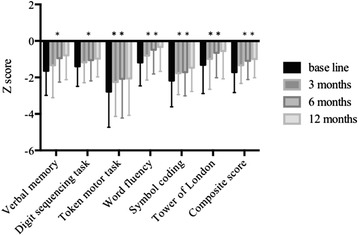
Statistically significant improvements were observed in all subscores of the PANSS, the GAF, and the symptoms and side effects subscale of the JSQLS, the DIEPSS, the AIS, and the PRL level, and nearly significant improvements were observed in the DAI-30. Quetiapine monotherapy was associated with significant improvement in the verbal memory test, even after controlling for the practice effect. Although quetiapine was well tolerated, three subjects dropped out because of the worsening of the psychotic symptoms and two additional subjects dropped out because of somnolence.
In this open-label, single-arm study of 29 patients, quetiapine improved both the clinical symptoms and the neurocognitive impairment in chronic schizophrenia patients who failed to respond to prior antipsychotic treatment.
虽然精神分裂症患者中抗精神病药物换药的频率及重要性已明确,但关于换药策略的证据仍不充分。喹硫平因其独特的受体作用特点,是换药的首选药物之一。然而,对于既往抗精神病药物治疗反应欠佳的患者,尚无关于喹硫平长期临床及神经认知效应的数据。本研究旨在探讨喹硫平对因治疗反应不佳而从其他抗精神病药物换药的精神分裂症患者的长期疗效及耐受性。我们假设喹硫平在包括阴性症状和神经认知症状在内的广泛症状维度上具有长期有效性,且耐受性良好。
29例对当前抗精神病药物单一疗法无反应或无法耐受治疗的精神分裂症患者换用喹硫平,并在基线、3个月、6个月和12个月时进行评估。结局指标包括精神分裂症认知简短评估量表(BACS)、阳性与阴性症状量表(PANSS)、临床总体印象量表(CGI)、精神分裂症生活质量量表日本版(JSQLS)、雅典失眠量表(AIS)以及30项药物态度量表(DAI - 30)。还评估了药物所致锥体外系症状量表(DIEPSS)、糖化血红蛋白(HbA1c)、催乳素(PRL)及体重。
PANSS的所有子量表、GAF、JSQLS的症状及副作用子量表、DIEPSS、AIS及PRL水平均有统计学显著改善,DAI - 30有近乎显著的改善。即使在控制练习效应后,喹硫平单一疗法在言语记忆测试中仍有显著改善。尽管喹硫平耐受性良好,但有3例患者因精神病症状恶化退出,另有2例患者因嗜睡退出。
在这项针对29例患者的开放标签单臂研究中,喹硫平改善了对既往抗精神病药物治疗无反应的慢性精神分裂症患者的临床症状及神经认知损害。