Gallus Susanne, Hallström Björn M, Kumar Vikas, Dodt William G, Janke Axel, Schumann Gerald G, Nilsson Maria A
Division of Medical Biotechnology, Paul Ehrlich Institute, Langen, Germany LOEWE Biodiversity and Climate Research Centre (BiK-F), Senckenberg Gesellschaft für Naturforschung, Frankfurt am Main, Germany.
Division of Medical Biotechnology, Paul Ehrlich Institute, Langen, Germany LOEWE Biodiversity and Climate Research Centre (BiK-F), Senckenberg Gesellschaft für Naturforschung, Frankfurt am Main, Germany Science for Life Laboratory, KTH-Royal Institute of Technology, Stockholm, Sweden.
Mol Biol Evol. 2015 May;32(5):1268-83. doi: 10.1093/molbev/msv017. Epub 2015 Jan 28.
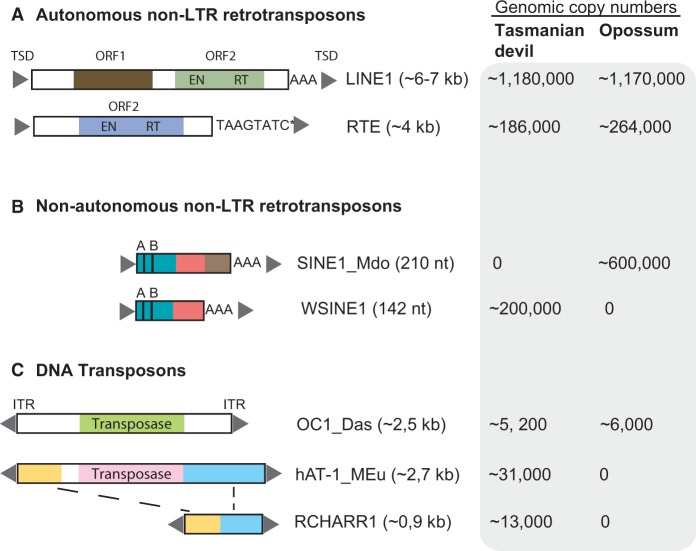
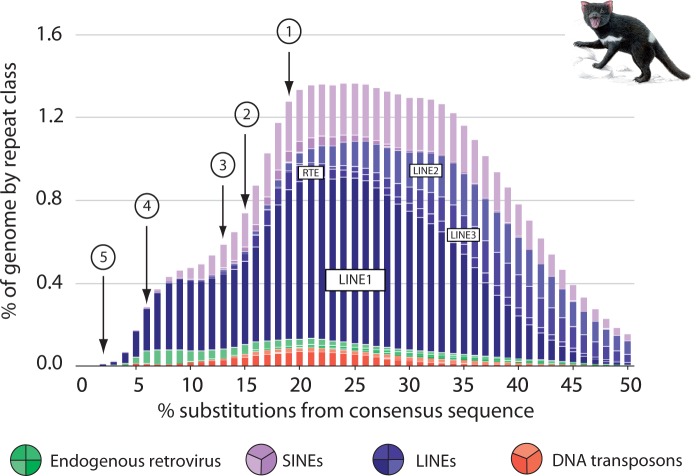
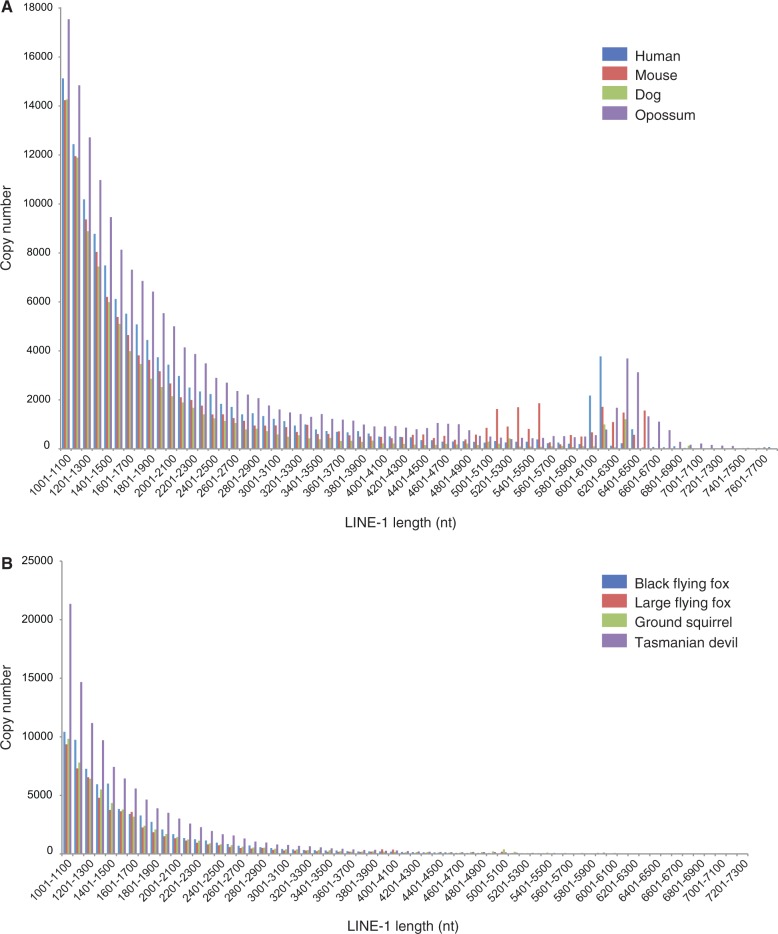
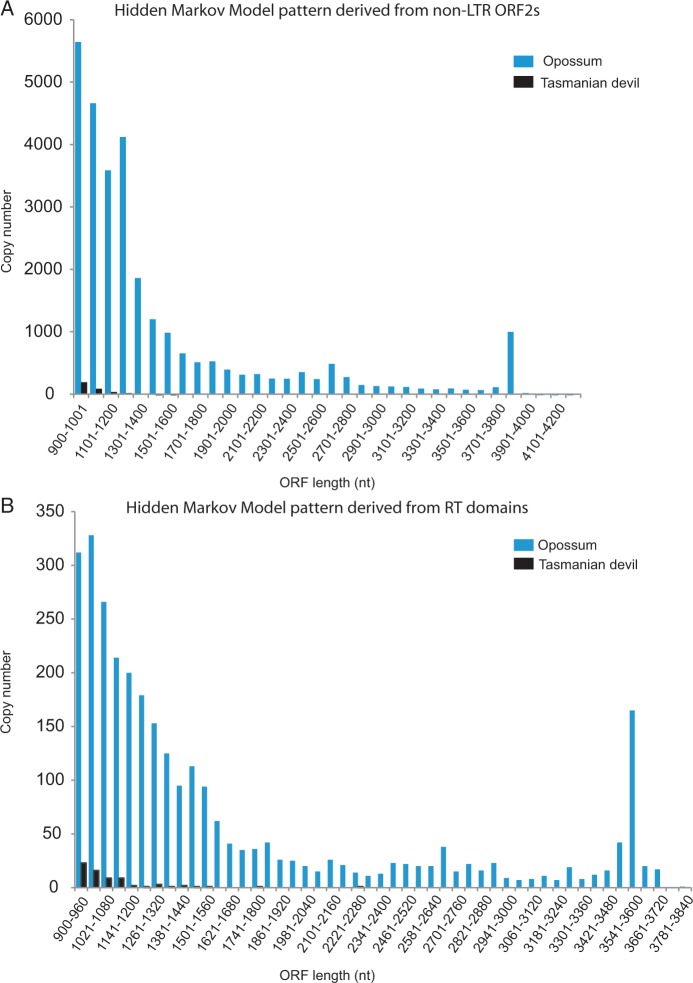
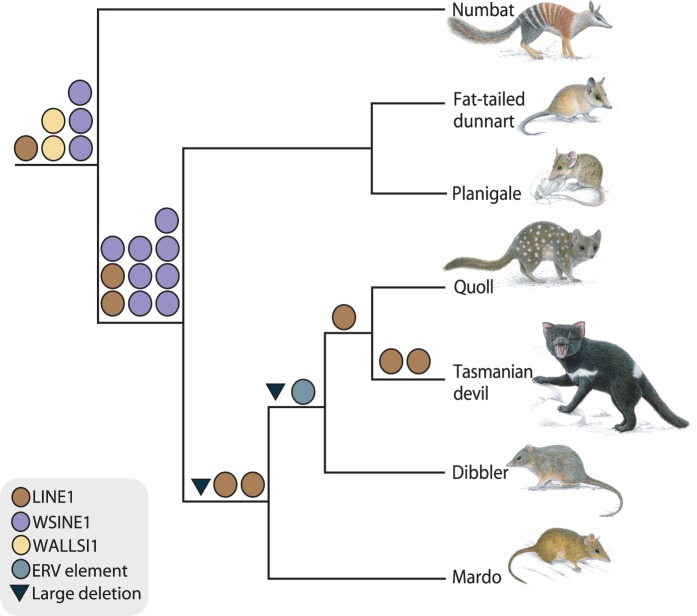
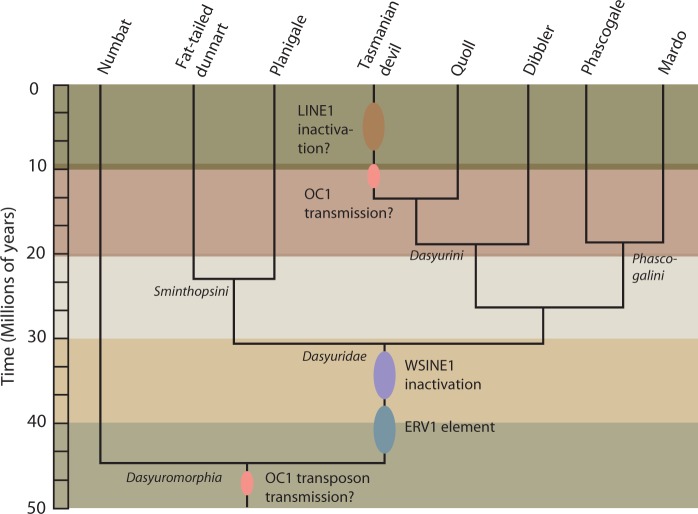
The largest living carnivorous marsupial, the Tasmanian devil (Sarcophilus harrisii), is the sole survivor of a lineage originating about 12 Ma. We set out to investigate the spectrum of transposable elements found in the Tasmanian devil genome, the first high-coverage genome of an Australian marsupial. Marsupial genomes have been shown to have the highest amount of transposable elements among vertebrates. We analyzed the horizontally transmitted DNA transposons OC1 and hAT-1_MEu in the Tasmanian devil genome. OC1 is present in all carnivorous marsupials, while having a very limited distribution among the remaining Australian marsupial orders. In contrast, hAT-1_MEu is present in all Australian marsupial orders, and has so far only been identified in a few placental mammals. We screened 158 introns for phylogenetically informative retrotransposons in the order Dasyuromorphia, and found that the youngest SINE (Short INterspersed Element), WSINE1, is no longer active in the subfamily Dasyuridae. The lack of detectable WSINE1 activity in this group may be due to a retrotransposon inactivation event approximately 30 Ma. We found that the Tasmanian devil genome contains a relatively low number of continuous full-length LINE-1 (Long INterspersed Element 1, L1) retrotransposons compared with the opossum genome. Furthermore, all L1 elements in the Tasmanian devil appeared to be nonfunctional. Hidden Markov Model approaches suggested that other potential sources of functional reverse transcriptase are absent from the genome. We discuss the issues associated with assembling long, highly similar L1 copies from short read Illumina data and describe how assembly artifacts can potentially lead to erroneous conclusions.
现存最大的肉食性有袋动物袋獾(袋獾属哈里斯袋獾)是一个起源于约1200万年前的谱系的唯一幸存者。我们着手研究袋獾基因组中发现的转座元件谱,这是澳大利亚有袋动物的首个高覆盖度基因组。有袋动物基因组已被证明在脊椎动物中拥有数量最多的转座元件。我们分析了袋獾基因组中水平传播的DNA转座子OC1和hAT-1_MEu。OC1存在于所有肉食性有袋动物中,而在其余澳大利亚有袋动物目中分布非常有限。相比之下,hAT-1_MEu存在于所有澳大利亚有袋动物目中,并且迄今为止仅在少数胎盘哺乳动物中被鉴定到。我们在袋鼬目动物中筛选了158个内含子以寻找具有系统发育信息的逆转录转座子,发现最年轻的短散在重复元件WSINE1在袋鼬科亚科中不再活跃。该类群中缺乏可检测到的WSINE1活性可能是由于大约3000万年前的一次逆转录转座子失活事件。我们发现与负鼠基因组相比,袋獾基因组中连续的全长LINE-1(长散在重复元件1,L1)逆转录转座子数量相对较少。此外,袋獾中的所有L1元件似乎都无功能。隐马尔可夫模型方法表明该基因组中不存在其他潜在的功能性逆转录酶来源。我们讨论了从短读长的Illumina数据组装长的、高度相似的L1拷贝相关的问题,并描述了组装假象如何可能导致错误结论。