Serner Andreas, van Eijck Casper H, Beumer Berend R, Hölmich Per, Weir Adam, de Vos Robert-Jan
Aspetar Sports Groin Pain Center, Orthopaedic and Sports Medicine Hospital, Doha, Qatar Arthroscopic Center Amager, SORC-C, Copenhagen University Hospital, Amager-Hvidovre, Denmark.
Department of Surgery, Erasmus University Medical Centre, Rotterdam, The Netherlands.
Br J Sports Med. 2015 Jun;49(12):813. doi: 10.1136/bjsports-2014-094256. Epub 2015 Jan 29.
Groin pain in athletes is frequent and many different treatment options have been proposed. The current level of evidence for the efficacy of these treatments is unknown.
Systematically review the literature on the efficacy of treatments for groin pain in athletes.
Nine medical databases were searched in May 2014.
treatment studies in athletes with groin pain; randomised controlled trials, controlled clinical trials or case series; n>10; outcome measures describing number of recovered athletes, patient satisfaction, pain scores or functional outcome scores. One author screened search results, and two authors independently assessed study quality. A best evidence synthesis was performed. Relationships between quality score and outcomes were evaluated. Review registration number CRD42014010262.
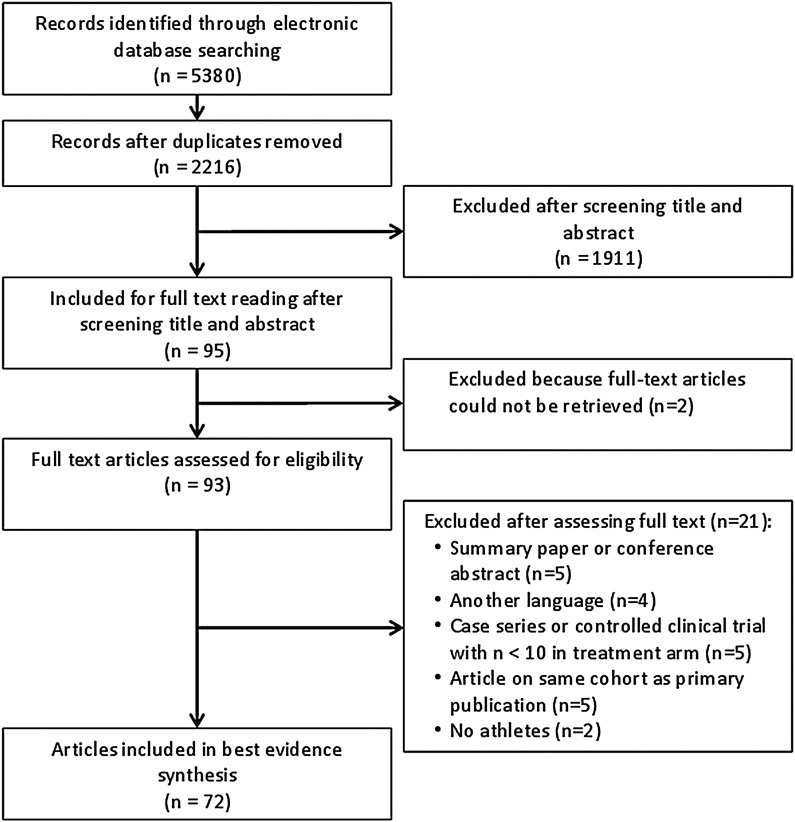
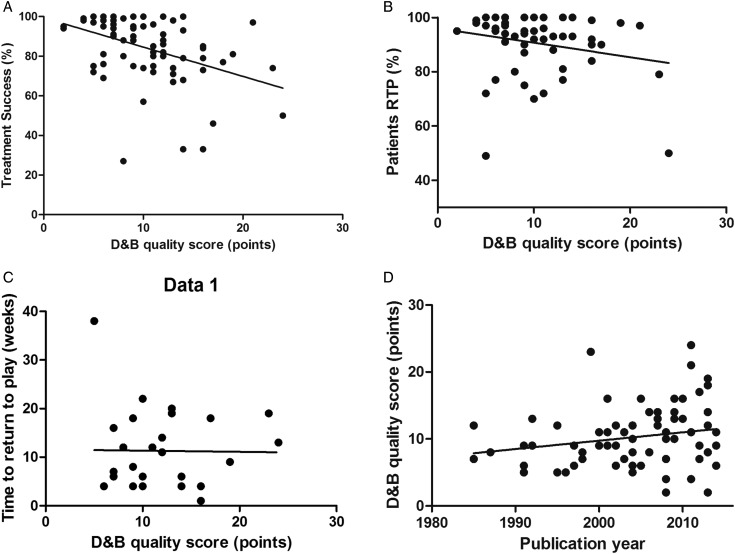
72 studies were included for quality analysis. Four studies were high quality. There is moderate evidence that, for adductor-related groin pain, active exercises compared with passive treatments improve success, multimodal treatment with a manual therapy technique shortens the time to return to sports compared with active exercises and adductor tenotomy improves treatment success over time. There is moderate evidence that for athletes with sportsman's hernia, surgery results in better treatment success then conservative treatment. There was a moderate and inverse correlation between study quality and treatment success (p<0.001, r=-0.41), but not between study quality and publication year (p=0.09, r=0.20).
Only 6% of publications were high quality. Low-quality studies showed significantly higher treatment success and study quality has not improved since 1985. There is moderate evidence for the efficacy of conservative treatment (active exercises and multimodal treatments) and for surgery in patients with adductor-related groin pain. There is moderate evidence for efficacy of surgical treatment in sportsman's hernia.
运动员腹股沟疼痛很常见,并且已经提出了许多不同的治疗方案。目前尚不清楚这些治疗方法疗效的证据水平。
系统回顾关于运动员腹股沟疼痛治疗效果的文献。
2014年5月检索了九个医学数据库。
针对患有腹股沟疼痛的运动员的治疗研究;随机对照试验、对照临床试验或病例系列;n>10;描述康复运动员数量、患者满意度、疼痛评分或功能结局评分的结局指标。由一位作者筛选检索结果,两位作者独立评估研究质量。进行了最佳证据综合分析。评估了质量评分与结局之间的关系。综述注册号CRD42014010262。
纳入72项研究进行质量分析。四项研究质量高。有中等证据表明,对于内收肌相关的腹股沟疼痛,与被动治疗相比,主动运动可提高成功率;与主动运动相比,采用手法治疗技术的多模式治疗可缩短恢复运动的时间,并且随着时间的推移,内收肌切断术可提高治疗成功率。有中等证据表明,对于患有运动性疝的运动员,手术治疗比保守治疗的成功率更高。研究质量与治疗成功率之间存在中等程度的负相关(p<0.001,r=-0.41),但研究质量与发表年份之间不存在相关性(p=0.09,r=0.20)。
只有6%的出版物质量高。低质量研究显示出明显更高的治疗成功率,并且自1985年以来研究质量并未提高。对于内收肌相关的腹股沟疼痛患者,保守治疗(主动运动和多模式治疗)和手术治疗的疗效有中等证据支持。对于运动性疝,手术治疗疗效有中等证据支持。