Huang Xin, Zhang Yanping, Gao Zifen
From the Department of Pathology, School of medical science, Peking University Health Science Center, Beijing, China (XH, YZ, ZG).
Medicine (Baltimore). 2015 Jan;94(4):e470. doi: 10.1097/MD.0000000000000470.
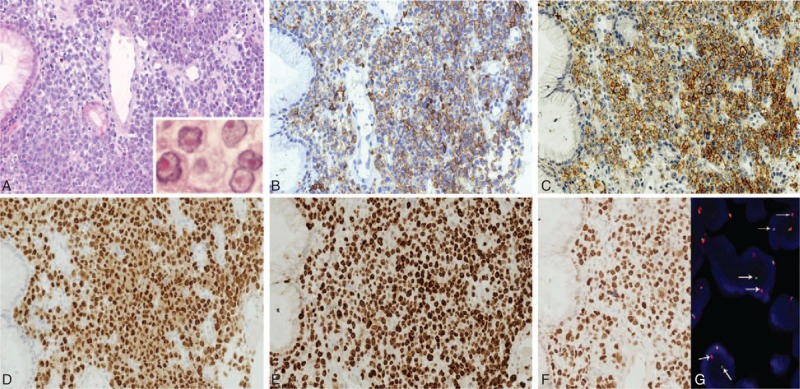
Plasmablastic lymphoma (PBL) is a rare B-cell neoplasm mostly described in human immunodeficiency virus-infected patients. Herein, we described a case of PBL presenting as gastric mass in a 21-year-old young adult without known immunodeficiency. The histological examination of the specimen showed a diffuse proliferation of round- to oval-shaped large cells with scant cytoplasm, and prominent nucleoli. The neoplasm stained positively for CD45, CD38, MUM1, and Vs38C, but typical B-cell and T-cell markers (PAX5, CD20, CD79a, and CD3) were absent. The proliferative index (Ki-67) was about 95%. And the neoplastic cells diffusely expressed the c-myc protein. Epstein-Barr virus-encoded RNA in situ hybridization was negative. Molecular genetic study via interphase fluorescence in situ hybridization disclosed the rearrangement involving c-myc gene. Awareness of this distinctive lymphoma can prevent misdiagnosis by the clinicians and/or the pathologists.
浆母细胞性淋巴瘤(PBL)是一种罕见的B细胞肿瘤,多见于人类免疫缺陷病毒感染患者。在此,我们报告一例21岁无已知免疫缺陷的年轻成人,其PBL表现为胃部肿块。标本的组织学检查显示,圆形至椭圆形大细胞弥漫性增生,胞质稀少,核仁突出。肿瘤细胞CD45、CD38、MUM1和Vs38C染色呈阳性,但缺乏典型的B细胞和T细胞标志物(PAX5、CD20、CD79a和CD3)。增殖指数(Ki-67)约为95%。肿瘤细胞弥漫性表达c-myc蛋白。爱泼斯坦-巴尔病毒编码RNA原位杂交为阴性。通过间期荧光原位杂交进行的分子遗传学研究揭示了涉及c-myc基因的重排。认识到这种独特的淋巴瘤可防止临床医生和/或病理学家误诊。