Adams Swann Arp, Choi Seul Ki, Khang Leepao, A Campbell Dayna, Friedman Daniela B, Eberth Jan M, Glasgow Russell E, Tucker-Seeley Reginald, Xirasagar Sudha, Yip Mei Po, Young Vicki M, Hébert James R
Cancer Prevention and Control Program, Arnold School of Public Health, University of South Carolina, 915 Greene Street, Columbia, SC, 29208, USA,
J Community Health. 2015 Aug;40(4):633-41. doi: 10.1007/s10900-014-9978-8.
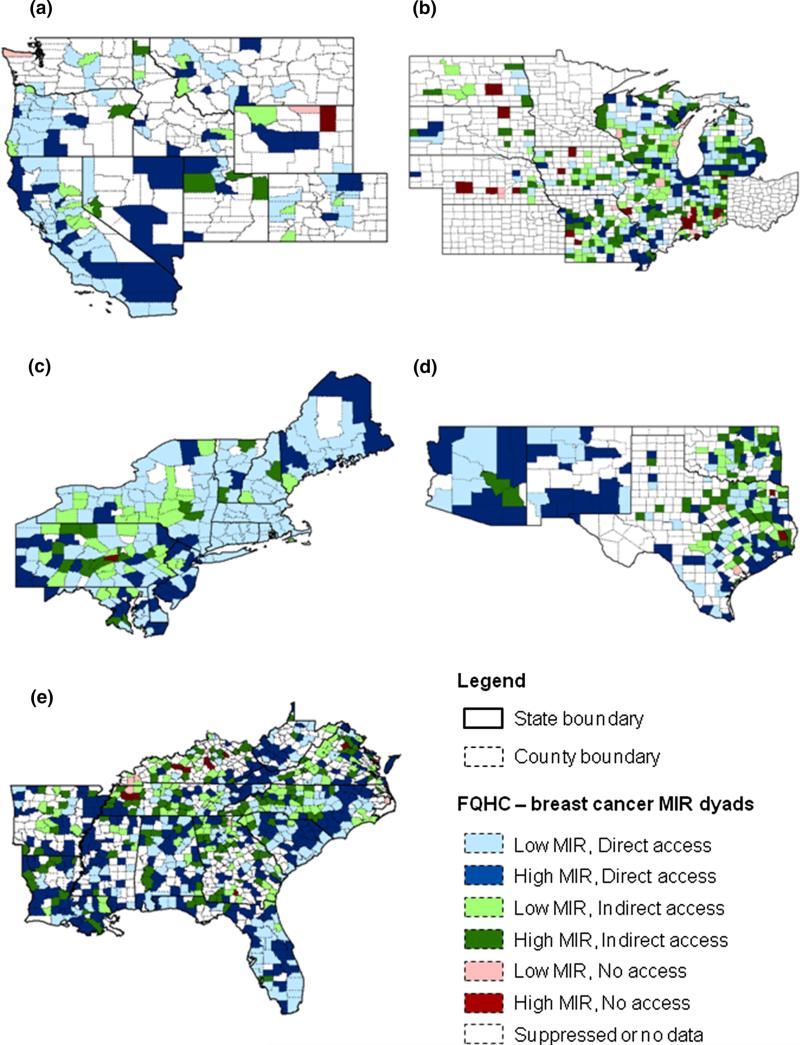
Federally qualified health centers (FQHCs) offer primary and preventive healthcare, including cancer screening, for the nation's most vulnerable population. The purpose of this study was to explore the relationship between access to FQHCs and cancer mortality-to-incidence ratios (MIRs). One-way analysis of variance was conducted to compare the mean MIRs for breast, cervical, prostate, and colorectal cancers for each U.S. county for 2006-2010 by access to FQHCs (direct access, in-county FQHC; indirect access, adjacent-county FQHC; no access, no FQHC either in the county or in adjacent counties). ArcMap 10.1 software was used to map cancer MIRs and FQHC access levels. The mean MIRs for breast, cervical, and prostate cancer differed significantly across FQHC access levels (p < 0.05). In urban and healthcare professional shortage areas, mean MIRs decreased as FQHC access increased. A trend of lower breast and prostate cancer MIRs in direct access to FQHCs was found for all racial groups, but this trend was significant for whites only. States with a large proportion of rural and medically underserved areas had high mean MIRs, with correspondingly more direct FQHC access. Expanding FQHCs to more underserved areas and concentrations of disparity populations may have an important role in reducing cancer morbidity and mortality, as well as racial-ethnic disparities, in the United States.
联邦合格医疗中心(FQHCs)为美国最脆弱的人群提供初级和预防性医疗服务,包括癌症筛查。本研究的目的是探讨获得FQHCs服务与癌症死亡率与发病率之比(MIRs)之间的关系。通过获得FQHCs服务的情况(直接获得,所在县的FQHC;间接获得,相邻县的FQHC;无获得,所在县及相邻县均无FQHC),对2006 - 2010年美国各县乳腺癌、宫颈癌、前列腺癌和结直肠癌的平均MIRs进行单因素方差分析。使用ArcMap 10.1软件绘制癌症MIRs和FQHCs获得水平的地图。乳腺癌、宫颈癌和前列腺癌的平均MIRs在不同的FQHCs获得水平上存在显著差异(p < 0.05)。在城市和医疗专业人员短缺地区,随着获得FQHCs服务的增加,平均MIRs下降。所有种族群体在直接获得FQHCs服务时,乳腺癌和前列腺癌的MIRs均有降低趋势,但仅白人的这一趋势具有显著性。农村和医疗服务不足地区比例较大的州,平均MIRs较高,相应地直接获得FQHCs服务的情况也更多。在美国,将FQHCs扩展到更多医疗服务不足地区和差异人群集中的地区,可能在降低癌症发病率和死亡率以及种族差异方面发挥重要作用。