Lachenmeier Dirk W, Rehm Jürgen
1] Epidemiological Research Unit, Technische Universität Dresden, Klinische Psychologie &Psychotherapie, Dresden, Germany [2] Chemisches und Veterinäruntersuchungsamt (CVUA) Karlsruhe, Germany.
1] Epidemiological Research Unit, Technische Universität Dresden, Klinische Psychologie &Psychotherapie, Dresden, Germany [2] Social and Epidemiological Research (SER) Department, Centre for Addiction and Mental Health (CAMH), Toronto, Canada [3] Institute of Medical Sciences, University of Toronto (UofT), Toronto, Canada [4] Dalla Lana School of Public Health, UofT, Toronto, Canada [5] Dept. of Psychiatry, Faculty of Medicine, UofT, Toronto, Canada [6] PAHO/WHO Collaborating Centre for Mental Health &Addiction, Toronto, Canada.
Sci Rep. 2015 Jan 30;5:8126. doi: 10.1038/srep08126.
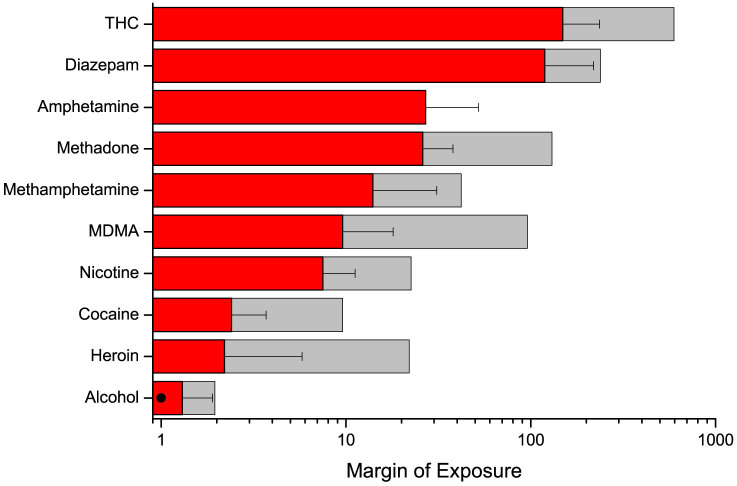
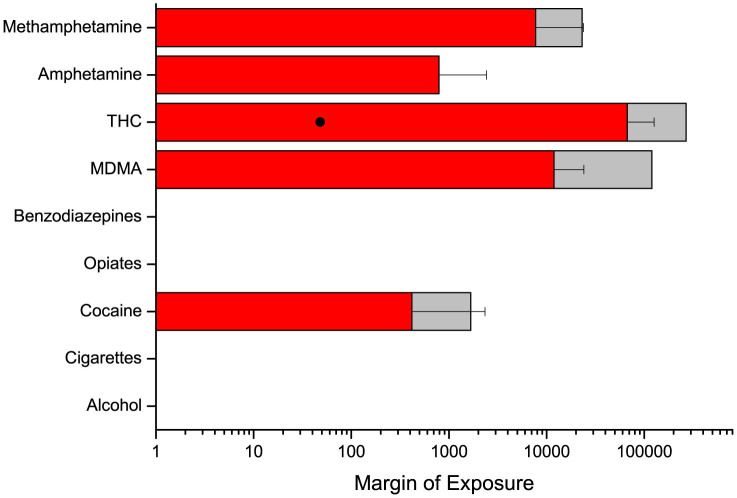
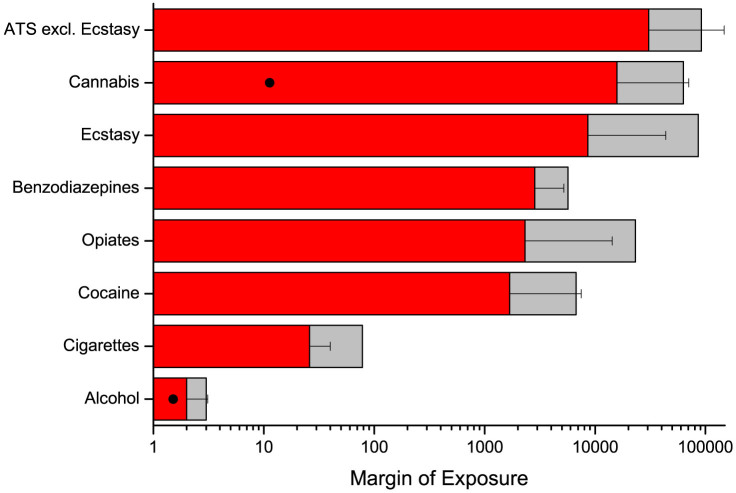
A comparative risk assessment of drugs including alcohol and tobacco using the margin of exposure (MOE) approach was conducted. The MOE is defined as ratio between toxicological threshold (benchmark dose) and estimated human intake. Median lethal dose values from animal experiments were used to derive the benchmark dose. The human intake was calculated for individual scenarios and population-based scenarios. The MOE was calculated using probabilistic Monte Carlo simulations. The benchmark dose values ranged from 2 mg/kg bodyweight for heroin to 531 mg/kg bodyweight for alcohol (ethanol). For individual exposure the four substances alcohol, nicotine, cocaine and heroin fall into the "high risk" category with MOE < 10, the rest of the compounds except THC fall into the "risk" category with MOE < 100. On a population scale, only alcohol would fall into the "high risk" category, and cigarette smoking would fall into the "risk" category, while all other agents (opiates, cocaine, amphetamine-type stimulants, ecstasy, and benzodiazepines) had MOEs > 100, and cannabis had a MOE > 10,000. The toxicological MOE approach validates epidemiological and social science-based drug ranking approaches especially in regard to the positions of alcohol and tobacco (high risk) and cannabis (low risk).
采用暴露边际(MOE)方法对包括酒精和烟草在内的药物进行了比较风险评估。MOE定义为毒理学阈值(基准剂量)与估计的人体摄入量之比。动物实验的半数致死剂量值用于推导基准剂量。针对个体情况和基于人群的情况计算人体摄入量。使用概率蒙特卡洛模拟计算MOE。基准剂量值范围从海洛因的2毫克/千克体重到酒精(乙醇)的531毫克/千克体重。对于个体暴露,酒精、尼古丁、可卡因和海洛因这四种物质属于“高风险”类别,MOE<10,除四氢大麻酚外的其他化合物属于“风险”类别,MOE<100。在人群层面,只有酒精属于“高风险”类别,吸烟属于“风险”类别,而所有其他药物(阿片类药物、可卡因、苯丙胺类兴奋剂、摇头丸和苯二氮䓬类药物)的MOE>100,大麻的MOE>10000。毒理学MOE方法验证了基于流行病学和社会科学的药物排名方法,特别是在酒精和烟草(高风险)以及大麻(低风险)的排名位置方面。