Kim Jae-Sung, Oh Dahye, Yim Min-Ji, Park Jin-Ju, Kang Kyeong-Rok, Cho In-A, Moon Sung-Min, Oh Ji-Su, You Jae-Seek, Kim Chun Sung, Kim Do Kyung, Lee Sook-Young, Lee Gyeong-Je, Im Hee-Jeong, Kim Su-Gwan
The Division of Natural Medical Science, College of Health Science, Chosun University, Dong-gu, Gwangju 501-759, Republic of Korea.
Oral Biology Research Institute, School of Dentistry, Chosun University, Dong-gu, Gwangju 501-759, Republic of Korea.
Oncol Rep. 2015 Apr;33(4):1775-82. doi: 10.3892/or.2015.3768. Epub 2015 Jan 29.
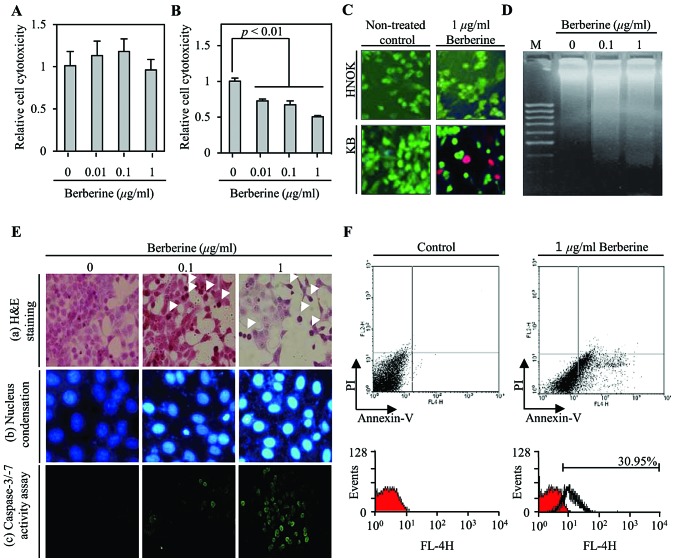
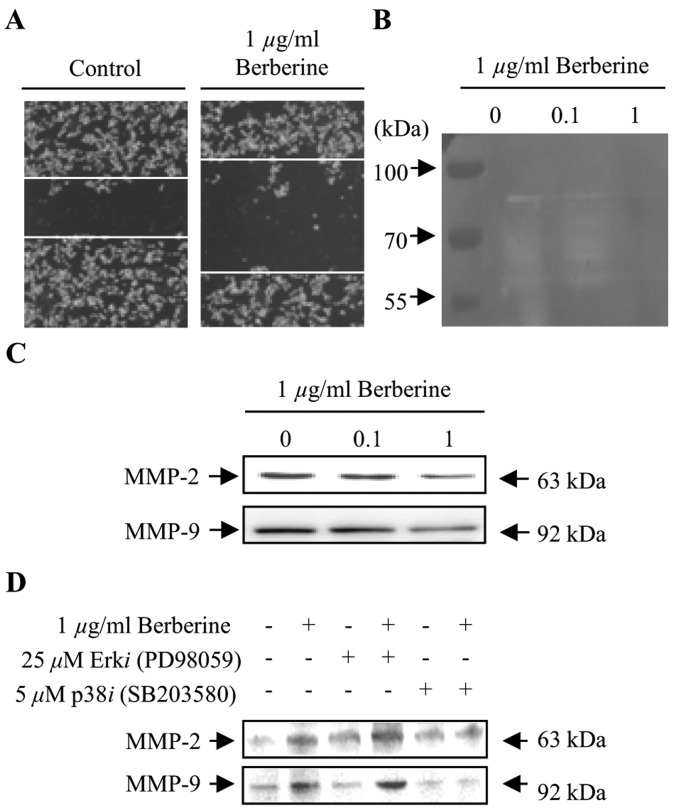
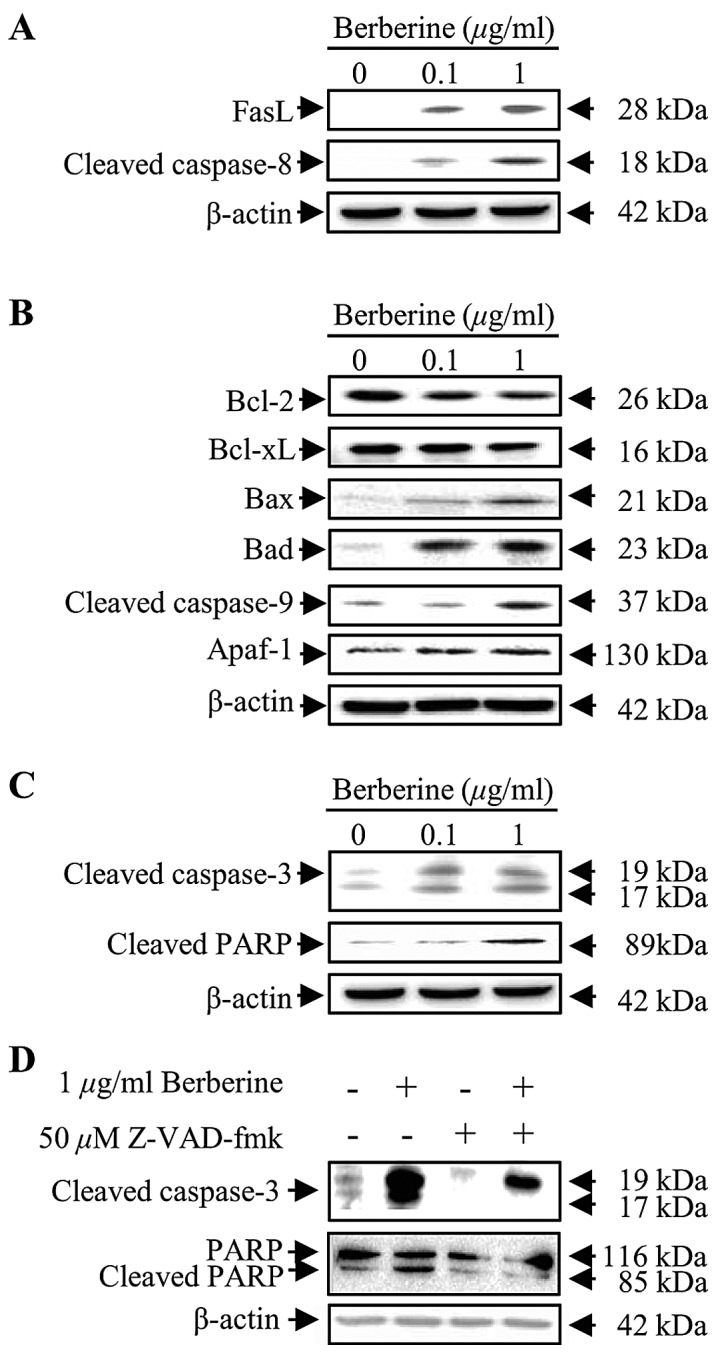
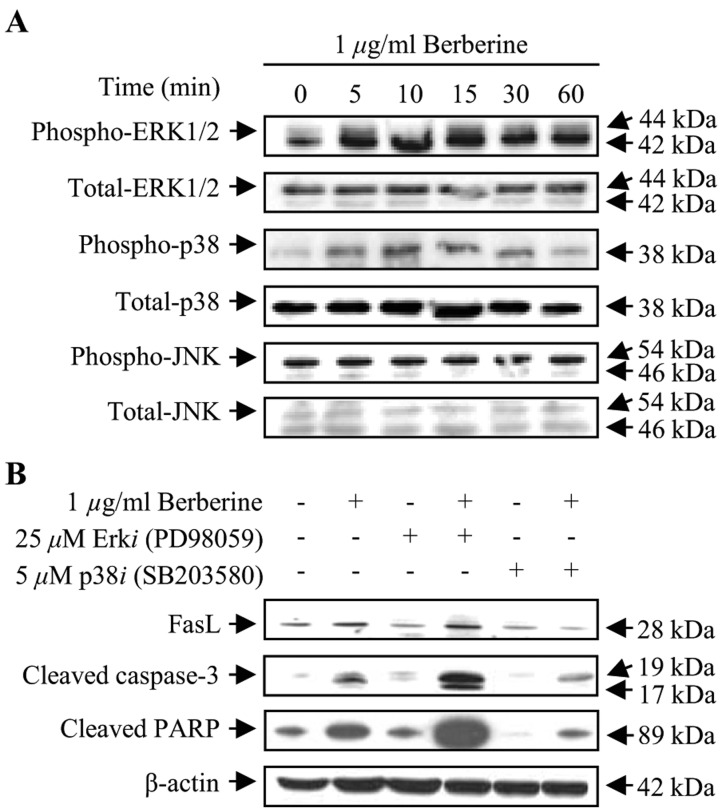
In the present study, we examined the anticancer properties of berberine in KB oral cancer cells with a specific focus on its cellular mechanism. Berberine did not affect the cell viability of the primary human normal oral keratinocytes that were used as a control. However, the viability of KB cells was found to decrease significantly in the presence of berberine in a dose-dependent manner. Furthermore, in KB cells, berberine induced the fragmentation of genomic DNA, changes in cell morphology, and nuclear condensation. In addition, caspase-3 and -7 activation, and an increase in apoptosis were observed. Berberine was also found to upregulate significantly the expression of the death receptor ligand, FasL. In turn, this upregulation triggered the activation of pro-apoptotic factors such as caspase-8, -9 and -3 and poly(ADP-ribose) polymerase (PARP). Furthermore, pro-apoptotic factors such as Bax, Bad and Apaf-1 were also significantly upregulated by berberine. Anti-apoptotic factors such as Bcl-2 and Bcl-xL were downregulated. Z-VAD-FMK, a cell-permeable pan-caspase inhibitor, suppressed the activation of caspase-3 and PARP. These results clearly indicate that berberine-induced cell death of KB oral cancer cells was mediated by both extrinsic death receptor-dependent and intrinsic mitochondrial-dependent apoptotic signaling pathways. In addition, berberine-induced upregulation of FasL was shown to be mediated by the p38 MAPK signaling pathway. We also found that berberine-induced migration suppression was mediated by downregulation of MMP-2 and MMP-9 through phosphorylation of p38 MAPK. In summary, berberine has the potential to be used as a chemotherapeutic agent, with limited side-effects, for the management of oral cancer.
在本研究中,我们研究了黄连素对KB口腔癌细胞的抗癌特性,并特别关注其细胞机制。黄连素对用作对照的原代人正常口腔角质形成细胞的细胞活力没有影响。然而,在黄连素存在的情况下,KB细胞的活力以剂量依赖的方式显著降低。此外,在KB细胞中,黄连素诱导基因组DNA片段化、细胞形态变化和核浓缩。此外,还观察到caspase-3和-7的激活以及细胞凋亡增加。还发现黄连素能显著上调死亡受体配体FasL的表达。反过来,这种上调触发了促凋亡因子如caspase-8、-9和-3以及聚(ADP-核糖)聚合酶(PARP)的激活。此外,黄连素还显著上调了促凋亡因子如Bax、Bad和Apaf-1的表达。抗凋亡因子如Bcl-2和Bcl-xL被下调。Z-VAD-FMK,一种细胞可渗透的泛半胱天冬酶抑制剂,抑制了caspase-3和PARP的激活。这些结果清楚地表明,黄连素诱导的KB口腔癌细胞死亡是由外源性死亡受体依赖性和内源性线粒体依赖性凋亡信号通路介导的。此外,黄连素诱导的FasL上调被证明是由p38丝裂原活化蛋白激酶信号通路介导。我们还发现,黄连素诱导的迁移抑制是通过p38丝裂原活化蛋白激酶磷酸化下调MMP-2和MMP-9介导的。总之,黄连素有可能作为一种副作用有限的化疗药物用于口腔癌的治疗。