William Timothy, Parameswaran Uma, Lee Wai Khew, Yeo Tsin Wen, Anstey Nicholas M, Ralph Anna P
Infectious Diseases Unit, Queen Elizabeth Hospital, Kota Kinabalu, Sabah, Malaysia.
Infectious Diseases Society Sabah-Menzies School of Health Research Clinical Research Unit, Kota Kinabalu, Sabah, Malaysia.
BMC Infect Dis. 2015 Jan 31;15:32. doi: 10.1186/s12879-015-0758-6.
Tuberculosis (TB) is generally well controlled in Malaysia, but remains an important problem in the nation's eastern states. In order to better understand factors contributing to high TB rates in the eastern state of Sabah, our aims were to describe characteristics of patients with TB at a large outpatient clinic, and determine the prevalence of HIV co-infection. Additionally, we sought to test sensitivity and specificity of the locally-available point-of-care HIV test kits.
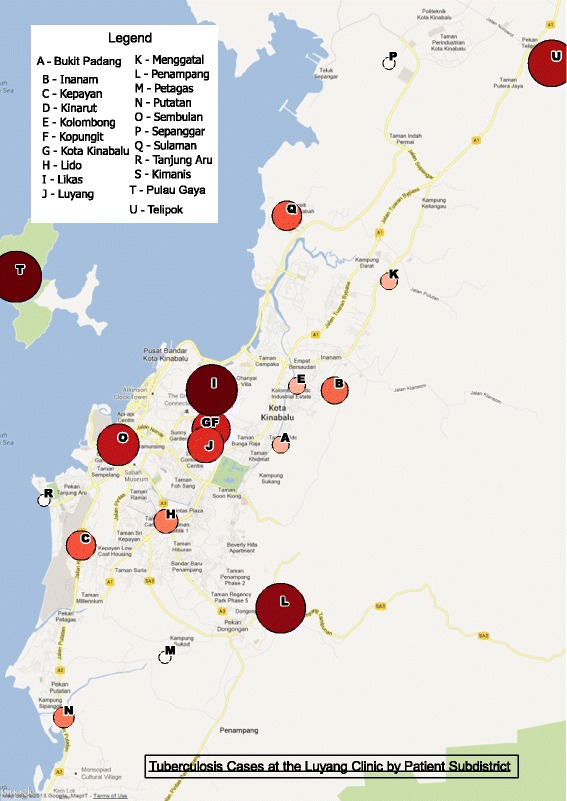
We enrolled consenting adults with smear-positive pulmonary TB for a 2-year period at Luyang Clinic, Kota Kinabalu, Malaysia. Participants were questioned about ethnicity, smoking, prior TB, disease duration, symptoms and comorbidities. Chest radiographs were scored using a previously devised tool. HIV was tested after counselling using 2 point-of-care tests for each patient: the test routinely in use at the TB clinic (either Advanced Quality™ Rapid Anti-HIV 1&2, FACTS anti-HIV 1/2 RAPID or HIV (1 + 2) Antibody Colloidal Gold), and a comparator test (Abbott Determine™ HIV-1/2, Inverness Medical). Positive tests were confirmed by enzyme immunoassay (EIA), particle agglutination and line immunoassay.
176 participants were enrolled; 59 (33.5%) were non-Malaysians and 104 (59.1%) were male. Smoking rates were high (81/104 males, 77.9%), most had cavitary disease (51/145, 64.8%), and 81/176 (46.0%) had haemoptysis. The median period of symptoms prior to treatment onset was 8 weeks. Diabetes was present in 12. People with diabetes or other comorbidities had less severe TB, suggesting different healthcare seeking behaviours in this group. All participants consented to HIV testing: three (1.7%) were positive according to Determine™ and EIA, but one of these tested negative on the point-of-care test available at the clinic (Advanced Quality™ Rapid Anti-HIV 1&2). The low number of positive tests and changes in locally-available test type meant that accurate estimates of sensitivity and specificity were not possible.
Patients had advanced disease at diagnosis, long diagnostic delays, low HIV co-infection rates, high smoking rates among males, and migrants may be over-represented. These findings provide important insights to guide local TB control efforts. Caution is required in using some point-of-care HIV tests, and ongoing quality control measures are of major importance.
马来西亚的结核病总体得到较好控制,但在该国东部各州仍是一个重要问题。为了更好地了解导致东部沙巴州结核病高发病率的因素,我们的目标是描述一家大型门诊诊所中结核病患者的特征,并确定艾滋病毒合并感染的患病率。此外,我们试图测试当地可用的即时检验艾滋病毒检测试剂盒的敏感性和特异性。
我们在马来西亚哥打基纳巴卢的卢阳诊所,招募了同意参与的涂片阳性肺结核成年患者,为期两年。询问参与者的种族、吸烟情况、既往结核病病史、疾病持续时间、症状和合并症。使用先前设计的工具对胸部X光片进行评分。在为每位患者提供咨询后,使用两种即时检验方法检测艾滋病毒:结核病诊所常规使用的检测方法(Advanced Quality™ Rapid Anti-HIV 1&2、FACTS anti-HIV 1/2 RAPID或HIV(1 + 2)抗体胶体金),以及一种对照检测方法(雅培Determine™ HIV-1/2、英维利斯医疗公司产品)。阳性检测结果通过酶免疫测定(EIA)、颗粒凝集试验和线性免疫测定进行确认。
共招募了176名参与者;其中59人(33.5%)为非马来西亚人,104人(59.1%)为男性。吸烟率很高(104名男性中有81人,77.9%),大多数患有空洞性疾病(145人中的51人,64.8%),176人中有81人(46.0%)咯血。治疗开始前症状出现的中位时间为8周。有12人患有糖尿病。患有糖尿病或其他合并症的患者结核病病情较轻,表明该组患者的就医行为不同。所有参与者均同意进行艾滋病毒检测:根据Determine™和EIA检测,有三人(1.7%)呈阳性,但其中一人在诊所可用的即时检验检测(Advanced Quality™ Rapid Anti-HIV 1&2)中呈阴性。阳性检测数量较少以及当地可用检测类型的变化意味着无法准确估计敏感性和特异性。
患者诊断时病情已较严重,诊断延误时间长,艾滋病毒合并感染率低,男性吸烟率高,且移民可能占比过高。这些发现为指导当地结核病控制工作提供了重要见解。在使用某些即时检验艾滋病毒检测方法时需要谨慎,持续的质量控制措施至关重要。