Robbins Hilary A, Hurley Emily A, Liu Li, Chao Shin Margaret
Department of Epidemiology, Johns Hopkins Bloomberg School of Public Health, Baltimore, MD, USA,
Matern Child Health J. 2015 Jul;19(7):1643-51. doi: 10.1007/s10995-015-1675-4.
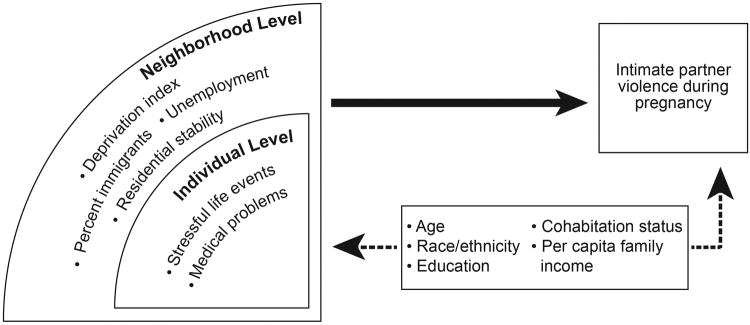
Studies have identified correlates of intimate partner violence (IPV) during pregnancy at the individual and neighborhood levels, but have used inconsistent definitions of IPV. We aimed to compare correlates based on two IPV definitions: broad (physical, sexual, or psychological violence) and narrow (physical or sexual violence only). Our analysis included 12,358 women in 2,110 census tracts (weighted to represent 269,671 women) who recently gave birth and responded to the Los Angeles Mommy and Baby (LAMB) survey. We linked 2007 and 2010 LAMB data to American Community Survey 2006-2010 census tract data, and conducted separate logistic multilevel analyses to identify correlates of IPV based on each definition. Prevalence of IPV during pregnancy was much higher by the broad (18.3 %) than the narrow definition (3.9 %). No independent neighborhood-level correlates were identified. Some individual-level correlates were associated with both IPV definitions, including substance abuse (OR 3.15, 95 % CI 2.47-4.00 for broad definition; OR 3.60, 95 % CI 2.30-5.64 for narrow definition) and medical problems (OR for ≥3 vs. 0 medical problems 2.03, 95 % CI 1.61-2.55 for broad definition, OR 2.40, 95 % CI 1.54-3.74 for narrow definition). Other correlates associated only with the broad definition, such as car accidents (OR 1.44, 95 % CI 1.04-2.00) and moving during pregnancy (OR 1.35, 95 % CI 1.12-1.62). Differences in correlates of IPV during pregnancy for a broad versus narrow IPV definition may illustrate the situations or mechanisms by which different types of IPV arise. Individual-level characteristics may outweigh neighborhood influences in a diverse population.
研究已在个体和社区层面确定了孕期亲密伴侣暴力(IPV)的相关因素,但对IPV的定义并不一致。我们旨在比较基于两种IPV定义的相关因素:宽泛定义(身体暴力、性暴力或心理暴力)和狭义定义(仅身体暴力或性暴力)。我们的分析纳入了2110个普查区的12358名女性(加权后代表269671名女性),这些女性近期分娩并回应了洛杉矶母婴(LAMB)调查。我们将2007年和2010年的LAMB数据与2006 - 2010年美国社区调查普查区数据相链接,并进行了单独的逻辑多水平分析,以根据每种定义确定IPV的相关因素。孕期IPV的患病率按宽泛定义(18.3%)远高于狭义定义(3.9%)。未确定独立的社区层面相关因素。一些个体层面的相关因素与两种IPV定义均有关联,包括药物滥用(宽泛定义的比值比为3.15,95%置信区间为2.47 - 4.00;狭义定义的比值比为3.60,95%置信区间为2.30 - 5.64)和医疗问题(宽泛定义中,有≥3个医疗问题与0个医疗问题相比的比值比为2.03,95%置信区间为1.61 - 2.55;狭义定义的比值比为2.40,95%置信区间为1.54 - 3.74)。其他仅与宽泛定义相关的因素,如车祸(比值比为1.44,95%置信区间为1.04 - 2.00)以及孕期搬家(比值比为1.35,95%置信区间为1.12 - 1.62)。孕期IPV宽泛定义与狭义定义相关因素的差异可能说明了不同类型IPV产生的情况或机制。在多样化人群中,个体层面特征可能比社区影响更为重要。