Department of Population, Family & Reproductive Health, Johns Hopkins Bloomberg School of Public Health, Johns Hopkins University, Baltimore, MD 21205, USA.
Hopkins Center for Health Disparities Solutions, Johns Hopkins Bloomberg School of Public Health, Johns Hopkins University, Baltimore, MD 21205, USA.
Int J Environ Res Public Health. 2021 Apr 15;18(8):4177. doi: 10.3390/ijerph18084177.
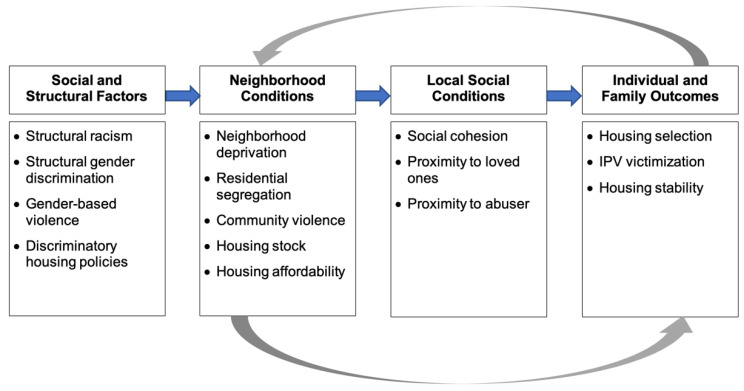
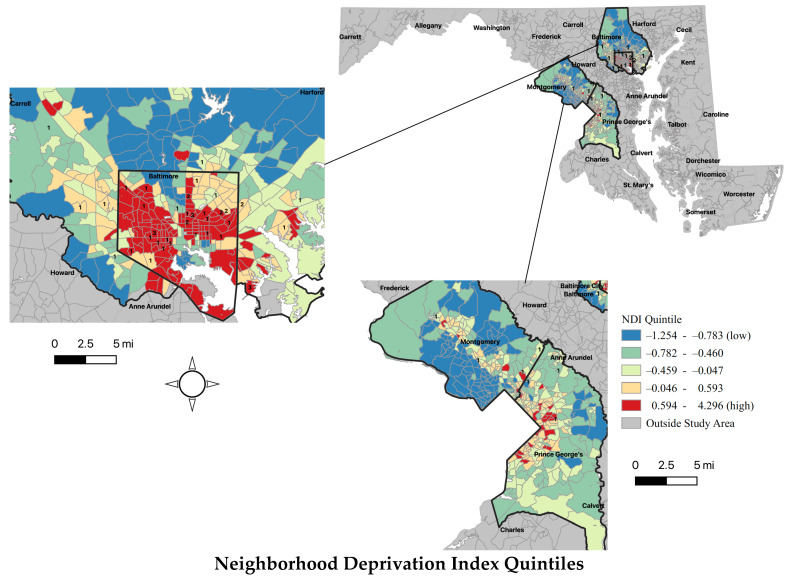
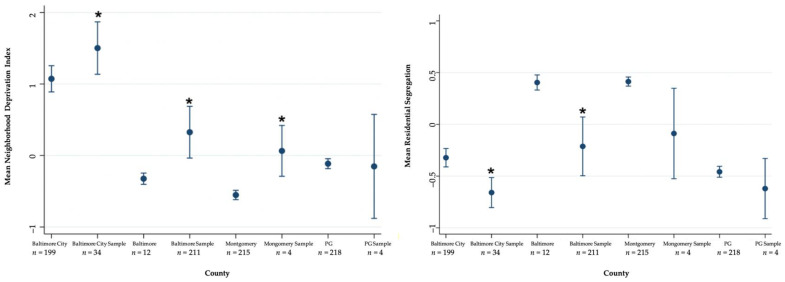
Survivors' considerations for re-housing following intimate partner violence (IPV) are understudied despite likely neighborhood-level influences on women's safety. We assess housing priorities and predictors of re-housing location among recent IPV survivors ( = 54) in Rapid Re-housing (RRH) in the Baltimore-Washington Metropolitan Area. Choropleth maps depict residential location relative to census tract characteristics (neighborhood deprivation index (NDI) and residential segregation) derived from American Community Survey data (2013-2017). Linear regression measured associations between women's individual, economic, and social factors and NDI and segregation. In-depth interviews ( = 16) contextualize quantitative findings. Overall, survivors re-housed in significantly more deprived and racially segregated census tracts within their respective regions. In adjusted models, trouble securing housing (B = 0.74, 95% CI: 0.13, 1.34), comfortability with proximity to loved ones (B = 0.75, 95% CI: 0.02, 1.48), and being unsure (vs unlikely) about IPV risk (B = -0.76, 95% CI: -1.39, -0.14) were significantly associated with NDI. Economic dependence on an abusive partner (B = -0.31, 95% CI: -0.56, -0.06) predicted re-housing in segregated census tracts; occasional stress about housing affordability (B = 0.39, 95% CI: 0.04, 0.75) predicted re-housing in less segregated census tracts. Qualitative results contextualize economic (affordability), safety, and social (familiarity) re-housing considerations and process impacts (inspection delays). Structural racism, including discriminatory housing practices, intersect with gender, exacerbating challenges among survivors of severe IPV. This mixed-methods study further highlights the significant economic tradeoffs for safety and stability, where the prioritization of safety may exacerbate economic devastation for IPV survivors. Findings will inform programmatic policies for RRH practices among survivors.
尽管邻里环境可能会对女性的安全产生影响,但在亲密伴侣暴力(IPV)后重新安置的幸存者考虑因素却很少受到研究。我们评估了巴尔的摩-华盛顿大都市区快速重新安置(RRH)中最近遭受 IPV 的幸存者(n=54)的住房优先事项和重新安置地点的预测因素。专题地图描绘了相对于人口普查区特征(邻里剥夺指数(NDI)和居住隔离)的居住位置,这些特征是根据美国社区调查数据(2013-2017 年)得出的。线性回归衡量了女性个人、经济和社会因素与 NDI 和隔离之间的关联。深入访谈(n=16)使定量研究结果更具背景意义。总体而言,幸存者在各自所在地区重新安置到了明显更贫困和种族隔离程度更高的人口普查区。在调整后的模型中,难以获得住房(B=0.74,95%置信区间:0.13,1.34)、与亲人的接近度舒适(B=0.75,95%置信区间:0.02,1.48)和对 IPV 风险的不确定(不确定(vs 不太可能)(B=-0.76,95%置信区间:-1.39,-0.14)与 NDI 显著相关。经济上依赖施虐伴侣(B=-0.31,95%置信区间:-0.56,-0.06)预测重新安置到隔离程度较高的人口普查区;偶尔对住房负担能力感到压力(B=0.39,95%置信区间:0.04,0.75)预测重新安置到隔离程度较低的人口普查区。定性结果从经济(负担能力)、安全和社会(熟悉程度)重新安置考虑因素和过程影响(检查延误)的角度描述了这些情况。结构性种族主义,包括歧视性住房做法,与性别相互作用,使严重 IPV 幸存者面临的挑战更加恶化。这项混合方法研究进一步强调了安全和稳定的巨大经济权衡,其中对安全的重视可能会加剧 IPV 幸存者的经济灾难。研究结果将为幸存者的 RRH 实践提供方案政策信息。