Nielsen Shawn E, Mather Mara
University of Southern California, Davis School of Gerontology, Los Angeles, CA 90089, USA.
University of Southern California, Davis School of Gerontology, Los Angeles, CA 90089, USA.
Physiol Behav. 2015 Apr 1;142:5-13. doi: 10.1016/j.physbeh.2015.01.031. Epub 2015 Jan 28.
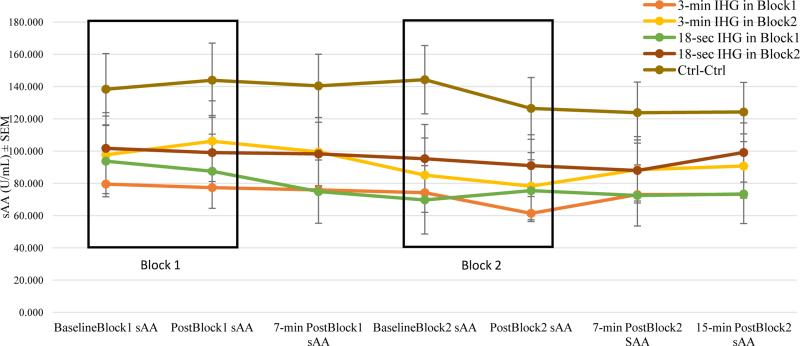
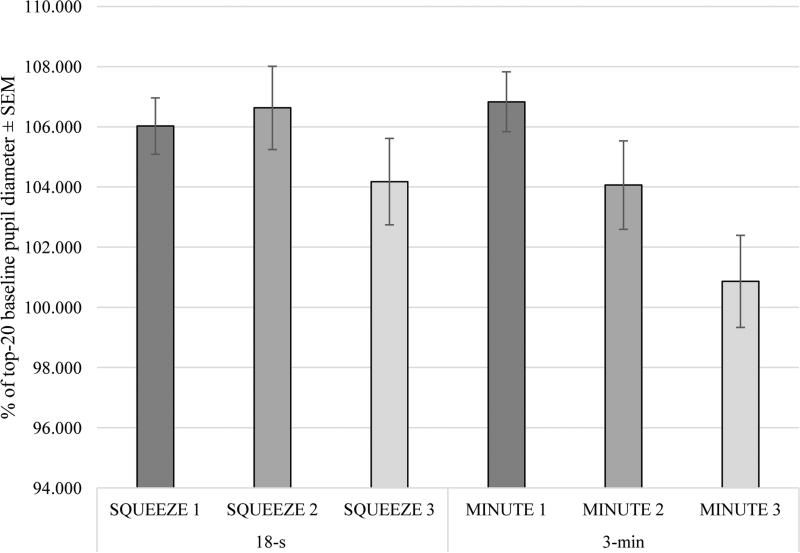
Isometric handgrip is commonly used in stress research because the task reliably increases sympathetic arousal. Various handgrip protocols have been used; they vary in handgrip strength, duration of grip, and the number of cycles of handgrip and rest. However, most protocols require the calibration of a maximum voluntary contraction (MVC) prior to the handgrip task, which is not always convenient (i.e., in a functional magnetic resonance imaging study). Here, we wanted to test whether two handgrip protocols with different strength, duration and cycle protocols would reliably elicit sympathetic arousal in the absence of calibrating an MVC. Sixty-two healthy naturally cycling women and women on hormonal contraception participated in one of the two isometric handgrip protocols using a hand therapy ball of medium resistance. Women completed one of the following handgrip protocols: 1) 30% of a perceived maximum voluntary contraction for 3 min or 2) 3 cycles of maximum voluntary contraction for 18s with a one minute rest in between. All handgrip blocks were counterbalanced with a control condition. Sympathetic arousal was measured throughout the session via pupil diameter changes and salivary alpha-amylase. Results indicate that in the absence of calibrating an MVC, the handgrip tasks elicited different changes in sympathetic arousal. Pupil dilation responses increased significantly in the handgrip versus control blocks only in participants in the 18-s protocol. Additionally, more participants exhibited a salivary alpha-amylase response to the handgrip block in the 18-s condition compared to the 3-min condition. Thus, these results suggest that neuroimaging and behavioral studies with isometric handgrip should be able to successfully induce sympathetic nervous activity with the 18-s paradigm, regardless of the handgrip device and the ability to calibrate an MVC.
等长握力常用于压力研究,因为该任务能可靠地增加交感神经兴奋。人们使用了各种握力方案;它们在握力强度、握力持续时间以及握力与休息的循环次数方面存在差异。然而,大多数方案在进行握力任务之前需要校准最大自主收缩(MVC),这并不总是方便的(例如,在功能磁共振成像研究中)。在此,我们想测试两种具有不同强度、持续时间和循环方案的握力方案在不校准MVC的情况下是否能可靠地引发交感神经兴奋。62名自然处于月经周期的健康女性和使用激素避孕的女性参与了两项等长握力方案中的一项,使用的是中等阻力的手部治疗球。女性完成了以下握力方案之一:1)以感知到的最大自主收缩的30%持续3分钟,或2)进行3个周期的最大自主收缩,每次18秒,中间休息1分钟。所有握力组均与对照条件进行了平衡。在整个过程中通过瞳孔直径变化和唾液α-淀粉酶来测量交感神经兴奋。结果表明,在不校准MVC的情况下,握力任务引发了交感神经兴奋的不同变化。仅在18秒方案的参与者中,握力组与对照组相比瞳孔扩张反应显著增加。此外,与3分钟条件相比,更多参与者在18秒条件下对握力组表现出唾液α-淀粉酶反应。因此,这些结果表明,无论握力设备和校准MVC 的能力如何,使用等长握力的神经影像学和行为学研究应该能够通过18秒范式成功诱导交感神经活动。