Gundtoft Per Hviid, Overgaard Søren, Schønheyder Henrik Carl, Møller Jens Kjølseth, Kjærsgaard-Andersen Per, Pedersen Alma Becic
Department of Orthopedics , Kolding Hospital , Kolding.
Acta Orthop. 2015 Jun;86(3):326-34. doi: 10.3109/17453674.2015.1011983. Epub 2015 Jan 30.
It has been suggested that the risk of prosthetic joint infection (PJI) in patients with total hip arthroplasty (THA) may be underestimated if based only on arthroplasty registry data. We therefore wanted to estimate the "true" incidence of PJI in THA using several data sources.
We searched the Danish Hip Arthroplasty Register (DHR) for primary THAs performed between 2005 and 2011. Using the DHR and the Danish National Register of Patients (NRP), we identified first revisions for any reason and those that were due to PJI. PJIs were also identified using an algorithm incorporating data from microbiological, prescription, and clinical biochemistry databases and clinical findings from the medical records. We calculated cumulative incidence with 95% confidence interval.
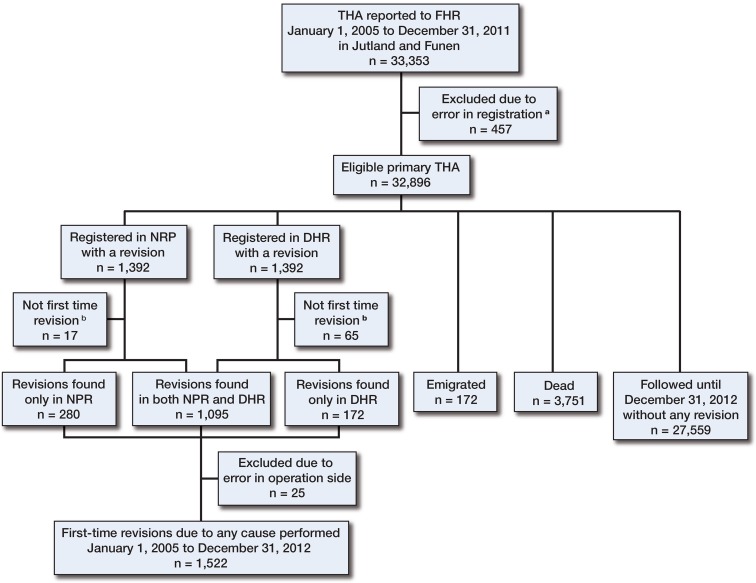
32,896 primary THAs were identified. Of these, 1,546 had first-time revisions reported to the DHR and/or the NRP. For the DHR only, the 1- and 5-year cumulative incidences of PJI were 0.51% (0.44-0.59) and 0.64% (0.51-0.79). For the NRP only, the 1- and 5-year cumulative incidences of PJI were 0.48% (0.41-0.56) and 0.57% (0.45-0.71). The corresponding 1- and 5-year cumulative incidences estimated with the algorithm were 0.86% (0.77-0.97) and 1.03% (0.87-1.22). The incidences of PJI based on the DHR and the NRP were consistently 40% lower than those estimated using the algorithm covering several data sources.
Using several available data sources, the "true" incidence of PJI following primary THA was estimated to be approximately 40% higher than previously reported by national registries alone.
有人提出,如果仅依据关节置换登记数据,全髋关节置换术(THA)患者发生人工关节感染(PJI)的风险可能被低估。因此,我们希望通过多种数据来源来估算THA中PJI的“真实”发病率。
我们在丹麦髋关节置换登记处(DHR)中搜索了2005年至2011年间进行的初次THA。利用DHR和丹麦国家患者登记处(NRP),我们确定了因任何原因进行的首次翻修以及因PJI进行的翻修。还使用一种算法确定PJI,该算法整合了微生物学、处方和临床生物化学数据库的数据以及病历中的临床发现。我们计算了95%置信区间的累积发病率。
共确定了32,896例初次THA。其中,1546例有首次翻修报告至DHR和/或NRP。仅对于DHR,PJI的1年和5年累积发病率分别为0.51%(0.44 - 0.59)和0.64%(0.51 - 0.79)。仅对于NRP,PJI的1年和5年累积发病率分别为0.48%(0.41 - 0.56)和0.57%(0.45 - 0.71)。用该算法估算的相应1年和5年累积发病率分别为0.86%(0.77 - 0.97)和1.03%(0.87 - 1.22)。基于DHR和NRP的PJI发病率始终比使用涵盖多种数据来源的算法估算的发病率低40%。
使用多种可用数据来源,初次THA后PJI的“真实”发病率估计比国家登记处此前单独报告的约高40%。