Simon Sebastian, Martalanz Luca, Frank Bernhard J H, Hartmann Susana Gardete, Mitterer Jennyfer A, Sebastian Sujeesh, Huber Stephanie, Hofstaetter Jochen G
Michael Ogon Laboratory for Orthopaedic Research, Orthopaedic Hospital Vienna-Speising, 1130, Vienna, Austria.
II. Department of Orthopaedic Surgery, Orthopaedic Hospital Vienna-Speising, 1130, Vienna, Austria.
J Orthop Translat. 2024 Aug 17;48:156-162. doi: 10.1016/j.jot.2024.08.002. eCollection 2024 Sep.
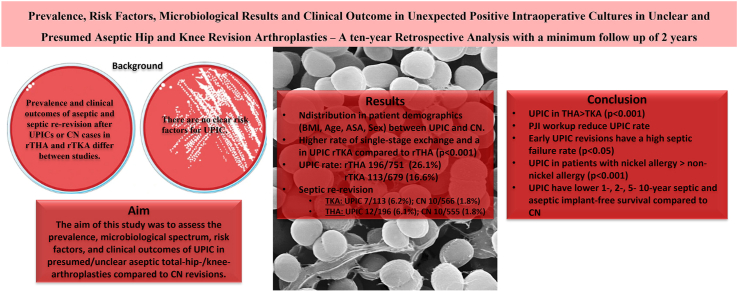
The aim of this study was to assess the prevalence, microbiological spectrum, risk factors, and clinical outcomes of unexpected-positive-intraoperative-cultures (UPIC) in presumed aseptic and unclear revision-total-hip-/knee-arthroplasties (rTHA and rTKA) compared to culture-negative (CN) revisions.
This study reviewed all International-consensus-meeting-2018 (ICM 2018) negative or inconclusive rTHA (n = 751) and rTKA (n = 679) performed at our institution from 2011 to 2020 with a minimum follow-up of two years. A Kaplan-Meier-analysis was performed to determine the septic and aseptic-free implant survival in cases with UPIC's and matched culture-negative cases. Patient demographics, risk factors, microbiological spectrum and clinical outcomes were evaluated.
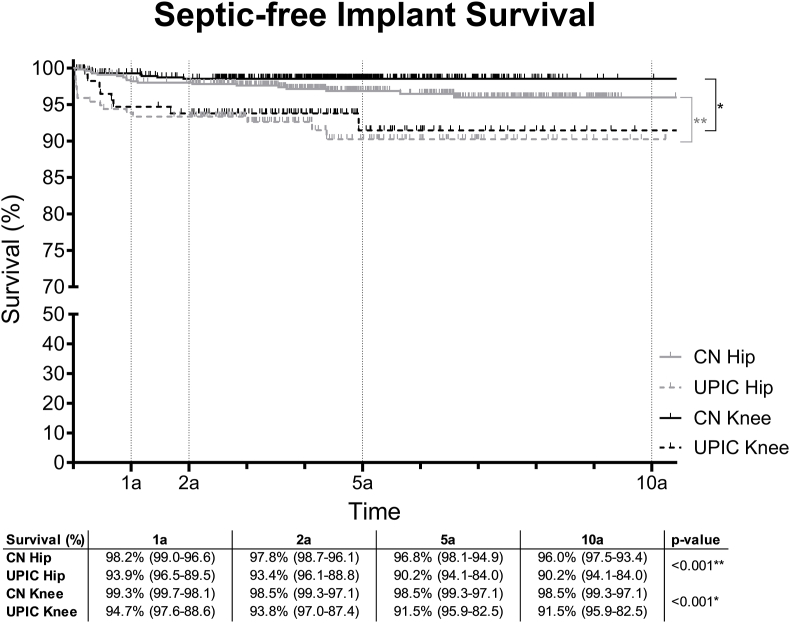
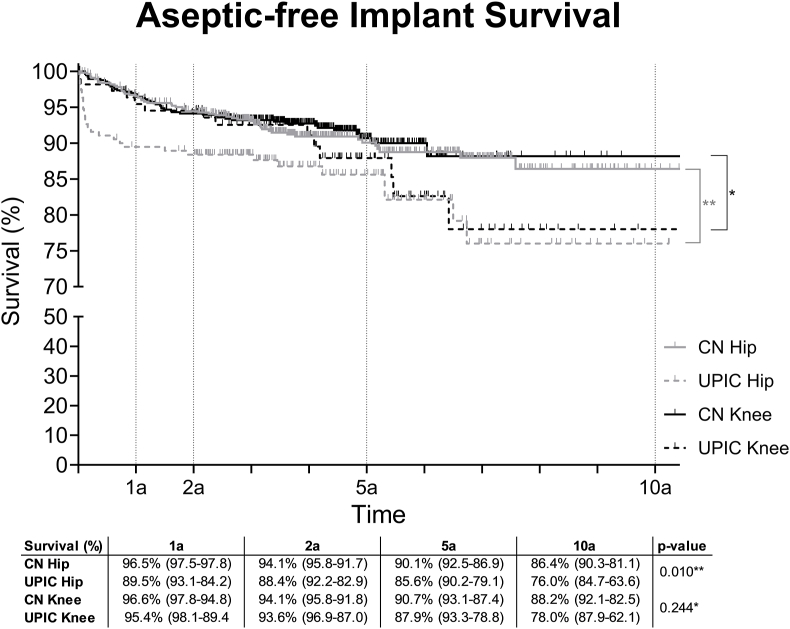
There were significantly more UPIC cases in rTHA 196/751 (26.1 %) compared to rTKA 113/679 (16.6 %); (p < 0.001). UPICs in rTKA and rTHA have a lower septic and aseptic implant-free-survival compared to CN revisions. Patients with a history of nickel allergy have a higher risk of an UPIC in rTHA and rTKA (p < 0.001). Septic re-revisions after UPIC had a significantly (H: p = 0.004; K: p = 0.030) shorter time period to the primary/previous surgery (H: 84 (IQR:41-797); K: 115 (IQR:55-446)) compared to patients with aseptic re-revisions after UPIC (H:1248 (IQR:178-3534); K: 827 (IQR:361-1183)).
UPICs have a higher rate of septic and aseptic failure than CN outcomes. UPICs are twice as common in rTHA compared to rTKA. Preoperative PJI workup reduces the UPIC rate. Nickel allergy is a risk factor for UPIC. Early revisions with UPICs after primary THA or TKA have a higher risk of septic failure.
This article provides new information on revision rates for UPIC and potential risk factors for UPIC and its treatment failure.
本研究的目的是评估在假定为无菌的不明确的全髋关节/膝关节翻修术(rTHA和rTKA)中意外术中培养阳性(UPIC)的发生率、微生物谱、危险因素和临床结果,并与培养阴性(CN)的翻修术进行比较。
本研究回顾了2011年至2020年在我们机构进行的所有2018年国际共识会议(ICM 2018)阴性或不确定的rTHA(n = 751)和rTKA(n = 679),最小随访时间为两年。进行Kaplan-Meier分析以确定UPIC病例和匹配的培养阴性病例的感染性和无菌性植入物生存率。评估患者的人口统计学、危险因素、微生物谱和临床结果。
与rTKA的113/679(16.6%)相比,rTHA的UPIC病例显著更多,为196/751(26.1%);(p < 0.001)。与CN翻修术相比,rTKA和rTHA中的UPIC具有更低的感染性和无菌性植入物无生存率。有镍过敏史的患者在rTHA和rTKA中发生UPIC的风险更高(p < 0.001)。与UPIC后无菌性再次翻修的患者相比,UPIC后感染性再次翻修与初次/上次手术的时间间隔显著更短(H:p = 0.004;K:p = 0.030)(H:84(IQR:41 - 797);K:115(IQR:55 - 446))(H:1248(IQR:178 - 3534);K:827(IQR:361 - 1183))。
与CN结果相比,UPIC的感染性和无菌性失败率更高。与rTKA相比,rTHA中UPIC的发生率是其两倍。术前PJI检查可降低UPIC发生率。镍过敏是UPIC的一个危险因素。初次THA或TKA后早期进行UPIC翻修的感染性失败风险更高。
本文提供了关于UPIC翻修率以及UPIC及其治疗失败的潜在危险因素的新信息。