Dobesh Paul P, Urban Jamela F, Shurmur Scott W, Oestreich Julie H
Department of Pharmacy Practice, University of Nebraska Medical Center College of Pharmacy, Omaha, Nebraska 68198-6045 USA.
Pharmacy Department, Denver Health Medical Center, Denver, Colorado USA.
Thromb J. 2015 Jan 23;13(1):3. doi: 10.1186/s12959-014-0033-x. eCollection 2015.
Ideal conditions for platelet reactivity testing are critical for optimal selection of a P2Y12 inhibitor. Data are inconsistent regarding the impact of high-fat meals on test assessment.
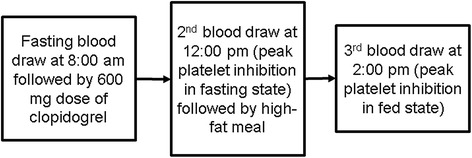
Participants included 12 healthy subjects not taking antiplatelet drugs after a 12-hour fast. After baseline assessment, subjects were given a 600 mg dose of clopidogrel. Four hours later, maximum platelet inhibition was tested in the fasting state by light transmission aggregometry (LTA), VerifyNow P2Y12, vasodilator-stimulated phosphoprotein (VASP), and whole blood aggregometry (WBA). Subjects were then provided a high-fat meal, and platelet function was evaluated two hours later. Change in measured platelet aggregation by LTA was the primary endpoint of the study. The Wilcoxon Rank Sum test was used to compare the change in platelet reactivity between fasting and non-fasting conditions. The Spearman rho (ρ) correlation coefficient was used to evaluate the association between fasting platelet reactivity and the change following a high-fat meal.
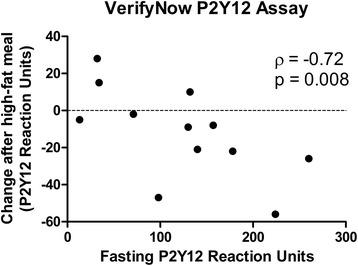
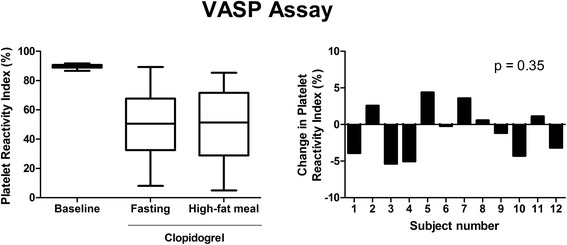
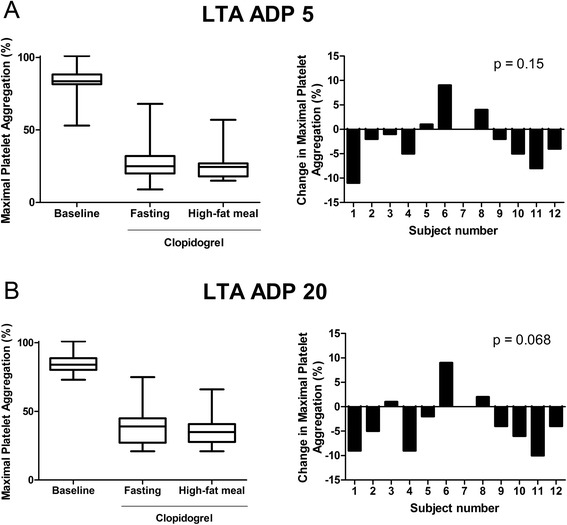
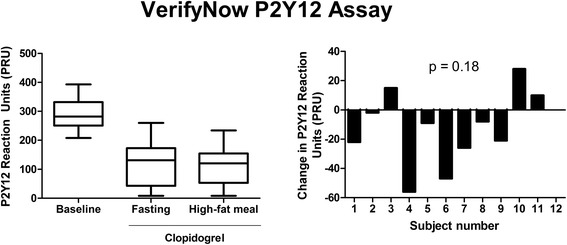
No significant change occurred in maximal light transmission, as assessed by LTA with 5 μM ADP (p = 0.15) and with 20 μM ADP (p = 0.07). There was a significant change in the area under the curve with 5 μM ADP (p = 0.03) but not with 20 μM ADP (p = 0.18). Although there was no significant change with the VerifyNow P2Y12 assay (p = 0.16), the change was correlated with the initial fasting value (Spearman's rho p = 0.008). The VASP assay and WBA varied minimally.
The high-fat meal did not significantly alter platelet function assessment of commonly used platelet function tests. Greater intra-subject variability existed for the optically-dependent compared with non-optically dependent tests.
NCT01307657.
血小板反应性检测的理想条件对于P2Y12抑制剂的最佳选择至关重要。关于高脂餐对检测评估的影响,数据并不一致。
参与者包括12名健康受试者,禁食12小时后未服用抗血小板药物。在基线评估后,受试者服用600毫克氯吡格雷。4小时后,通过光透射聚集法(LTA)、VerifyNow P2Y12、血管舒张剂刺激磷蛋白(VASP)和全血聚集法(WBA)在禁食状态下测试最大血小板抑制。然后为受试者提供高脂餐,并在两小时后评估血小板功能。LTA测量的血小板聚集变化是该研究的主要终点。采用Wilcoxon秩和检验比较禁食和非禁食条件下血小板反应性的变化。Spearman秩(ρ)相关系数用于评估禁食血小板反应性与高脂餐后变化之间的关联。
用5 μM ADP的LTA评估时,最大光透射率无显著变化(p = 0.15),用20 μM ADP评估时也无显著变化(p = 0.07)。5 μM ADP时曲线下面积有显著变化(p = 0.03),但20 μM ADP时无显著变化(p = 0.18)。虽然VerifyNow P2Y12检测无显著变化(p = 0.16),但该变化与初始禁食值相关(Spearman秩p = 0.008)。VASP检测和WBA变化最小。
高脂餐并未显著改变常用血小板功能检测的血小板功能评估。与非光学依赖性检测相比,光学依赖性检测的受试者内变异性更大。
NCT01307657。