Wang Lisha, Shen Xiaohan, Wang Zhimin, Xiao Xiuying, Wei Ping, Wang Qifeng, Ren Fei, Wang Yiqin, Liu Zebing, Sheng Weiqi, Huang Wei, Zhou Xiaoyan, Du Xiang
Department of Pathology, Fudan University Shanghai Cancer Center, Shanghai, 200032, China.
Department of Oncology, Shanghai Medical College, Fudan University, Shanghai, 200032, China.
Mol Cancer. 2015 Feb 3;14(1):22. doi: 10.1186/s12943-015-0296-2.
Several clinical and pathological factors have an impact on the prognosis of colorectal cancer (CRC), but they are not yet adequate for risk assessment. We aimed to identify a molecular signature that can reliably identify CRC patients at high risk for recurrence.
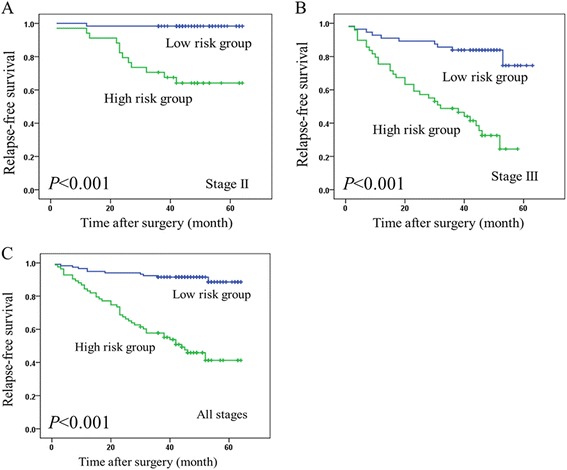
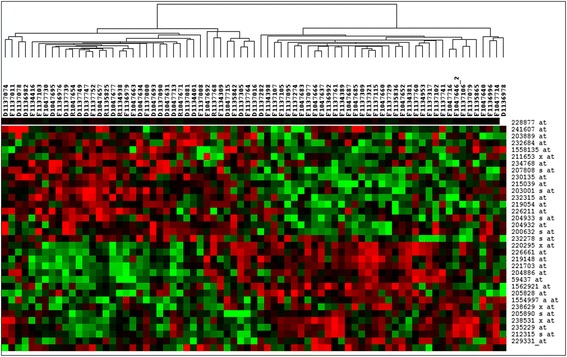
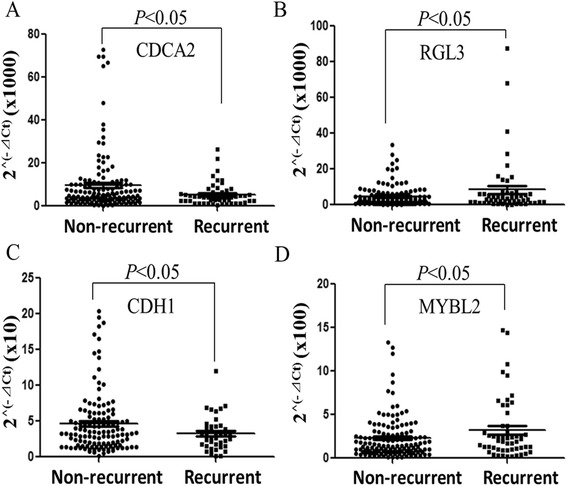
Two hundred eighty-one CRC samples (stage II/III) were included in this study. A two-step gene expression profiling study was conducted. First, gene expression measurements from 81 fresh frozen CRC samples were obtained using Affymetrix Human Genome U133 Plus 2.0 Arrays. Second, a focused gene expression assay, including prognostic genes and genes of interest from literature reviews, was performed using 200 fresh frozen samples and a Taqman low-density array (TLDA) analysis. An optimal 31-gene expression classifier for the prediction of recurrence among patients with stage II/III CRC was developed using logistic regression analysis. This gene expression signature classified 58.5% of patients as low-risk and 41.5% as high-risk (P < 0.001). The signature was the strongest independent prognostic factor in the multivariate analysis. The five-year relapse-free survival (RFS) rates for the low-risk patients and the high-risk patients were 88.5% and 41.3% (P < 0.001), respectively.
We identified a 31-gene expression signature that is closely associated with the clinical outcome of stage II/III CRC patients.
多种临床和病理因素会影响结直肠癌(CRC)的预后,但它们尚不足以用于风险评估。我们旨在识别一种能够可靠地识别复发高风险CRC患者的分子特征。
本研究纳入了281例II/III期CRC样本。进行了两步基因表达谱研究。首先,使用Affymetrix Human Genome U133 Plus 2.0芯片获得了81例新鲜冷冻CRC样本的基因表达测量值。其次,使用200例新鲜冷冻样本和Taqman低密度阵列(TLDA)分析进行了一项聚焦基因表达检测,包括来自文献综述的预后基因和感兴趣的基因。使用逻辑回归分析开发了一种用于预测II/III期CRC患者复发的最佳31基因表达分类器。该基因表达特征将58.5%的患者分类为低风险,41.5%为高风险(P < 0.001)。在多变量分析中,该特征是最强的独立预后因素。低风险患者和高风险患者的五年无复发生存率(RFS)分别为88.5%和41.3%(P < 0.001)。
我们识别出一种与II/III期CRC患者临床结局密切相关的31基因表达特征。