Center for Gastrointestinal Research, Center for Translational Genomics and Oncology, Baylor Scott & White Research Institute and Charles A. Sammons Cancer Center, Baylor University Medical Center, Dallas, Texas.
Department of Biomedical Sciences, City University of Hong Kong, Hong Kong, China.
Clin Cancer Res. 2018 Aug 15;24(16):3867-3877. doi: 10.1158/1078-0432.CCR-17-3236. Epub 2018 Mar 7.
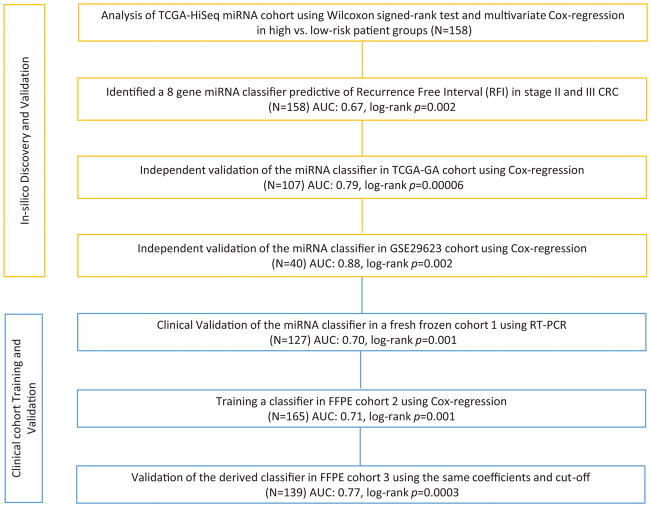
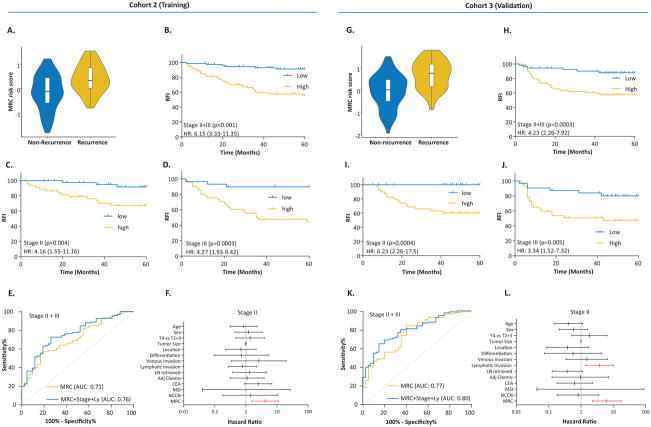
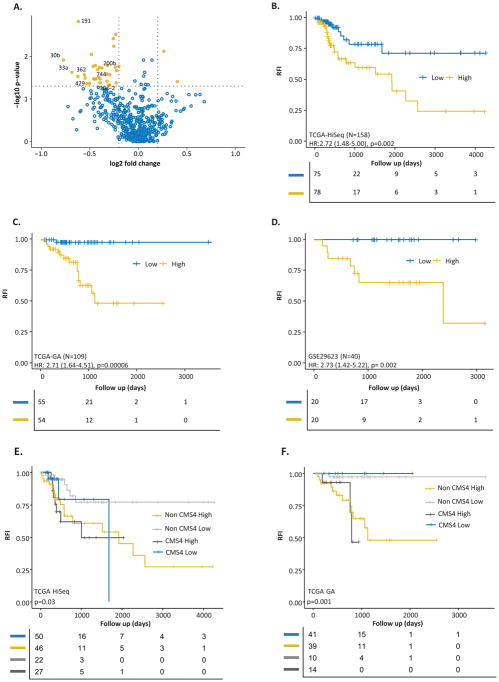
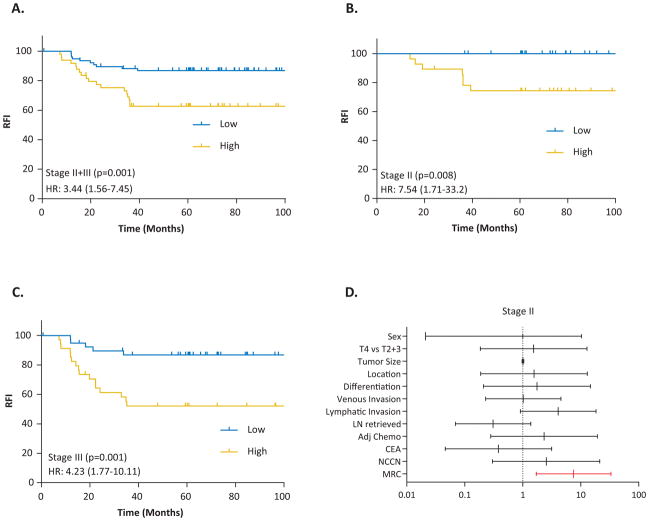
The current tumor-node-metastasis (TNM) staging system is inadequate at identifying patients with high-risk colorectal cancer. Using a systematic and comprehensive biomarker discovery and validation approach, we aimed to identify an miRNA recurrence classifier (MRC) that can improve upon the current TNM staging as well as is superior to currently offered molecular assays. Three independent genome-wide miRNA expression profiling datasets were used for biomarker discovery ( = 158) and validation ( = 109 and = 40) to identify an miRNA signature for predicting tumor recurrence in patients with colorectal cancer. Subsequently, this signature was analytically trained and validated in retrospectively collected independent patient cohorts of fresh-frozen ( = 127, cohort 1) and formalin-fixed paraffin-embedded (FFPE; = 165, cohort 2 and = 139, cohort 3) specimens. We identified an 8-miRNA signature that significantly predicted recurrence-free interval (RFI) in the discovery ( = 0.002) and two independent publicly available datasets ( = 0.00006 and = 0.002). The RT-PCR-based validation in independent clinical cohorts revealed that MRC-derived high-risk patients succumb to significantly poor RFI in patients with stage II and III colorectal cancer [cohort 1: hazard ratio (HR), 3.44 (1.56-7.45), = 0.001; cohort 2: HR, 6.15 (3.33-11.35), = 0.001; and cohort 3: HR, 4.23 (2.26-7.92), = 0.0003]. In multivariate analyses, MRC emerged as an independent predictor of tumor recurrence and achieved superior predictive accuracy over the currently available molecular assays. The RT-PCR-based MRC risk score = (-0.1218 × miR-744) + (-3.7142 × miR-429) + (-2.2051 × miR-362) + (3.0564 × miR-200b) + (2.4997 × miR-191) + (-0.0065 × miR-30c2) + (2.2224 × miR-30b) + (-1.1162 × miR-33a). This novel MRC is superior to currently used clinicopathologic features, as well as National Comprehensive Cancer Network (NCCN) criteria, and works regardless of adjuvant chemotherapy status in identifying patients with high-risk stage II and III colorectal cancer. This can be readily deployed in clinical practice with FFPE specimens for decision-making pending further model testing and validation. .
当前的肿瘤-淋巴结-转移(TNM)分期系统在识别高危结直肠癌患者方面存在不足。本研究采用系统全面的生物标志物发现和验证方法,旨在确定一种 miRNA 复发分类器(MRC),该分类器不仅可以改善当前的 TNM 分期,而且优于目前提供的分子检测。使用三个独立的全基因组 miRNA 表达谱数据集进行生物标志物发现(=158)和验证(=109 和=40),以确定用于预测结直肠癌患者肿瘤复发的 miRNA 特征。随后,在回顾性收集的新鲜冷冻(=127,队列 1)和福尔马林固定石蜡包埋(FFPE;=165,队列 2 和=139,队列 3)标本的独立患者队列中,对该特征进行分析性训练和验证。我们确定了一个由 8 个 miRNA 组成的特征,该特征在发现(=0.002)和两个独立的公开可用数据集(=0.00006 和=0.002)中显著预测了无复发生存期(RFI)。在独立临床队列中的 RT-PCR 验证显示,MRC 衍生的高危患者在 II 期和 III 期结直肠癌患者中 RFI 显著较差[队列 1:风险比(HR),3.44(1.56-7.45),=0.001;队列 2:HR,6.15(3.33-11.35),=0.001;队列 3:HR,4.23(2.26-7.92),=0.0003]。在多变量分析中,MRC 是肿瘤复发的独立预测因子,并且优于当前可用的分子检测方法,具有更高的预测准确性。基于 RT-PCR 的 MRC 风险评分=(-0.1218×miR-744)+(-3.7142×miR-429)+(-2.2051×miR-362)+(3.0564×miR-200b)+(2.4997×miR-191)+(-0.0065×miR-30c2)+(2.2224×miR-30b)+(-1.1162×miR-33a)。这种新的 MRC 优于目前使用的临床病理特征和国家综合癌症网络(NCCN)标准,并且在确定高危 II 期和 III 期结直肠癌患者时,无论辅助化疗状态如何,均具有更好的效果。可以使用 FFPE 标本在临床实践中进行快速部署,以便在进一步的模型测试和验证后进行决策。