Lewis Lisa A, Gulati Sunita, Burrowes Elizabeth, Zheng Bo, Ram Sanjay, Rice Peter A
Division of Infectious Diseases and Immunology, University of Massachusetts Medical School, Worcester, Massachusetts, USA
Division of Infectious Diseases and Immunology, University of Massachusetts Medical School, Worcester, Massachusetts, USA.
mBio. 2015 Feb 3;6(1):e02465-14. doi: 10.1128/mBio.02465-14.
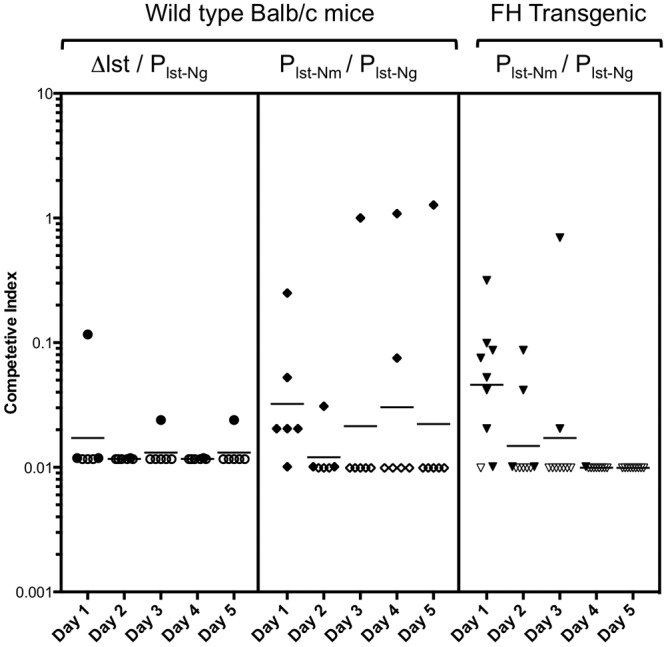
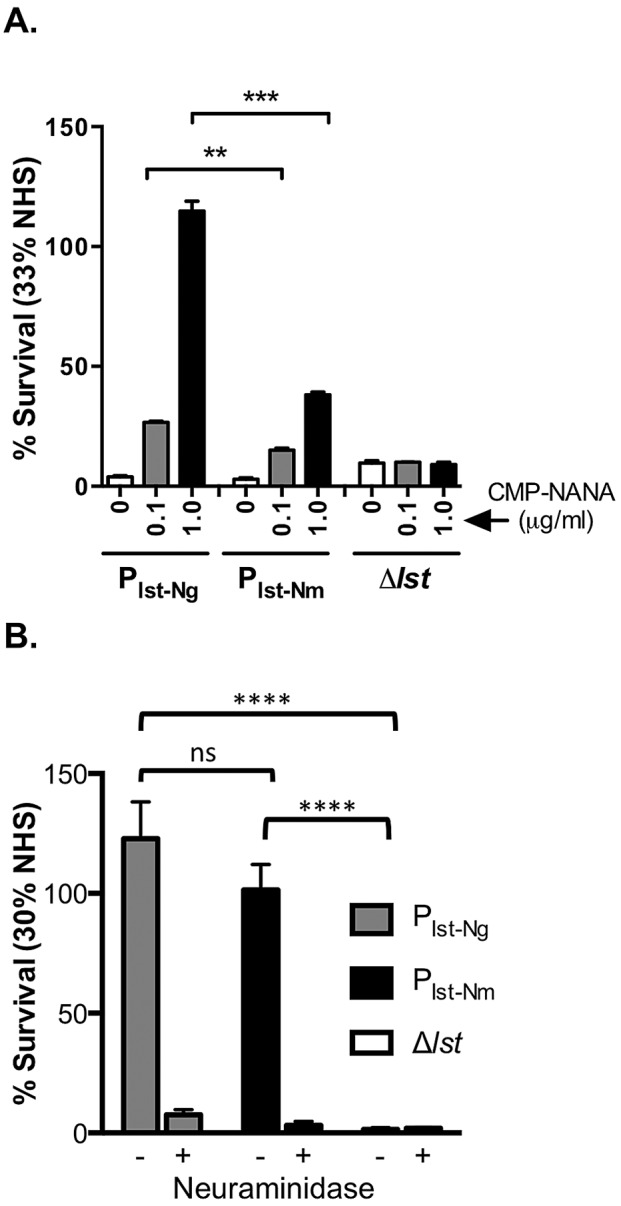
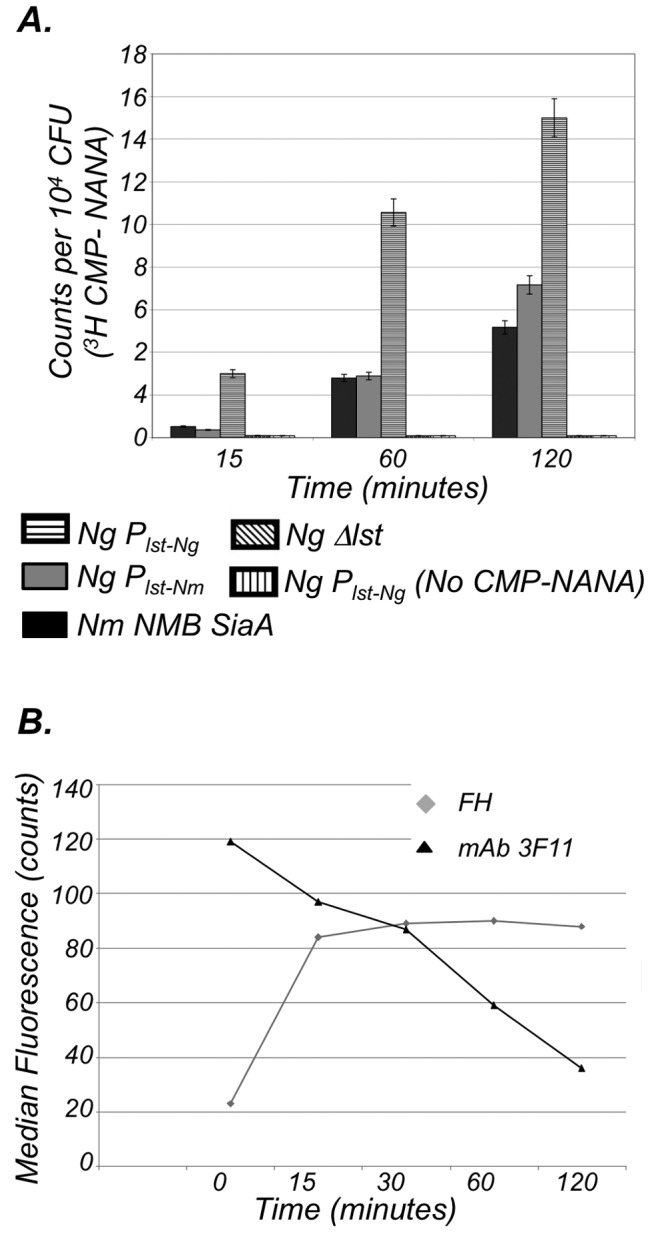
Neisseria meningitidis and Neisseria gonorrhoeae modify the terminal lacto-N-neotetraose moiety of their lipooligosaccharide (LOS) with sialic acid. N. gonorrhoeae LOS sialylation blocks killing by complement, which is mediated at least in part by enhanced binding of the complement inhibitor factor H (FH). The role of LOS sialylation in resistance of N. meningitidis to serum killing is less well defined. Sialylation in each species is catalyzed by the enzyme LOS α-2,3-sialyltransferase (Lst). Previous studies have shown increased Lst activity in N. gonorrhoeae compared to N. meningitidis due to an ~5-fold increase in lst transcription. Using isogenic N. gonorrhoeae strains engineered to express gonococcal lst from either the N. gonorrhoeae or N. meningitidis lst promoter, we show that decreased expression of lst (driven by the N. meningitidis promoter) reduced LOS sialylation as determined by less incorporation of tritium-labeled cytidine monophospho-N-acetylneuraminic acid (CMP-NANA; the donor molecule for sialic acid). Diminished LOS sialylation resulted in reduced rates of FH binding and increased pathway activation compared to N. gonorrhoeae promoter-driven lst expression. The N. meningitidis lst promoter generated sufficient Lst to sialylate N. gonorrhoeae LOS in vivo, and the level of sialylation after 24 h in the mouse genital tract was sufficient to mediate resistance to human serum ex vivo. Despite demonstrable LOS sialylation in vivo, gonococci harboring the N. meningitidis lst promoter were outcompeted by those with the N. gonorrhoeae lst promoter during coinfection of the vaginal tract of estradiol-treated mice. These data highlight the importance of high lst expression levels for gonococcal pathogenesis.
Neisseria gonorrhoeae has become resistant to nearly every therapeutic antibiotic used and is listed as an "urgent threat" by the Centers for Disease Control and Prevention. Novel therapies are needed to combat drug-resistant N. gonorrhoeae. Gonococci express an α-2,3-sialyltransferase (Lst) that can scavenge sialic acid from the host and use it to modify lipooligosaccharide (LOS). Sialylation of gonococcal LOS converts serum-sensitive strains to serum resistance, decreases antibody binding, and combats killing by neutrophils and antimicrobial peptides. Mutant N. gonorrhoeae that lack Lst (cannot sialylate LOS) are attenuated in a mouse model. Lst expression levels differ among N. gonorrhoeae strains, and N. gonorrhoeae typically expresses more Lst than Neisseria meningitidis. Here we examined the significance of differential lst expression levels and determined that the level of LOS sialylation is critical to the ability of N. gonorrhoeae to combat the immune system and survive in an animal model. LOS sialylation may be an ideal target for novel therapies.
脑膜炎奈瑟菌和淋病奈瑟菌用唾液酸修饰其脂寡糖(LOS)的末端乳糖 - N - 新四糖部分。淋病奈瑟菌LOS的唾液酸化可阻止补体杀伤,这至少部分是由补体抑制因子H(FH)结合增强介导的。LOS唾液酸化在脑膜炎奈瑟菌抵抗血清杀伤中的作用尚不太明确。每个物种中的唾液酸化由LOSα - 2,3 - 唾液酸转移酶(Lst)催化。先前的研究表明,与脑膜炎奈瑟菌相比,淋病奈瑟菌中Lst活性增加,这是由于lst转录增加了约5倍。使用经基因工程改造以从淋病奈瑟菌或脑膜炎奈瑟菌lst启动子表达淋球菌lst的同基因淋病奈瑟菌菌株,我们发现lst表达降低(由脑膜炎奈瑟菌启动子驱动)会降低LOS唾液酸化,这通过氚标记的胞苷单磷酸 - N - 乙酰神经氨酸(CMP - NANA;唾液酸的供体分子)掺入减少来确定。与淋病奈瑟菌启动子驱动的lst表达相比,LOS唾液酸化减少导致FH结合率降低和途径激活增加。脑膜炎奈瑟菌lst启动子产生足够的Lst以在体内使淋病奈瑟菌LOS唾液酸化,并且在小鼠生殖道中24小时后的唾液酸化水平足以介导对人血清的体外抗性。尽管在体内可证明LOS唾液酸化,但在雌二醇处理的小鼠阴道道共感染期间,携带脑膜炎奈瑟菌lst启动子的淋球菌被具有淋病奈瑟菌lst启动子的菌株竞争淘汰。这些数据突出了高lst表达水平对淋球菌致病性的重要性。
淋病奈瑟菌已对几乎所有使用的治疗性抗生素产生抗性,并被疾病控制和预防中心列为“紧急威胁”。需要新的疗法来对抗耐药性淋病奈瑟菌。淋球菌表达一种α - 2,3 - 唾液酸转移酶(Lst),该酶可从宿主中清除唾液酸并用于修饰脂寡糖(LOS)。淋球菌LOS的唾液酸化将血清敏感菌株转化为血清抗性,减少抗体结合,并对抗中性粒细胞和抗菌肽的杀伤。缺乏Lst(不能使LOS唾液酸化)突变的淋病奈瑟菌在小鼠模型中减毒。淋病奈瑟菌菌株之间的Lst表达水平不同,并且淋病奈瑟菌通常比脑膜炎奈瑟菌表达更多的Lst。在这里,我们研究了不同lst表达水平的意义,并确定LOS唾液酸化水平对于淋病奈瑟菌对抗免疫系统并在动物模型中存活的能力至关重要。LOS唾液酸化可能是新疗法的理想靶点。