Liu Haoxuan, Zhang Xiaohui, Huang Ju, Chen Jian-Qun, Tian Dacheng, Hurst Laurence D, Yang Sihai
Genome Biol. 2015 Jan 2;16(1):15. doi: 10.1186/s13059-014-0566-0.
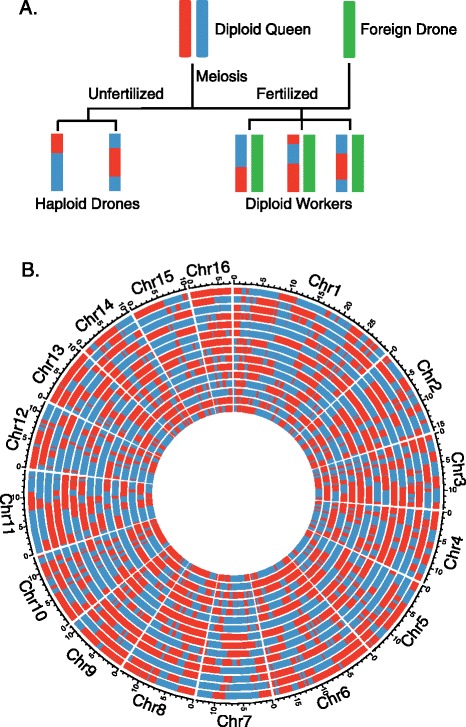
Social hymenoptera, the honey bee (Apis mellifera) in particular, have ultra-high crossover rates and a large degree of intra-genomic variation in crossover rates. Aligned with haploid genomics of males, this makes them a potential model for examining the causes and consequences of crossing over. To address why social insects have such high crossing-over rates and the consequences of this, we constructed a high-resolution recombination atlas by sequencing 55 individuals from three colonies with an average marker density of 314 bp/marker.
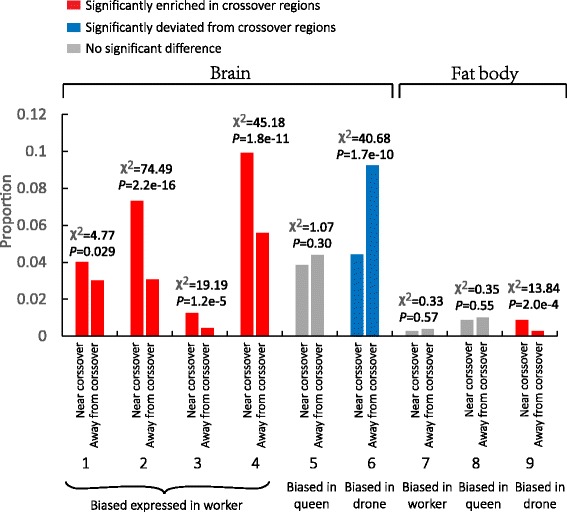
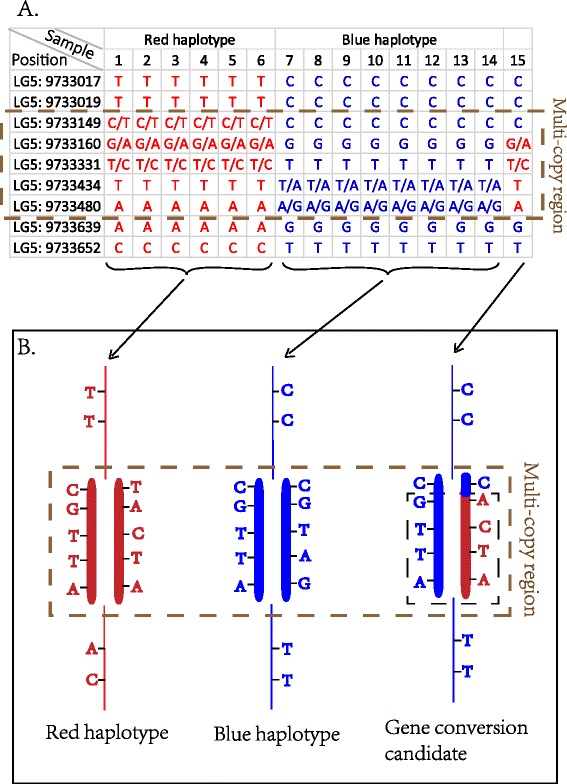
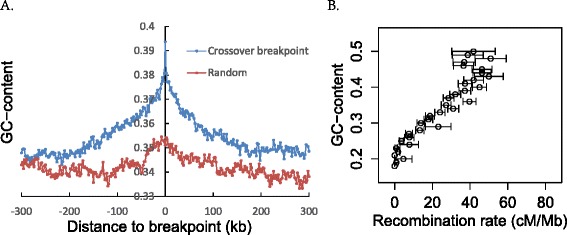
We find crossing over to be especially high in proximity to genes upregulated in worker brains, but see no evidence for a coupling with immune-related functioning. We detect only a low rate of non-crossover gene conversion, contrary to current evidence. This is in striking contrast to the ultrahigh crossing-over rate, almost double that previously estimated from lower resolution data. We robustly recover the predicted intragenomic correlations between crossing over and both population level diversity and GC content, which could be best explained as indirect and direct consequences of crossing over, respectively.
Our data are consistent with the view that diversification of worker behavior, but not immune function, is a driver of the high crossing-over rate in bees. While we see both high diversity and high GC content associated with high crossing-over rates, our estimate of the low non-crossover rate demonstrates that high non-crossover rates are not a necessary consequence of high recombination rates.
社会性膜翅目昆虫,尤其是蜜蜂(西方蜜蜂),具有超高的交叉率以及基因组内交叉率的高度变异。结合雄性的单倍体基因组学,这使其成为研究交叉发生的原因及后果的潜在模型。为了探究社会性昆虫为何具有如此高的交叉率以及其后果,我们通过对来自三个蜂群的55个个体进行测序构建了一个高分辨率重组图谱,平均标记密度为314 bp/标记。
我们发现交叉在工蜂大脑中上调的基因附近尤其高,但未发现与免疫相关功能存在关联的证据。与现有证据相反,我们仅检测到低水平的非交叉基因转换率。这与超高的交叉率形成了鲜明对比,几乎是先前基于较低分辨率数据估计值的两倍。我们有力地恢复了交叉与群体水平多样性和GC含量之间预测的基因组内相关性,这分别可以最好地解释为交叉的间接和直接后果。
我们的数据与这样一种观点一致,即工蜂行为的多样化而非免疫功能是蜜蜂高交叉率的驱动因素。虽然我们看到高交叉率与高多样性和高GC含量都相关,但我们对低非交叉率的估计表明,高非交叉率并非高重组率的必然结果。