Wlodarski Rafael, Manning John, Dunbar R I M
Department of Experimental Psychology, University of Oxford, Oxford OX1 3UD, UK
Department of Psychology, Northumbria University, Newcastle-upon-Tyne, UK.
Biol Lett. 2015 Feb;11(2):20140977. doi: 10.1098/rsbl.2014.0977.
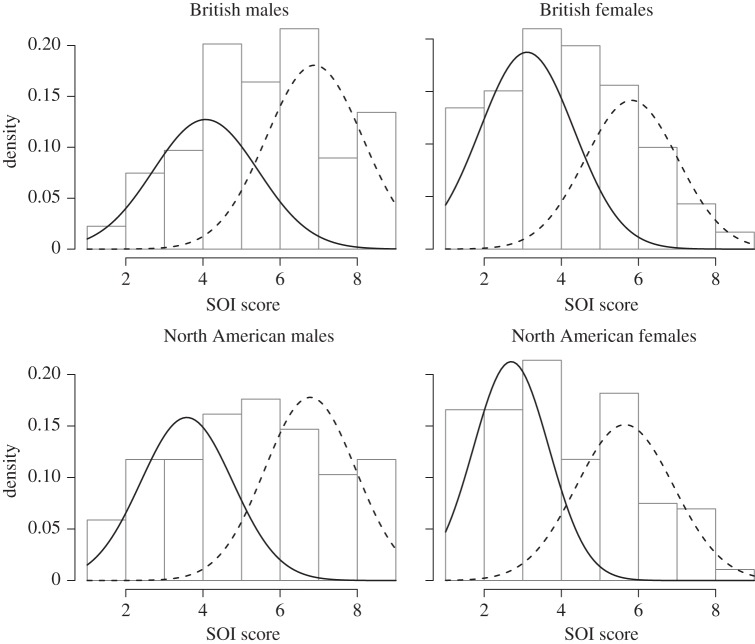
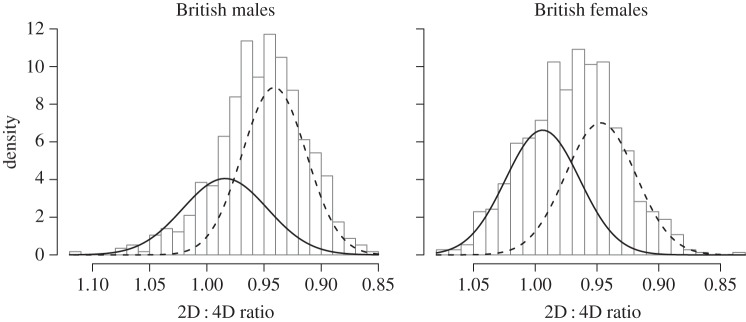
In all comparative analyses, humans always fall on the borderline between obligate monogamy and polygamy. Here, we use behavioural indices (sociosexuality) and anatomical indices (prenatal testosterone exposure indexed by 2D : 4D digit ratio) from three human populations to show that this may be because there are two distinct phenotypes in both sexes. While males are more promiscuous and display higher prenatal testosterone exposure than females overall, our analyses also suggest that the within-sex variation of these variables is best described by two underlying mixture models, suggesting the presence of two phenotypes with a monogamous/promiscuous ratio that slightly favours monogamy in females and promiscuity in males. The presence of two phenotypes implies that mating strategy might be under complex frequency-dependent selection.
在所有比较分析中,人类总是处于一夫一妻制和一夫多妻制的边界线上。在这里,我们使用来自三个人类群体的行为指标(社会性取向)和解剖学指标(通过2D:4D指长比来衡量产前睾酮暴露)来表明,这可能是因为两性中都存在两种不同的表型。虽然总体上男性比女性更滥交且产前睾酮暴露水平更高,但我们的分析也表明,这些变量在性别内部的变异最好用两种潜在的混合模型来描述,这表明存在两种表型,其一夫一妻制/滥交的比例在女性中略倾向于一夫一妻制,在男性中倾向于滥交。两种表型的存在意味着交配策略可能受到复杂的频率依赖性选择。