Gong Hong, Ni Chenxu, Shen Xiaoliang, Wu Tengyun, Jiang Chunlei
Faculty of Psychology and Mental Health, Second Military Medical University, Shanghai, People's Republic of China.
Department of Pharmacy, Second Military Medical University, Shanghai, People's Republic of China.
BMC Psychiatry. 2015 Feb 5;15:14. doi: 10.1186/s12888-015-0393-1.
Prenatal depression can negatively affect the physical and mental health of both mother and fetus. The aim of this study was to determine the effectiveness of yoga as an intervention in the management of prenatal depression.
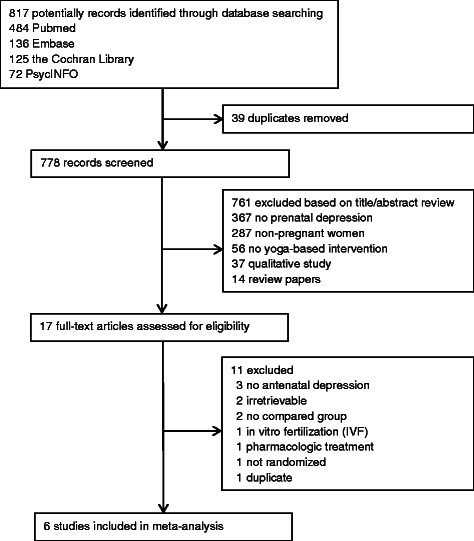
A systematic review and meta-analysis of randomized controlled trials (RCTs) was conducted by searching PubMed, Embase, the Cochrane Library and PsycINFO from all retrieved articles describing such trials up to July 2014.
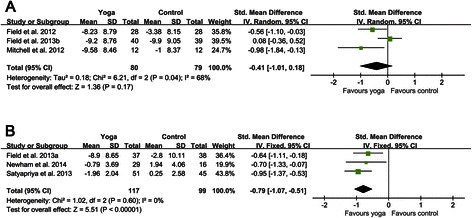
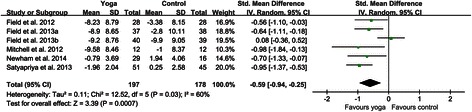
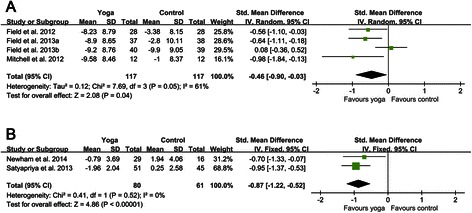
Six RCTs were identified in the systematic search. The sample consisted of 375 pregnant women, most of whom were between 20 and 40 years of age. The diagnoses of depression were determined by their scores on Structured Clinical Interview for DSM-IV and the Center for Epidemiological Studies Depression Scale. When compared with comparison groups (e.g., standard prenatal care, standard antenatal exercises, social support, etc.), the level of depression statistically significantly reduced in yoga groups (standardized mean difference [SMD], -0.59; 95% confidence interval [CI], -0.94 to -0.25; p = 0.0007). One subgroup analysis revealed that both the levels of depressive symptoms in prenatally depressed women (SMD, -0.46; CI, -0.90 to -0.03; p = 0.04) and non-depressed women (SMD, -0.87; CI, -1.22 to -0.52; p < 0.00001) were statistically significantly lower in yoga group than that in control group. There were two kinds of yoga: the physical-exercise-based yoga and integrated yoga, which, besides physical exercises, included pranayama, meditation or deep relaxation. Therefore, the other subgroup analysis was conducted to estimate effects of the two kinds of yoga on prenatal depression. The results showed that the level of depression was significantly decreased in the integrated yoga group (SMD, -0.79; CI, -1.07 to -0.51; p < 0.00001) but not significantly reduced in physical-exercise-based yoga group (SMD, -0.41; CI, -1.01 to -0.18; p = 0.17).
Prenatal yoga intervention in pregnant women may be effective in partly reducing depressive symptoms.
产前抑郁会对母亲和胎儿的身心健康产生负面影响。本研究旨在确定瑜伽作为一种干预措施在产前抑郁管理中的有效性。
通过检索PubMed、Embase、Cochrane图书馆和PsycINFO,对截至2014年7月所有检索到的描述此类试验的文章进行随机对照试验(RCT)的系统评价和荟萃分析。
在系统检索中确定了6项RCT。样本包括375名孕妇,其中大多数年龄在20至40岁之间。抑郁诊断通过她们在《精神疾病诊断与统计手册》第四版结构化临床访谈和流行病学研究中心抑郁量表上的得分来确定。与对照组(如标准产前护理、标准产前运动、社会支持等)相比,瑜伽组的抑郁水平在统计学上显著降低(标准化均值差[SMD],-0.59;95%置信区间[CI],-0.94至-0.25;p = 0.0007)。一项亚组分析显示,产前抑郁女性(SMD,-0.46;CI,-0.90至-0.03;p = 0.04)和非抑郁女性(SMD,-0.87;CI,-1.22至-0.52;p < 0.00001)的抑郁症状水平在瑜伽组均显著低于对照组。有两种瑜伽:基于体育锻炼的瑜伽和综合瑜伽,综合瑜伽除体育锻炼外,还包括呼吸控制法、冥想或深度放松。因此,进行了另一项亚组分析以评估这两种瑜伽对产前抑郁的影响。结果显示,综合瑜伽组的抑郁水平显著降低(SMD,-0.79;CI,-1.07至-0.51;p < 0.00001),而基于体育锻炼的瑜伽组抑郁水平未显著降低(SMD,-0.41;CI,-1.01至-0.18;p = 0.17)。
对孕妇进行产前瑜伽干预可能在一定程度上有效减轻抑郁症状。