Zhang Lei, Ye Xin, Sun Yi, Deng An-mei, Qian Bao-hua
Department of Laboratory Diagnosis, Changhai hospital, Second Military Medical University, Shanghai, 200433, China.
Department of Transfusion Medicine, Changhai hospital, Second Military Medical University, Shanghai, 200433, China.
J Hematol Oncol. 2015 Feb 6;8:8. doi: 10.1186/s13045-014-0103-3.
Hematologic disease affects people of all ages worldwide. In the past decade, researchers have made great progress in the field of hematology. In the present study we compared the hematology research output from China and other countries (USA, Germany, UK, Japan and South Korea) over the past 10 years and 5 years.
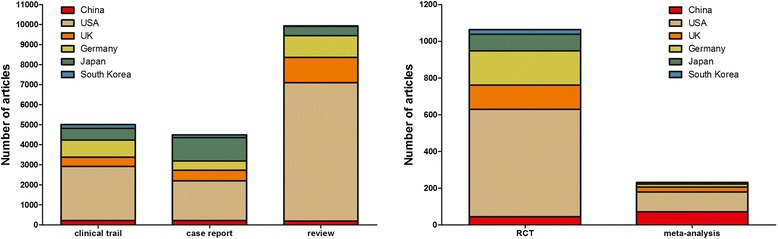
The related articles were extracted based on the PubMed database. We recorded the number of publications, clinical trials, randomized controlled trials, meta-analyses, case reports, reviews, citations, impact factors, articles in the top 10 journals and most published journals to assess the quantity and quality of research output in each region.
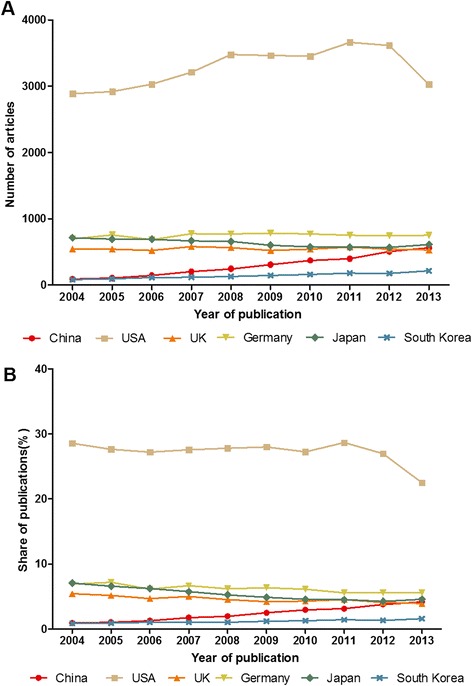
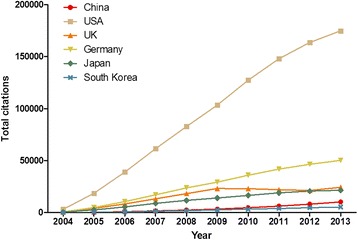
A total of 120,641 hematology-related articles were published from 2004 to 2013. The USA accounted for 27.13% (32,732/120,641) of the publications, followed by Germany (7,479/120,641; 6.20%), Japan (6,347/120,641; 5.26%), the UK (5,453/120,641; 4.52%), China (2,924/120,641; 2.42%) and South Korea (1,413/120,641; 1.17%). The ranking for cumulative impact factors was as follows: USA; Germany; UK; Japan; China and South Korea. The median impact factors in the UK, USA, and Germany were higher than Japan, South Korea, and China. Interestingly, the median impact factors in the three Asia countries were similar both in 2004-2013 and 2009-2013. The UK had the highest percentage of publications in the top 25% of journals, while China lagged behind and ranked last. When comparing the number of articles in the top 10 journals, the results were similar to the IF findings. Germany had the highest number of average citations, while China had the lowest number of average citation. The status of hematology research output from the 6 countries in 2009-2013 had little difference from 2004-2013.
Thus, the USA has had a dominant role in hematologic research in the past 10 years. Overall, the quality of publications in European countries was better than Asia countries. Although China has made considerable progress in hematology research, the quality of research needs improvement.
血液学疾病影响着全球各个年龄段的人群。在过去十年中,研究人员在血液学领域取得了巨大进展。在本研究中,我们比较了中国与其他国家(美国、德国、英国、日本和韩国)在过去10年和5年的血液学研究产出。
基于PubMed数据库提取相关文章。我们记录了出版物数量、临床试验、随机对照试验、荟萃分析、病例报告、综述、引用次数、影响因子、排名前十的期刊和发文最多的期刊上的文章,以评估每个地区研究产出的数量和质量。
2004年至2013年共发表了120,641篇血液学相关文章。美国占出版物的27.13%(32,732/120,641),其次是德国(7,479/120,641;6.20%)、日本(6,347/120,641;5.26%)、英国(5,453/120,641;4.52%)、中国(2,924/120,641;2.42%)和韩国(1,413/120,641;1.17%)。累积影响因子排名如下:美国;德国;英国;日本;中国和韩国。英国、美国和德国的影响因子中位数高于日本、韩国和中国。有趣的是,在2004 - 2013年和2009 - 2013年期间,这三个亚洲国家的影响因子中位数相似。英国在排名前25%的期刊上发表的文章比例最高,而中国则落后并排名最后。在比较排名前十的期刊上的文章数量时,结果与影响因子的结果相似。德国的平均引用次数最高,而中国的平均引用次数最低。2009 - 2013年这6个国家的血液学研究产出状况与2004 - 2013年相比差异不大。
因此,在过去10年中,美国在血液学研究中占据主导地位。总体而言,欧洲国家的出版物质量优于亚洲国家。尽管中国在血液学研究方面取得了相当大的进展,但研究质量仍需提高。