Institute of Basic Medical Sciences, Chinese Academy of Medical Sciences & School of Basic Medicine, Peking Union Medical College, Beijing, China.
Lancet. 2013 Jun 8;381(9882):1987-2015. doi: 10.1016/S0140-6736(13)61097-1.
China has undergone rapid demographic and epidemiological changes in the past few decades, including striking declines in fertility and child mortality and increases in life expectancy at birth. Popular discontent with the health system has led to major reforms. To help inform these reforms, we did a comprehensive assessment of disease burden in China, how it changed between 1990 and 2010, and how China's health burden compares with other nations.
We used results of the Global Burden of Diseases, Injuries, and Risk Factors Study 2010 (GBD 2010) for 1990 and 2010 for China and 18 other countries in the G20 to assess rates and trends in mortality, causes of death, years of life lost (YLLs), years lived with disability (YLDs), disability-adjusted life-years (DALYs), and healthy life expectancy (HALE). We present results for 231 diseases and injuries and for 67 risk factors or clusters of risk factors relevant to China. We assessed relative performance of China against G20 countries (significantly better, worse, or indistinguishable from the G20 mean) with age-standardised rates and 95% uncertainty intervals.
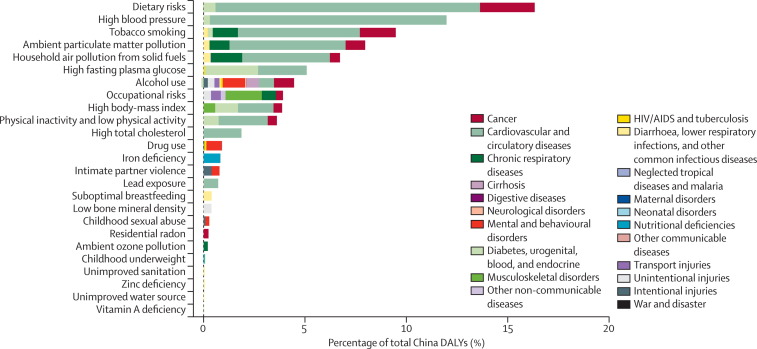
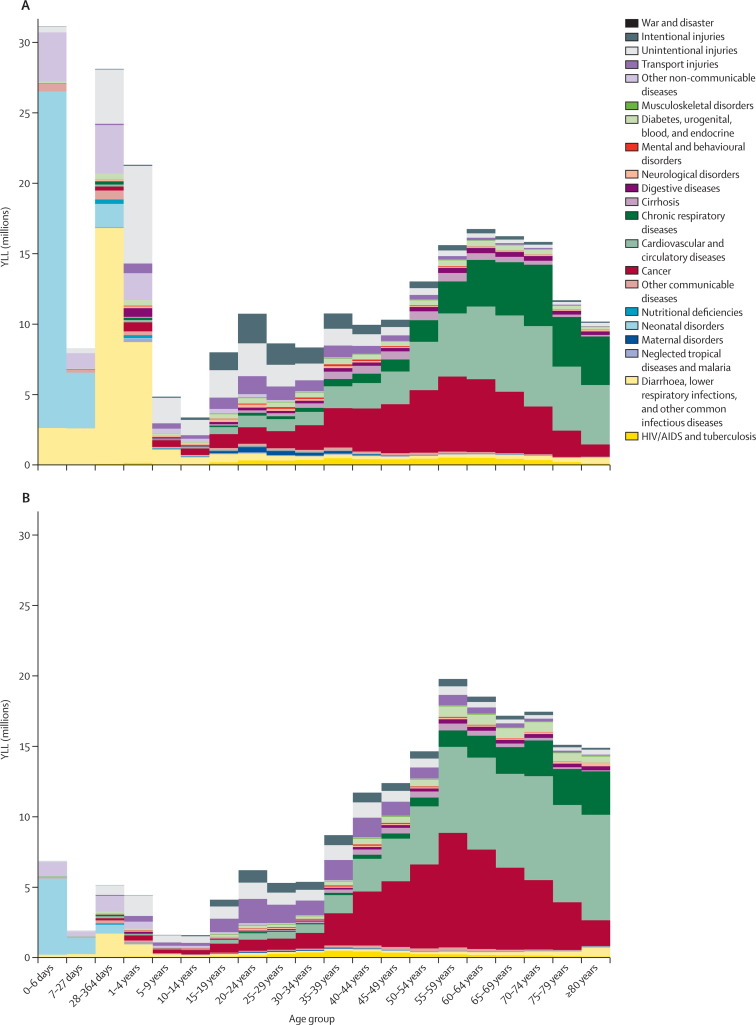
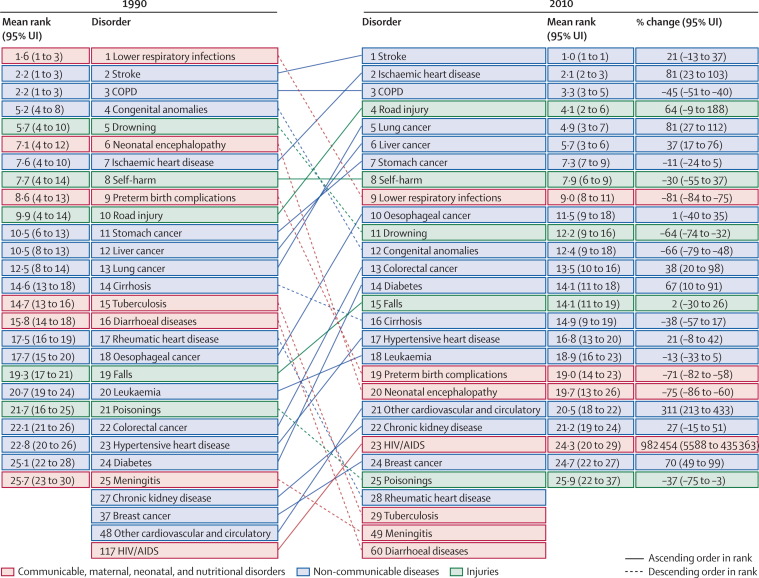
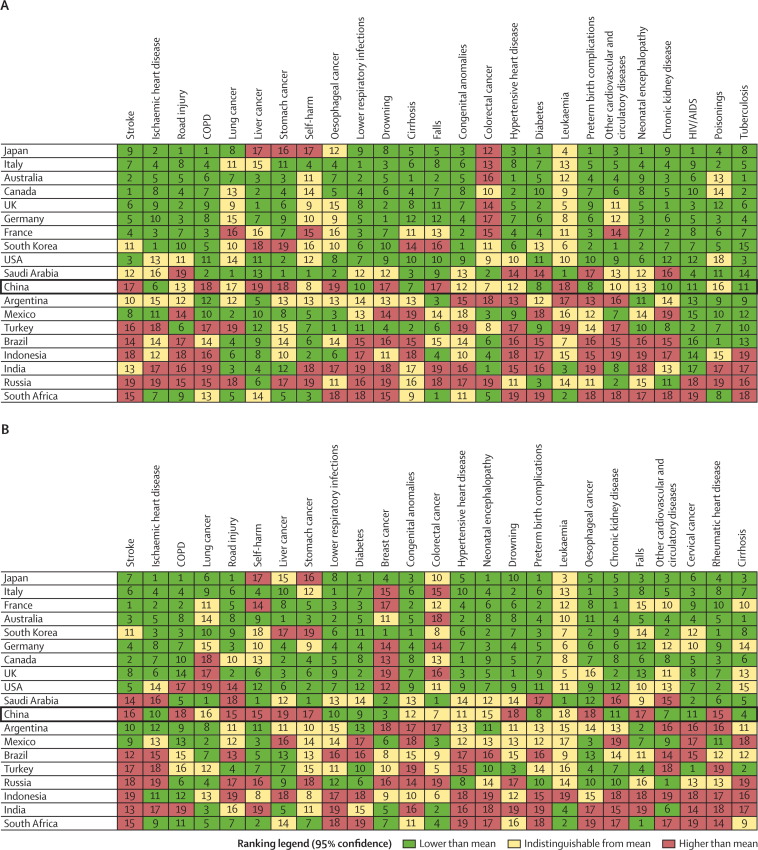
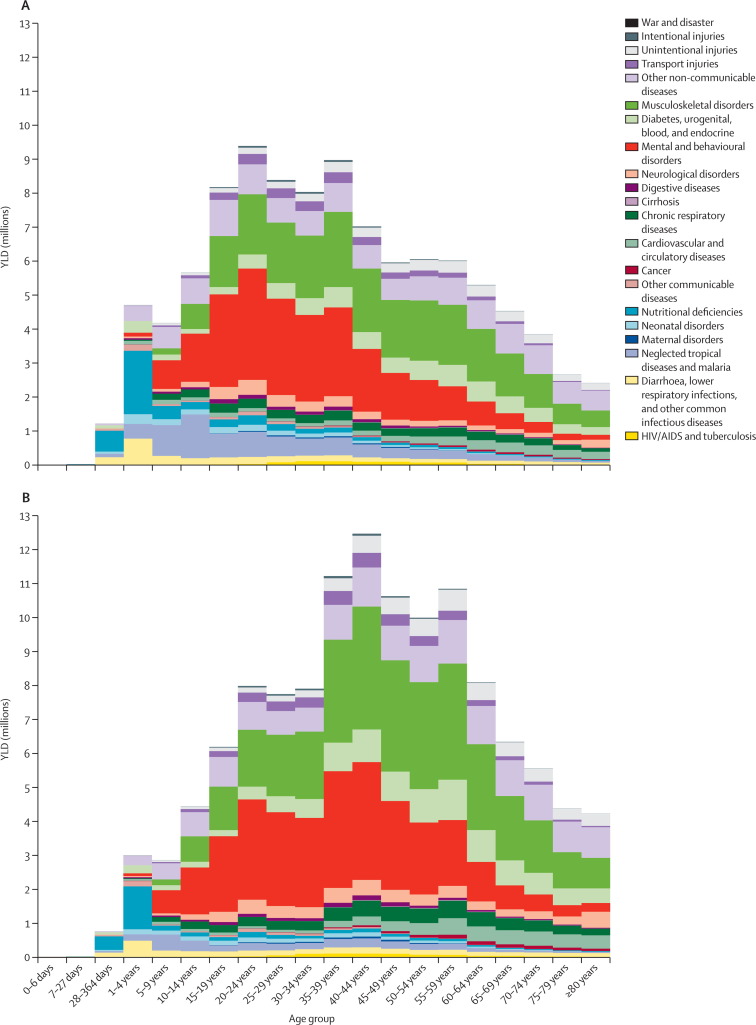
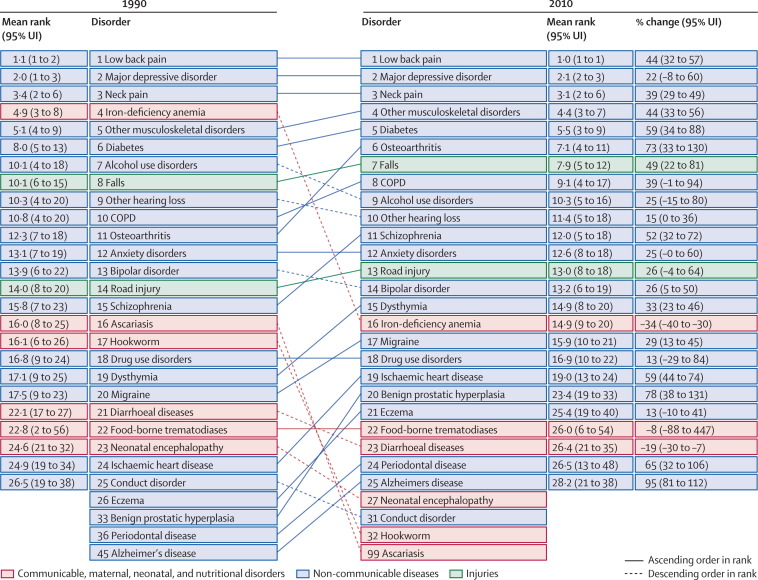
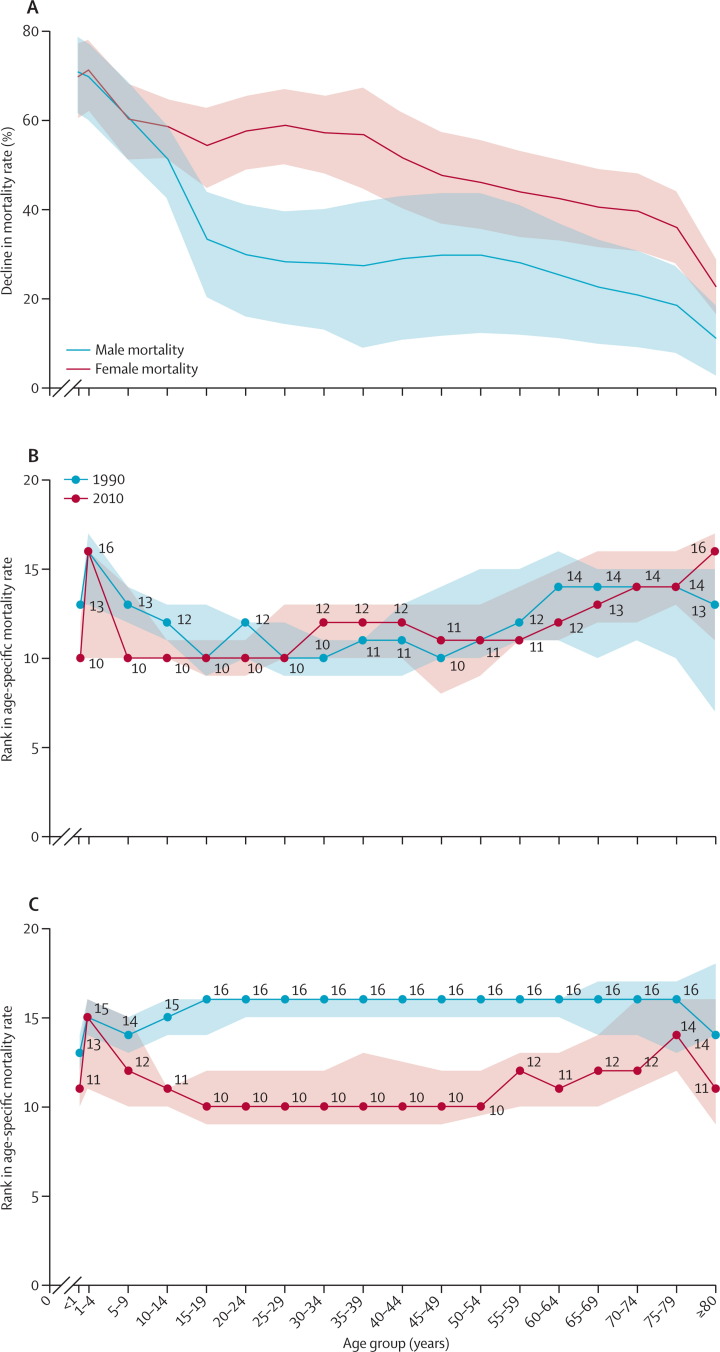
The leading causes of death in China in 2010 were stroke (1·7 million deaths, 95% UI 1·5-1·8 million), ischaemic heart disease (948,700 deaths, 774,500-1,024,600), and chronic obstructive pulmonary disease (934,000 deaths, 846,600-1,032,300). Age-standardised YLLs in China were lower in 2010 than all emerging economies in the G20, and only slightly higher than noted in the USA. China had the lowest age-standardised YLD rate in the G20 in 2010. China also ranked tenth (95% UI eighth to tenth) for HALE and 12th (11th to 13th) for life expectancy. YLLs from neonatal causes, infectious diseases, and injuries in children declined substantially between 1990 and 2010. Mental and behavioural disorders, substance use disorders, and musculoskeletal disorders were responsible for almost half of all YLDs. The fraction of DALYs from YLDs rose from 28·1% (95% UI 24·2-32·5) in 1990 to 39·4% (34·9-43·8) in 2010. Leading causes of DALYs in 2010 were cardiovascular diseases (stroke and ischaemic heart disease), cancers (lung and liver cancer), low back pain, and depression. Dietary risk factors, high blood pressure, and tobacco exposure are the risk factors that constituted the largest number of attributable DALYs in China. Ambient air pollution ranked fourth (third to fifth; the second highest in the G20) and household air pollution ranked fifth (fourth to sixth; the third highest in the G20) in terms of the age-standardised DALY rate in 2010.
The rapid rise of non-communicable diseases driven by urbanisation, rising incomes, and ageing poses major challenges for China's health system, as does a shift to chronic disability. Reduction of population exposures from poor diet, high blood pressure, tobacco use, cholesterol, and fasting blood glucose are public policy priorities for China, as are the control of ambient and household air pollution. These changes will require an integrated government response to improve primary care and undertake required multisectoral action to tackle key risks. Analyses of disease burden provide a useful framework to guide policy responses to the changing disease spectrum in China.
Bill & Melinda Gates Foundation.
过去几十年,中国经历了快速的人口和流行病学变化,包括生育率和儿童死亡率的显著下降以及出生时预期寿命的增加。公众对卫生系统的不满导致了重大改革。为了帮助这些改革,我们对中国的疾病负担进行了全面评估,评估了 1990 年至 2010 年期间的变化情况,以及中国的健康负担与其他国家的比较情况。
我们使用 2010 年全球疾病、伤害和危险因素研究(GBD 2010)的结果,评估了中国和 2010 年 G20 中的其他 18 个国家的死亡率、死因、生命损失年数(YLLs)、失能生命年数(YLDs)、残疾调整生命年数(DALYs)和健康预期寿命(HALE)的比率和趋势。我们为 231 种疾病和伤害以及与中国相关的 67 个风险因素或风险因素群提供了结果。我们根据年龄标准化率和 95%置信区间,评估了中国相对于 G20 国家的相对表现(明显更好、更差或与 G20 平均水平相当)。
2010 年中国的主要死因是中风(170 万人死亡,95%置信区间 150 万至 190 万)、缺血性心脏病(94.87 万人死亡,774500 至 1024600 人)和慢性阻塞性肺疾病(93.4 万人死亡,846600 至 1032300 人)。2010 年,中国的年龄标准化 YLLs 低于 G20 中的所有新兴经济体,仅略高于美国。2010 年,中国在 G20 中的年龄标准化 YLD 率最低。中国在 HALE 方面排名第十(95%置信区间第八至第十),在预期寿命方面排名第十二(11 至 13)。1990 年至 2010 年间,新生儿病因、传染病和儿童伤害导致的 YLLs 大幅下降。精神和行为障碍、物质使用障碍和肌肉骨骼疾病占所有 YLD 的近一半。2010 年,YLD 造成的 DALYs 比例从 1990 年的 28.1%(95%置信区间 24.2-32.5)上升到 39.4%(34.9-43.8)。2010 年的主要 DALY 原因是心血管疾病(中风和缺血性心脏病)、癌症(肺癌和肝癌)、下背痛和抑郁症。饮食风险因素、高血压和烟草暴露是中国归因于 DALYs 数量最多的风险因素。2010 年,环境空气污染在年龄标准化 DALY 率方面排名第四(第三至第五;G20 中第二高),家庭空气污染排名第五(第四至第六;G20 中第三高)。
城市化、收入增长和人口老龄化推动的非传染性疾病的快速上升,以及向慢性残疾的转变,给中国的卫生系统带来了重大挑战。改善饮食、高血压、烟草使用、胆固醇和空腹血糖等方面的人口暴露情况是中国公共政策的优先事项,控制环境和家庭空气污染也是如此。这些变化将需要政府采取综合措施,改善初级保健,并开展必要的多部门行动,以应对主要风险。疾病负担分析为指导中国疾病谱变化的政策应对提供了有用的框架。
比尔和梅琳达·盖茨基金会。