Research Centre for Genetic Engineering and Biotechnology "Georgi D Efremov", Macedonian Academy of Sciences and Arts, Krste Misirkov 2, 1000 Skopje, Republic of Macedonia.
Institute of Pathology, Medical Faculty, University "St. Cyril and Methodius", Skopje, Republic of Macedonia.
Proteome Sci. 2015 Jan 29;13(1):2. doi: 10.1186/s12953-014-0059-9. eCollection 2015.
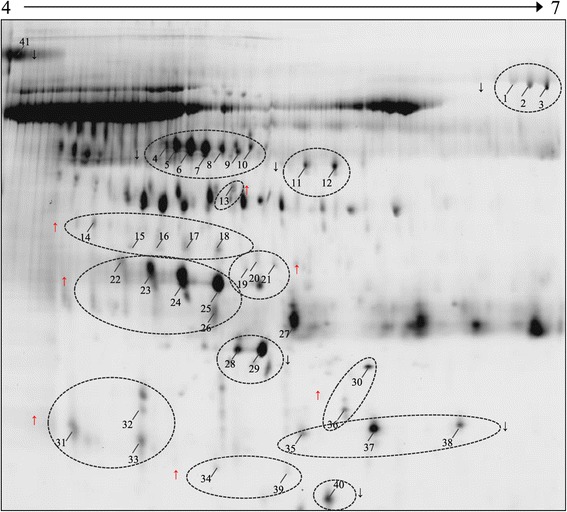
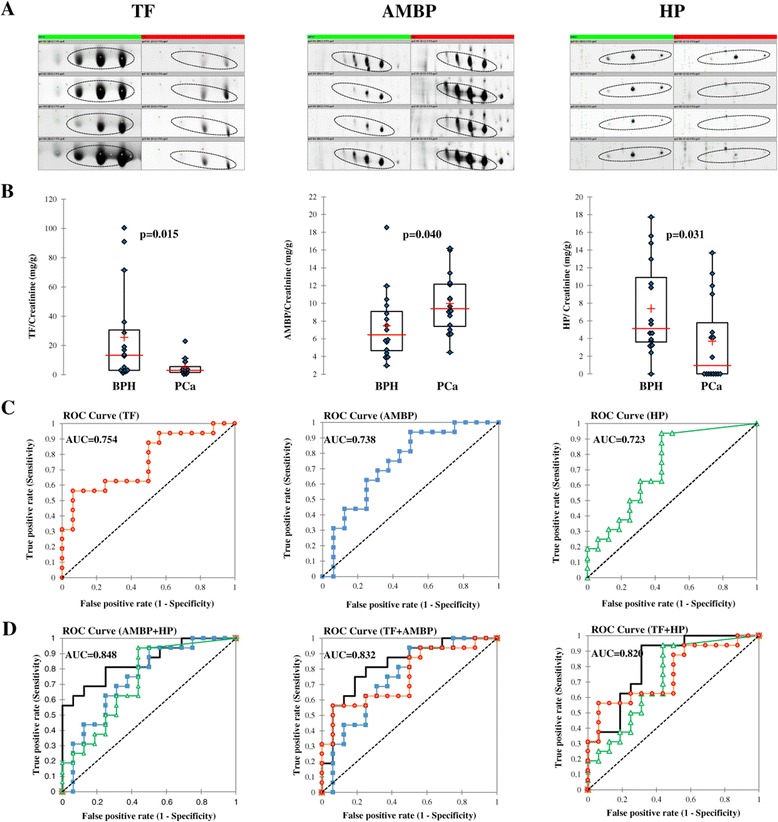
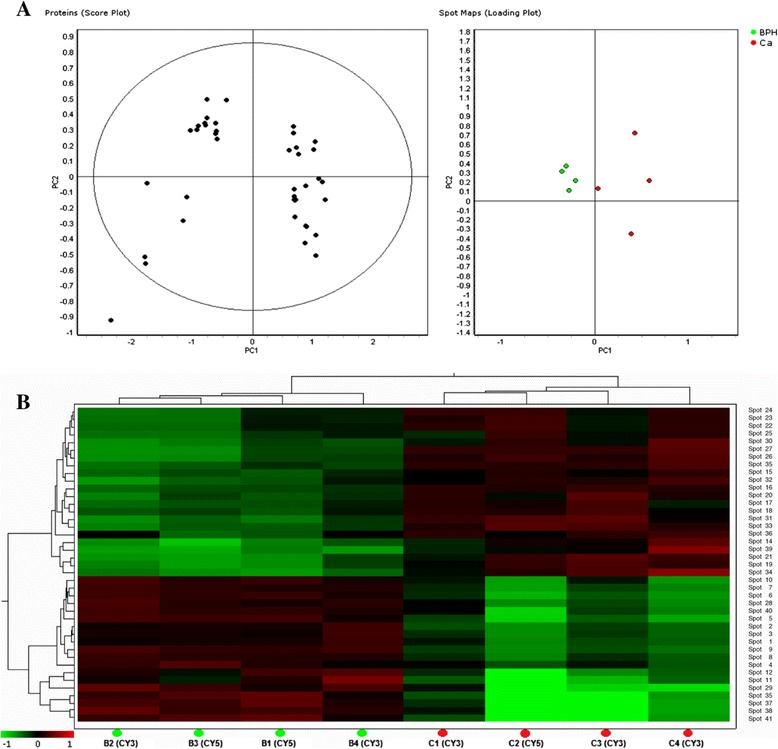
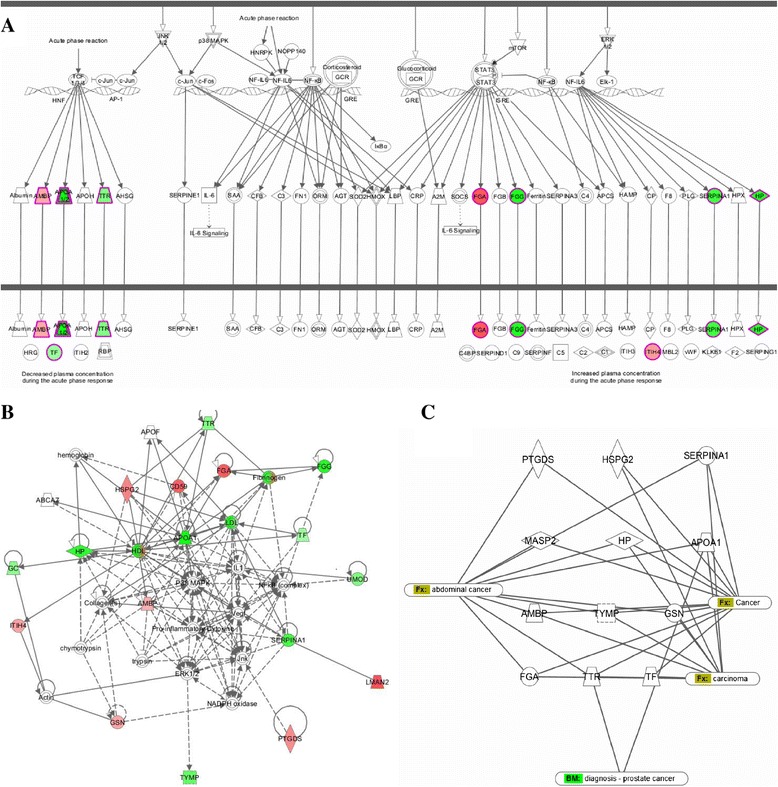
Despite the overall success of prostate specific antigen (PSA) in screening and detection of prostate cancer (PCa), its use has been limited due to the lack of specificity. The principal driving goal currently within PCa research is to identify non-invasive biomarker(s) for early detection of aggressive tumors with greater sensitivity and specificity than PSA. In this study, we focused on identification of non-invasive biomarkers in urine with higher specificity than PSA. We tested urine samples from PCa and benign prostatic hyperplasia (BPH) patients by 2-D DIGE coupled with MS and bioinformatics analysis. Statistically significant (p < 0.05), 1.8 fold variation or more in abundance, showed 41 spots, corresponding to 23 proteins. The Ingenuity Pathway Analysis showed significant association with the Acute Phase Response Signaling pathway. Nine proteins with differential abundances were included in this pathway: AMBP, APOA1, FGA, FGG, HP, ITIH4, SERPINA1, TF and TTR. The expression pattern of 4 acute phase response proteins differed from the defined expression in the canonical pathway. The urine levels of TF, AMPB and HP were measured by immunoturbidimetry in an independent validation set. The concentration of AMPB in urine was significantly higher in PCa while levels of TF and HP were opposite (p < 0.05). The AUC for the individual proteins ranged from 0.723 to 0.754. The combination of HP and AMBP yielded the highest accuracy (AUC = 0.848), greater than PSA. The proposed biomarker set is quickly quantifiable and economical with potential to improve the sensitivity and specificity of PCa detection.
尽管前列腺特异性抗原 (PSA) 在前列腺癌 (PCa) 的筛查和检测方面总体上取得了成功,但由于其特异性不足,其应用受到了限制。目前 PCa 研究的主要目标是确定非侵入性生物标志物,以比 PSA 更灵敏和更特异的方式早期检测侵袭性肿瘤。在这项研究中,我们专注于鉴定比 PSA 特异性更高的尿液中的非侵入性生物标志物。我们通过 2-D DIGE 结合 MS 和生物信息学分析,测试了来自 PCa 和良性前列腺增生 (BPH) 患者的尿液样本。具有统计学意义 (p < 0.05)、丰度变化 1.8 倍或更多的有 41 个斑点,对应 23 种蛋白质。通路分析显示与急性期反应信号通路有显著关联。在该通路中包含 9 个具有差异丰度的蛋白质:AMBP、APOA1、FGA、FGG、HP、ITIH4、SERPINA1、TF 和 TTR。4 种急性期反应蛋白的表达模式与经典通路中的定义表达不同。在独立验证集中,通过免疫比浊法测量了 TF、AMBP 和 HP 在尿液中的水平。在 PCa 中,AMPB 在尿液中的水平显著升高,而 TF 和 HP 的水平则相反(p < 0.05)。单个蛋白质的 AUC 范围为 0.723 到 0.754。HP 和 AMBP 的组合产生了最高的准确性(AUC = 0.848),优于 PSA。所提出的生物标志物组具有快速可量化性和经济性,有可能提高 PCa 检测的灵敏度和特异性。