Helen Wills Neuroscience Institute, University of California Berkeley, CA, USA.
Front Hum Neurosci. 2015 Jan 21;8:1042. doi: 10.3389/fnhum.2014.01042. eCollection 2014.
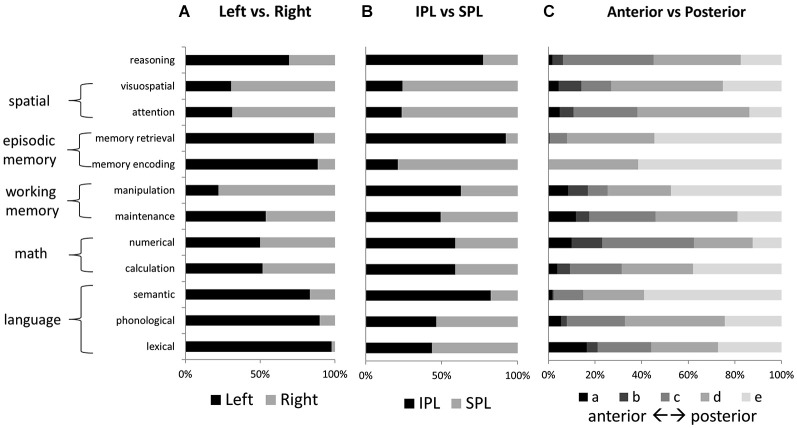
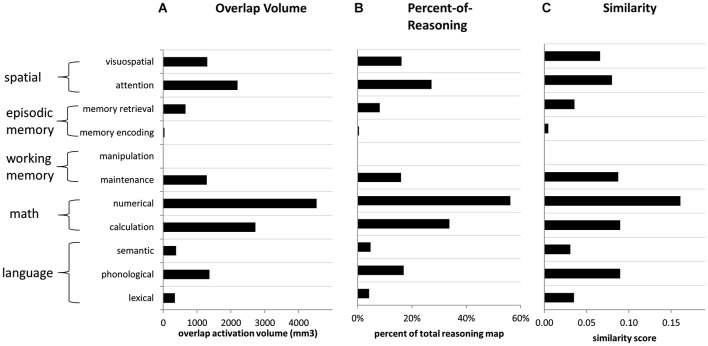
Reasoning depends on the contribution of posterior parietal cortex (PPC). But PPC is involved in many basic operations-including spatial attention, mathematical cognition, working memory, long-term memory, and language-and the nature of its contribution to reasoning is unclear. Psychological theories of the processes underlying reasoning make divergent claims about the neural systems that are likely to be involved, and better understanding the specific contribution of PPC can help to inform these theories. We set out to address several competing hypotheses, concerning the role of PPC in reasoning: (1) reasoning involves application of formal logic and is dependent on language, with PPC activation for reasoning mainly reflective of linguistic processing; (2) reasoning involves probabilistic computation and is thus dependent on numerical processing mechanisms in PPC; and (3) reasoning is built upon the representation and processing of spatial relations, and PPC activation associated with reasoning reflects spatial processing. We conducted two separate meta-analyses. First, we pooled data from our own studies of reasoning in adults, and examined activation in PPC regions of interest (ROI). Second, we conducted an automated meta-analysis using Neurosynth, in which we examined overlap between activation maps associated with reasoning and maps associated with other key functions of PPC. In both analyses, we observed reasoning-related activation concentrated in the left Inferior Parietal Lobe (IPL). Reasoning maps demonstrated the greatest overlap with mathematical cognition. Maintenance, visuospatial, and phonological processing also demonstrated some overlap with reasoning, but a large portion of the reasoning map did not overlap with the map for any other function. This evidence suggests that the PPC's contribution to reasoning may be most closely related to its role in mathematical cognition, but that a core component of this contribution may be specific to reasoning.
推理依赖于后顶叶皮层(PPC)的贡献。但是,PPC 参与了许多基本操作,包括空间注意、数学认知、工作记忆、长期记忆和语言,其对推理的贡献性质尚不清楚。推理的心理理论对可能涉及的神经系统提出了不同的主张,更好地理解 PPC 的特定贡献可以帮助这些理论。我们着手解决几个相互竞争的假设,这些假设涉及 PPC 在推理中的作用:(1)推理涉及形式逻辑的应用,依赖于语言,推理中的 PPC 激活主要反映语言处理;(2)推理涉及概率计算,因此依赖于 PPC 中的数值处理机制;(3)推理是基于空间关系的表示和处理构建的,与推理相关的 PPC 激活反映了空间处理。我们进行了两项独立的荟萃分析。首先,我们汇总了我们自己关于成年人推理的研究数据,并检查了 PPC 感兴趣区(ROI)中的激活情况。其次,我们使用 Neurosynth 进行了自动荟萃分析,在该分析中,我们检查了与推理相关的激活图与与 PPC 其他关键功能相关的图之间的重叠。在这两项分析中,我们观察到与推理相关的激活集中在左顶下小叶(IPL)。推理图与数学认知的重叠最大。维护、视觉空间和语音处理也与推理有一定的重叠,但推理图的很大一部分与任何其他功能的图没有重叠。这一证据表明,PPC 对推理的贡献可能与它在数学认知中的作用最密切相关,但这一贡献的核心部分可能是推理所特有的。