Natural History Museum, University of Pisa , Calci, Pisa , Italy.
Natural History Museum, University of Pisa , Calci, Pisa , Italy ; Institute of Cognitive Sciences and Technologies, Unit of Cognitive Primatology & Primate Center, CNR , Rome , Italy.
PeerJ. 2015 Jan 15;3:e729. doi: 10.7717/peerj.729. eCollection 2015.
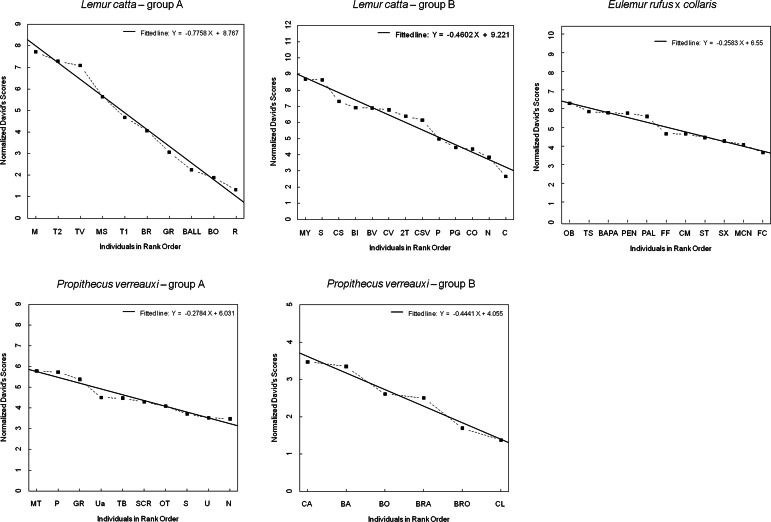
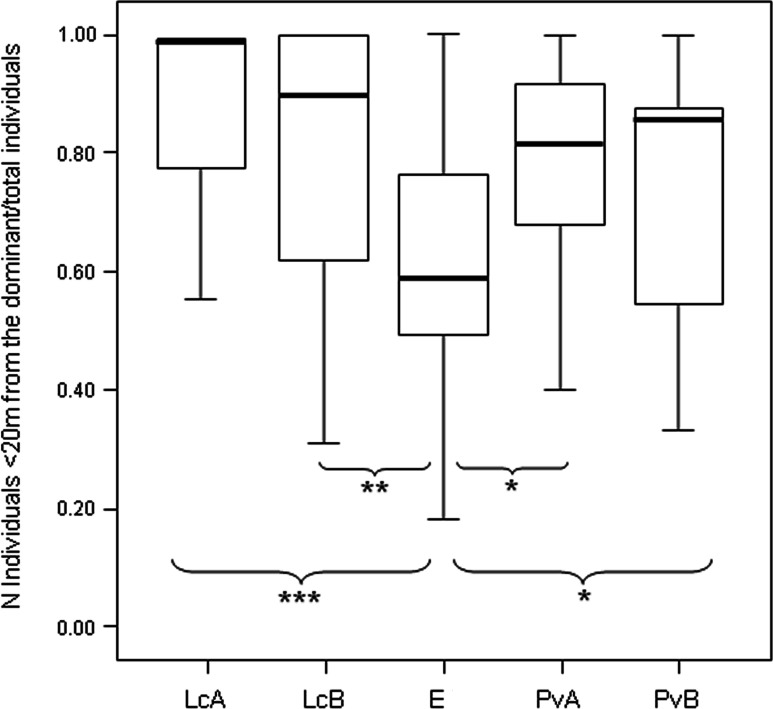
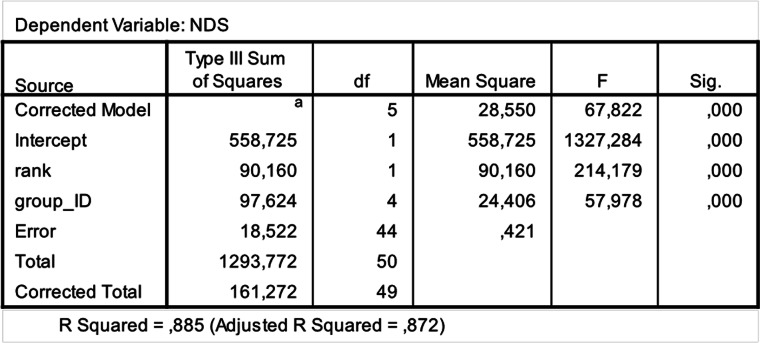
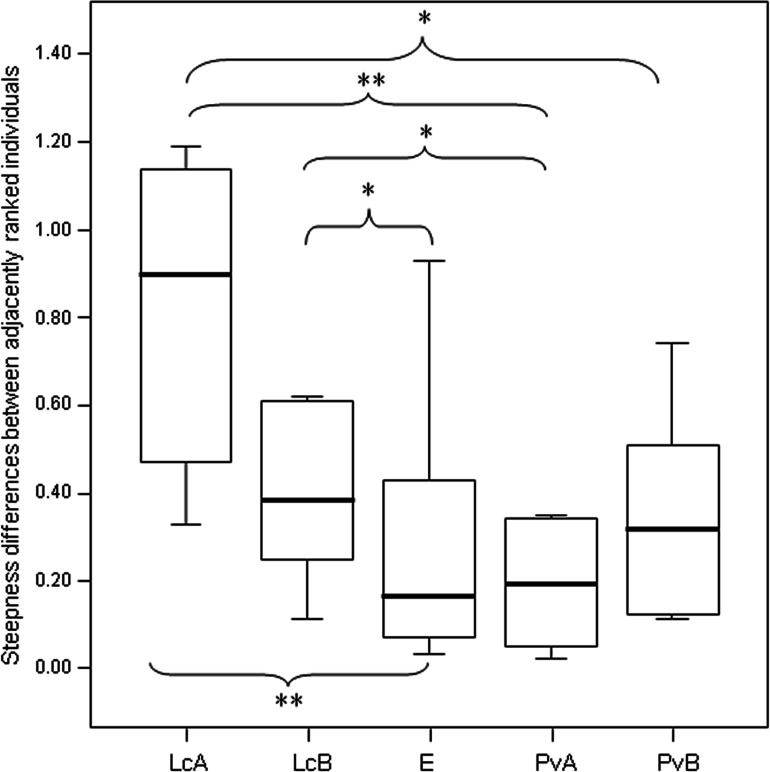
Dominance hierarchy influences the life quality of social animals, and its definition should in principle be based on the outcome of agonistic interactions. However, defining and comparing the dominance profile of social groups is difficult due to the different dominance measures used and because no one measure explains it all. We applied different analytical methods to winner-loser sociomatrices to determine the dominance profile of five groups of wild lemurs (species: Lemur catta, Propithecus verreauxi, and Eulemur rufus x collaris) from the Berenty forest (Madagascar). They are an excellent study model because they share the same habitat and an apparently similar dominance profile: linear hierarchy and female dominance. Data were collected over more than 1200 h of observation. Our approach included four steps: (1) by applying the binary dyadic dominance relationship method (I&SI) on either aggressions or supplant sociomatrices we verified whether hierarchy was aggression or submission based; (2) by calculating normalized David's scores and measuring steepness from aggression sociomatrices we evaluated whether hierarchy was shallow or steep; (3) by comparing the ranking orders obtained with methods 1 and 2 we assessed whether hierarchy was consistent or not; and (4) by assessing triangle transitivity and comparing it with the linearity index and the level of group cohesion we determined if hierarchy was more or less cohesive. Our results show that L. catta groups have got a steep, consistent, highly transitive and cohesive hierarchy. P. verreauxi groups are characterized by a moderately steep and consistent hierarchy, with variable levels of triangle transitivity and cohesion. E. rufus x collaris group possesses a shallow and inconsistent hierarchy, with lower (but not lowest) levels of transitivity and cohesion. A multiple analytical approach on winner-loser sociomatrices other than leading to an in-depth description of the dominance profile, allows intergroup and cross-species comparisons.
优势等级制度影响着群居动物的生活质量,其定义原则上应基于竞争互动的结果。然而,由于使用的优势等级衡量标准不同,以及没有一种单一的衡量标准能够完全解释所有情况,因此定义和比较群居动物群体的优势等级分布是很困难的。我们应用了不同的分析方法来处理胜者-败者社会矩阵,以确定来自贝伦蒂森林(马达加斯加)的五组野生狐猴(物种:环尾狐猴、白鼻长尾猴和白领领狐猴 x 条纹领狐猴)的优势等级分布。它们是一个极好的研究模型,因为它们共享相同的栖息地和明显相似的优势等级分布:线性等级制度和雌性优势。数据是通过 1200 多个小时的观察收集的。我们的方法包括四个步骤:(1)通过应用二元对偶支配关系方法(I&SI)在攻击或取代社会矩阵上,我们验证了等级制度是基于攻击还是屈服;(2)通过计算标准化的大卫得分并从攻击社会矩阵中测量陡峭程度,我们评估了等级制度是浅还是陡峭;(3)通过比较方法 1 和 2 获得的排名顺序,我们评估了等级制度是否一致;(4)通过评估三角形传递性,并将其与线性指数和群体凝聚力水平进行比较,我们确定了等级制度是更具凝聚力还是更不具凝聚力。我们的研究结果表明,环尾狐猴群体具有陡峭、一致、高度传递性和凝聚力的等级制度。白鼻长尾猴群体的等级制度具有适度陡峭和一致的特征,具有可变的三角形传递性和凝聚力水平。白领领狐猴 x 条纹领狐猴群体则具有浅而不一致的等级制度,其传递性和凝聚力水平较低(但不是最低)。除了深入描述优势等级分布外,对胜者-败者社会矩阵进行多分析方法还允许进行群体间和跨物种比较。