Austin Peter C, Pencinca Michael J, Steyerberg Ewout W
1 Institute for Clinical Evaluative Sciences, Toronto, Canada.
2 Institute of Health Management, Policy and Evaluation, University of Toronto.
Stat Methods Med Res. 2017 Jun;26(3):1053-1077. doi: 10.1177/0962280214567141. Epub 2015 Feb 5.
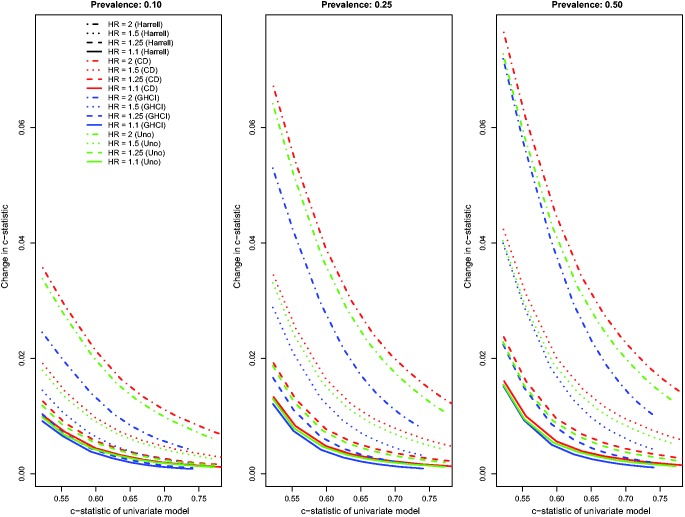
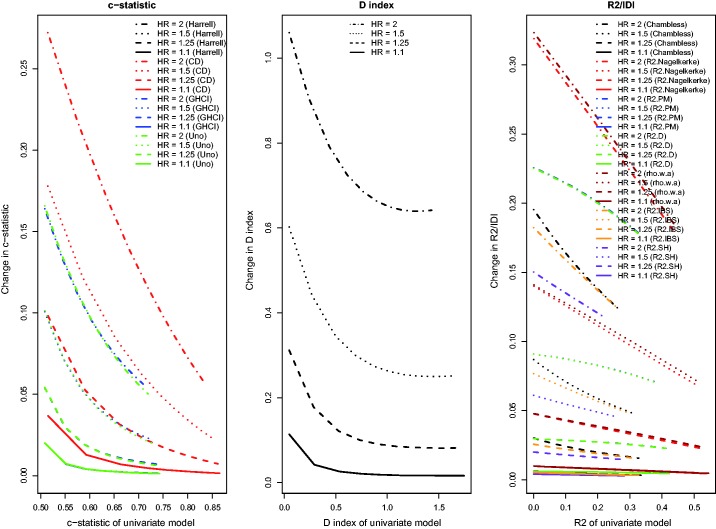
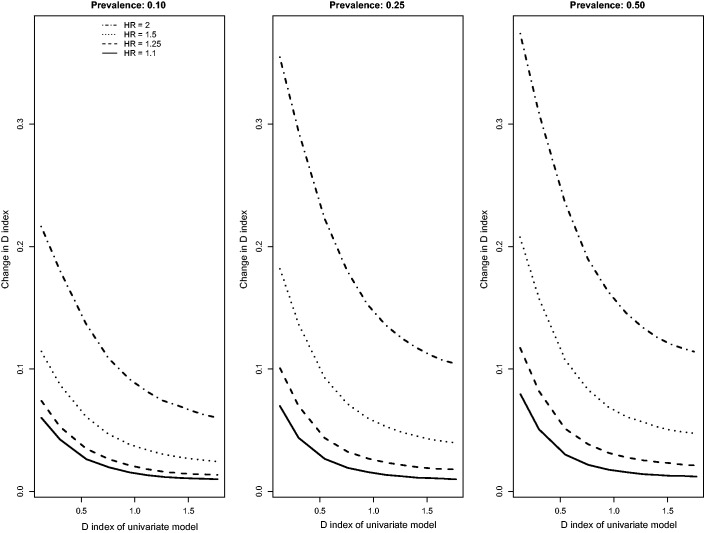
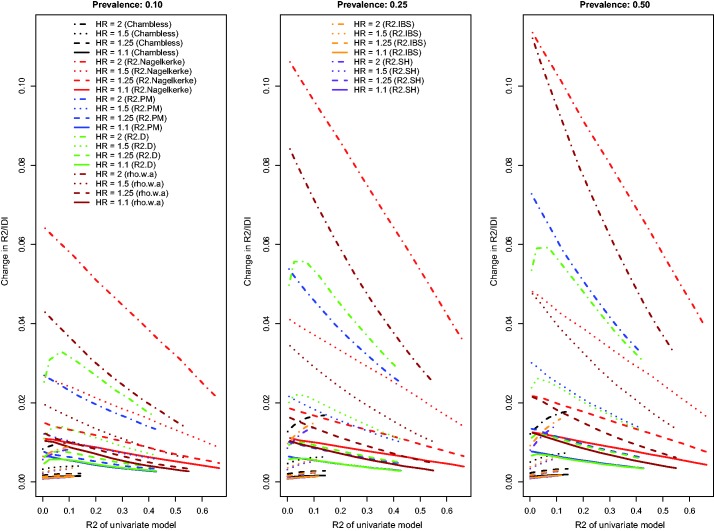
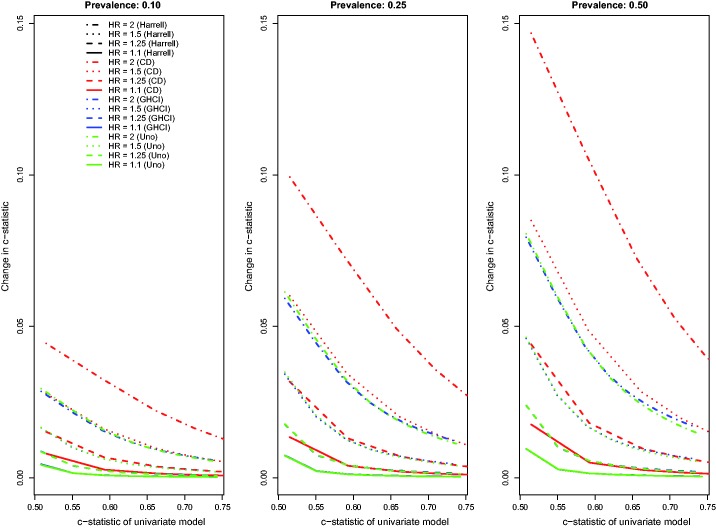
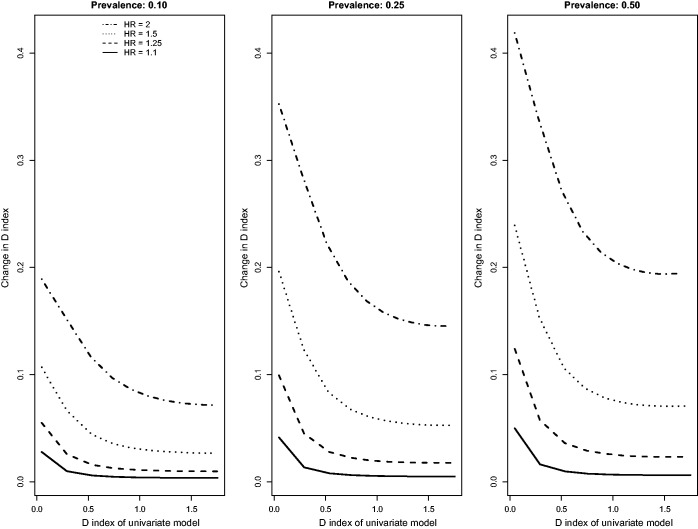
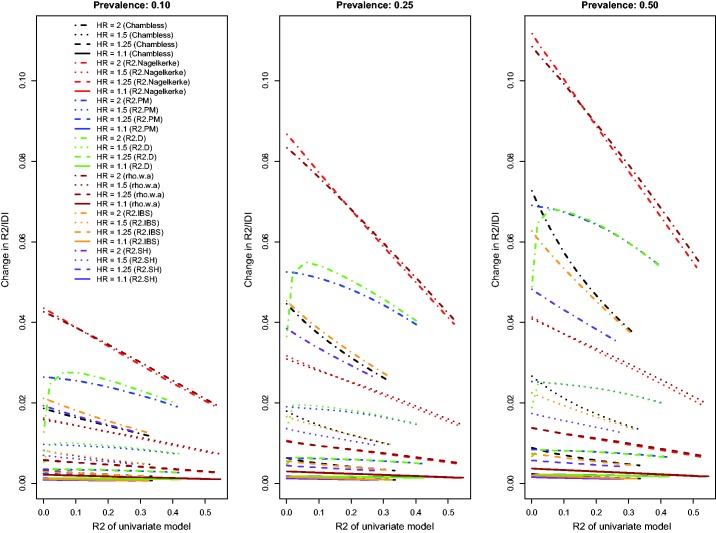
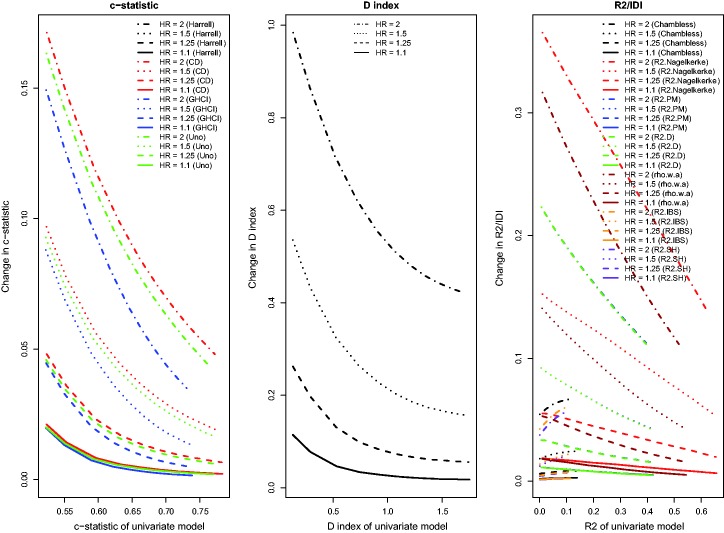
Predicting outcomes that occur over time is important in clinical, population health, and health services research. We compared changes in different measures of performance when a novel risk factor or marker was added to an existing Cox proportional hazards regression model. We performed Monte Carlo simulations for common measures of performance: concordance indices ( c, including various extensions to survival outcomes), Royston's D index, R-type measures, and Chambless' adaptation of the integrated discrimination improvement to survival outcomes. We found that the increase in performance due to the inclusion of a risk factor tended to decrease as the performance of the reference model increased. Moreover, the increase in performance increased as the hazard ratio or the prevalence of a binary risk factor increased. Finally, for the concordance indices and R-type measures, the absolute increase in predictive accuracy due to the inclusion of a risk factor was greater when the observed event rate was higher (low censoring). Amongst the different concordance indices, Chambless and Diao's c-statistic exhibited the greatest increase in predictive accuracy when a novel risk factor was added to an existing model. Amongst the different R-type measures, O'Quigley et al.'s modification of Nagelkerke's R index and Kent and O'Quigley's [Formula: see text] displayed the greatest sensitivity to the addition of a novel risk factor or marker. These methods were then applied to a cohort of 8635 patients hospitalized with heart failure to examine the added benefit of a point-based scoring system for predicting mortality after initial adjustment with patient age alone.
在临床、人群健康和卫生服务研究中,预测随时间发生的结果非常重要。我们比较了将新的风险因素或标志物添加到现有的Cox比例风险回归模型时,不同性能指标的变化。我们对常见的性能指标进行了蒙特卡洛模拟:一致性指数(c,包括生存结果的各种扩展)、罗伊斯顿D指数、R型指标以及钱布利斯对生存结果综合判别改善的改编。我们发现,随着参考模型性能的提高,由于纳入风险因素导致的性能提升趋于下降。此外,随着风险比或二元风险因素患病率的增加,性能提升也会增加。最后,对于一致性指数和R型指标,当观察到的事件发生率较高(低删失)时,由于纳入风险因素导致的预测准确性的绝对增加更大。在不同的一致性指数中,当将新的风险因素添加到现有模型中时,钱布利斯和刁的c统计量在预测准确性方面表现出最大的提高。在不同的R型指标中,奥奎利等人对纳格尔克R指数的修改以及肯特和奥奎利的[公式:见原文]对添加新的风险因素或标志物表现出最大的敏感性。然后,这些方法被应用于8635名因心力衰竭住院的患者队列,以检验仅根据患者年龄进行初始调整后,基于点数的评分系统对预测死亡率的额外益处。