Ye Jun-Song, Su Xiao-San, Stoltz J-F, de Isla N, Zhang Lei
BRC, First Hospital of Kun Ming, Kun Ming, 650011, China; Lorraine University and CNRS UMR 7365, Medical College, Vandoeuvre-lès-Nancy, 54500, France.
Cell Prolif. 2015 Apr;48(2):157-65. doi: 10.1111/cpr.12165. Epub 2015 Feb 6.
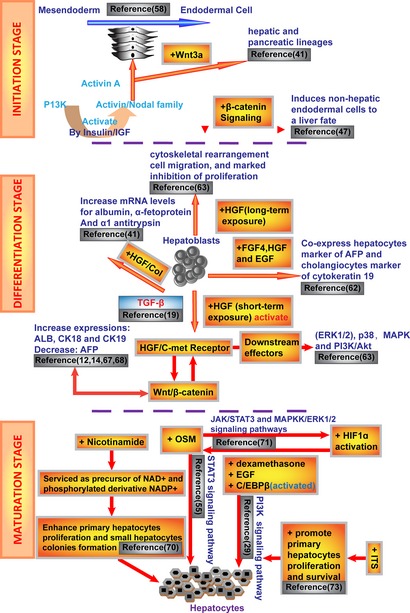
End-stage liver disease can be the termination of acute or chronic liver diseases, with manifestations of liver failure; transplantation is currently an effective treatment for these. However, transplantation is severely limited due to the serious lack of donors, expense, graft rejection and requirement of long-term immunosuppression. Mesenchymal stem cells (MSCs) have attracted considerable attention as therapeutic tools as they can be obtained with relative ease and expanded in culture, along with features of self-renewal and multidirectional differentiation. Many scientific groups have sought to use MSCs differentiating into functional hepatocytes to be used in cell transplantation with liver tissue engineering to repair diseased organs. In most of the literature, hepatocyte differentiation refers to use of various additional growth factors and cytokines, such as hepatocyte growth factor (HGF), fibroblast growth factor (FGF), epidermal growth factor (EGF), oncostatin M (OSM) and more, and most are involved in signalling pathway regulation and cell-cell/cell-matrix interactions. Signalling pathways have been shown to play critical roles in embryonic development, tumourigenesis, tumour progression, apoptosis and cell-fate determination. However, mechanisms of MSCs differentiating into hepatocytes, particularly signalling pathways involved, have not as yet been completely illustrated. In this review, we have focused on progress of signalling pathways associated with mesenchymal stem cells differentiating into hepatocytes along with the stepwise differentiation procedure.
终末期肝病可能是急性或慢性肝病的终末阶段,表现为肝功能衰竭;目前,肝移植是治疗此类疾病的有效方法。然而,由于供体严重短缺、费用高昂、移植物排斥反应以及需要长期免疫抑制,肝移植受到严重限制。间充质干细胞(MSCs)作为治疗工具已引起广泛关注,因为它们相对容易获取且可在培养中扩增,同时具有自我更新和多向分化的特性。许多科研团队试图将分化为功能性肝细胞的间充质干细胞用于细胞移植及肝脏组织工程,以修复患病器官。在大多数文献中,肝细胞分化是指使用各种额外的生长因子和细胞因子,如肝细胞生长因子(HGF)、成纤维细胞生长因子(FGF)、表皮生长因子(EGF)、制瘤素M(OSM)等,且大多数涉及信号通路调节以及细胞 - 细胞/细胞 - 基质相互作用。信号通路已被证明在胚胎发育、肿瘤发生、肿瘤进展、细胞凋亡和细胞命运决定中起关键作用。然而,间充质干细胞向肝细胞分化的机制,尤其是所涉及的信号通路,尚未完全阐明。在本综述中,我们重点关注了与间充质干细胞向肝细胞分化相关的信号通路进展以及逐步分化过程。