Sendlhofer Gerald, Mosbacher Nina, Karina Leitgeb, Kober Brigitte, Jantscher Lydia, Berghold Andrea, Pregartner Gudrun, Brunner Gernot, Kamolz Lars Peter
Executive Department for Quality and Risk Management, University Hospital Graz, Graz, Austria; Division of Plastic, Aesthetic and Reconstructive Surgery, Department of Surgery, Medical University Graz, Graz, Austria.
Division of Plastic, Aesthetic and Reconstructive Surgery, Department of Surgery, Medical University Graz, Graz, Austria.
PLoS One. 2015 Feb 6;10(2):e0116926. doi: 10.1371/journal.pone.0116926. eCollection 2015.
A surgical safety checklist (SSC) was implemented and routinely evaluated within our hospital. The purpose of this study was to analyze compliance, knowledge of and satisfaction with the SSC to determine further improvements.
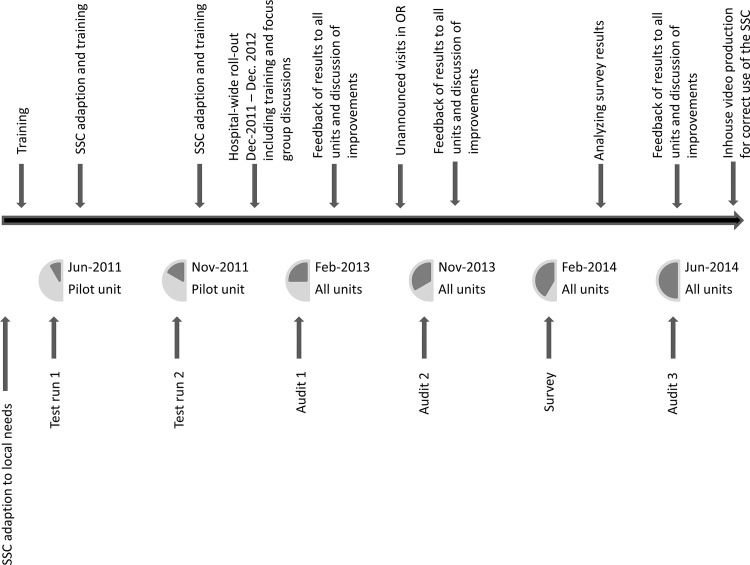
The implementation of the SSC was observed in a pilot unit. After roll-out into each operating theater, compliance with the SSC was routinely measured. To assess subjective and objective knowledge, as well as satisfaction with the SSC implementation, an online survey (N = 891) was performed.
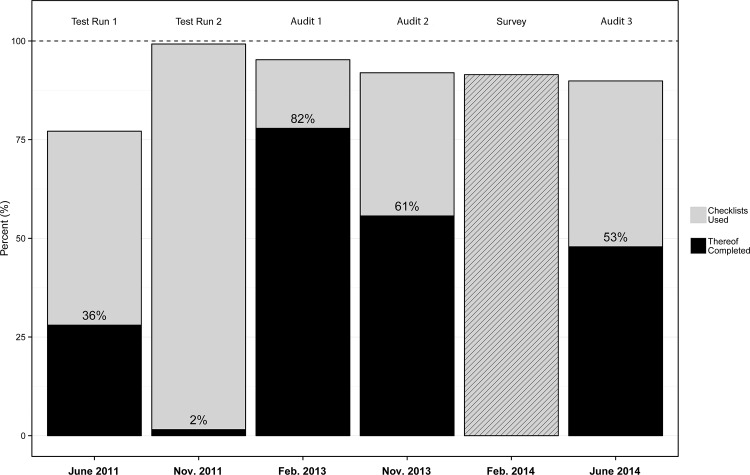
During two test runs in a piloting unit, 305 operations were observed, 175 in test run 1 and 130 in test run 2. The SSC was used in 77.1% of all operations in test run 1 and in 99.2% in test run 2. Within used SSCs, completion rates were 36.3% in test run 1 and 1.6% in test run 2. After roll-out, three unannounced audits took place and showed that the SSC was used in 95.3%, 91.9% and 89.9%. Within used SSCs, completion rates decreased from 81.7% to 60.6% and 53.2%. In 2014, 164 (18.4%) operating team members responded to the online survey, 160 of which were included in the analysis. 146 (91.3%) consultants and nursing staff reported to use the SSC regularly in daily routine.
These data show that the implementation of new tools such as the adapted WHO SSC needs constant supervision and instruction until it becomes self-evident and accepted. Further efforts, consisting mainly of hands-on leadership and training are necessary.
我院实施了手术安全核对表(SSC)并进行定期评估。本研究旨在分析对SSC的依从性、认知度和满意度,以确定进一步改进的方向。
在一个试点科室观察SSC的实施情况。在推广至每个手术室后,定期测量对SSC的依从性。为评估主观和客观知识以及对SSC实施的满意度,开展了一项在线调查(N = 891)。
在试点科室的两次试运行期间,共观察了305例手术,第一次试运行175例,第二次试运行130例。第一次试运行中,77.1%的手术使用了SSC,第二次试运行中这一比例为99.2%。在使用的SSC中,第一次试运行的完成率为36.3%,第二次试运行为1.6%。推广后,进行了三次不预先通知的审核,结果显示SSC的使用率分别为95.3%、91.9%和89.9%。在使用的SSC中,完成率从81.7%降至60.6%和53.2%。2014年,164名(18.4%)手术团队成员回复了在线调查,其中160人纳入分析。146名(9