Kim Sang-Hun, Li Mei, Pyeon Tae-Hee, So Keum-Young, Kwak Sang-Hyun
Department of Anesthesiology and Pain Meidicne, Chosun University Medical School, Gwangju, Korea.
Department of Anesthesiology, Zhejiang University School of Medicine, Hangzhou, China.
Korean J Anesthesiol. 2015 Feb;68(1):62-9. doi: 10.4097/kjae.2015.68.1.62. Epub 2015 Jan 28.
Ventilator-induced lung injury (VILI) sustained during mechanical ventilator support is still a cause of a high rate of morbidity and mortality in intensive care units and in operating rooms. VILI is characterized by pulmonary inflammation that appears to be mediated by proinflammatory cytokines. This study investigates whether the volatile anesthetic sevoflurane has an anti-inflammatory effect that attenuates VILI.
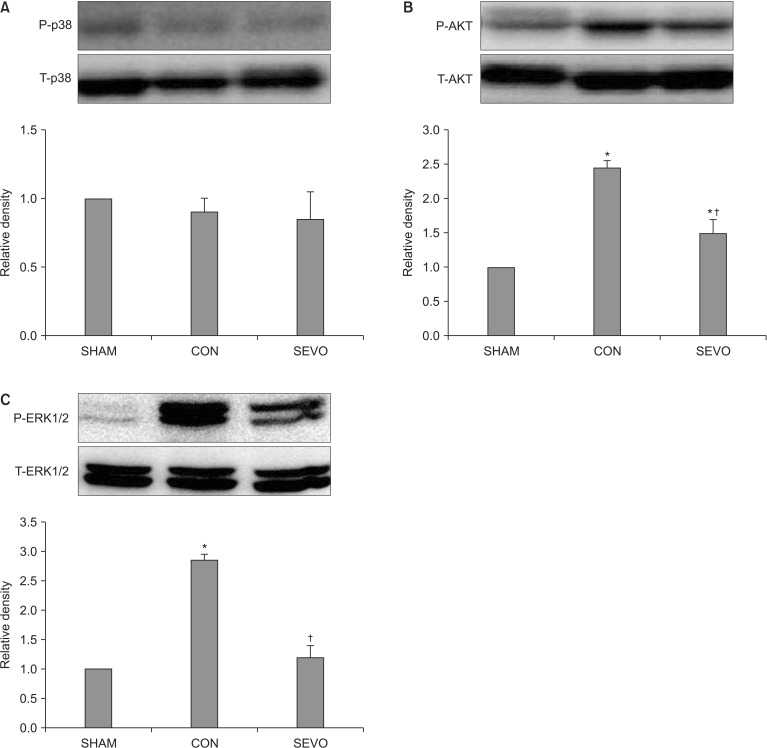
Twenty one male rabbits were anesthetized and were mechanically ventilated with 50% oxygen at a peak inspiratory pressure (PIP) of 10 cmH2O, I : E ratio of 1 : 4, and positive end expiratory pressure of 5 cmH2O. All animals were randomly assigned to one of three groups that were ventilated for 5 h with 10 cmH2O of PIP (Sham group, n = 7); 30 cmH2O of PIP (Control group, n = 7); or 30 cmH2O of PIP and 0.8 vol% sevoflurane (Sevoflurane group, n = 7). The wet/dry weight (W/D) ratio and histopathology of the lung; concentration of interleukin-8 (IL-8) in the bronchoalveolar lavage fluid; and activation of extracellular signal-regulated kinases (ERK) 1/2, p38 mitogen-activated protein kinase, and Akt were measured in the lung tissue after completing the protocol.
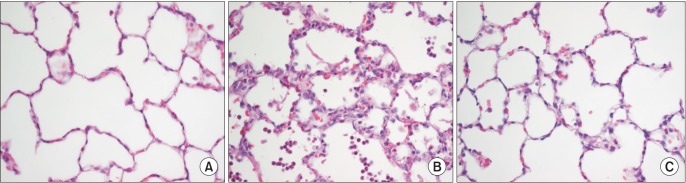
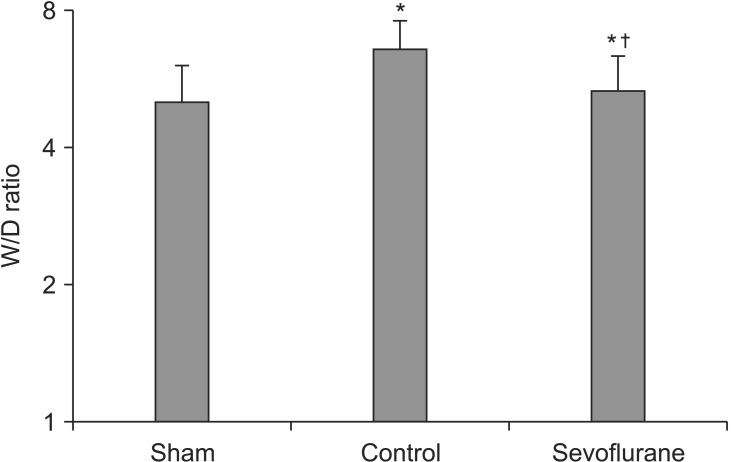
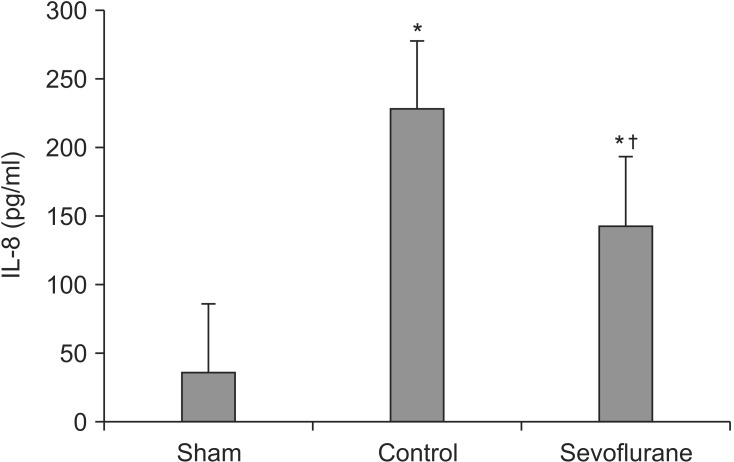
Histopathology indicated that the sevoflurane group showed fewer inflammatory cells and architectural changes than the control group did. The W/D ratio [(5.36 ± 0.13) versus (6.61 ± 0.20)], expression of IL-8 [(144.08 ± 14.61) versus (228.56 ± 15.13) pg/ml] and phosphorylation of ERK1/2 and Akt decreased significantly in the sevoflurane group relative to the control group.
Sevoflurane attenuates VILI in rabbits mainly by inhibiting expression of IL-8, and Sevoflurane-induced inhibition of phosphorylated ERK1/2 and Akt might be a possible pathway for protection.
在重症监护病房和手术室中,机械通气支持期间发生的呼吸机诱导性肺损伤(VILI)仍是导致高发病率和死亡率的原因。VILI的特征是肺部炎症,这种炎症似乎由促炎细胞因子介导。本研究调查挥发性麻醉药七氟醚是否具有减轻VILI的抗炎作用。
21只雄性兔麻醉后,以10 cmH₂O的吸气峰压(PIP)、1 : 4的吸呼比(I : E)和5 cmH₂O的呼气末正压,用50%氧气进行机械通气。所有动物随机分为三组之一,分别以10 cmH₂O的PIP通气5小时(假手术组,n = 7);30 cmH₂O的PIP通气(对照组,n = 7);或30 cmH₂O的PIP加0.8 vol%七氟醚通气(七氟醚组,n = 7)。实验结束后,测定肺组织的湿/干重(W/D)比值和组织病理学;支气管肺泡灌洗液中白细胞介素-8(IL-8)的浓度;以及肺组织中细胞外信号调节激酶(ERK)1/2、p38丝裂原活化蛋白激酶和Akt的活性。
组织病理学显示,七氟醚组的炎症细胞和结构改变比对照组少。与对照组相比,七氟醚组的W/D比值[(5.36 ± 0.13)对(6.61 ± 0.20)]、IL-8表达[(144.08 ± 14.61)对(228.56 ± 15.13)pg/ml]以及ERK1/2和Akt的磷酸化显著降低。
七氟醚主要通过抑制IL-8的表达减轻兔的VILI,七氟醚诱导的对磷酸化ERK1/2和Akt的抑制可能是一种保护途径。