Department of Computer Engineering, Faculty of Engineering and Natural Sciences, Uskudar University, Istanbul, Turkey.
Department of Bioengineering, Faculty of Engineering and Natural Sciences, Uskudar University, Istanbul, Turkey.
Psychiatry Investig. 2015 Jan;12(1):61-5. doi: 10.4306/pi.2015.12.1.61. Epub 2015 Jan 12.
The combination of repetitive transcranial magnetic stimulation (rTMS), a non-pharmacological form of therapy for treating major depressive disorder (MDD), and electroencephalogram (EEG) is a valuable tool for investigating the functional connectivity in the brain. This study aims to explore whether pre-treating frontal quantitative EEG (QEEG) cordance is associated with response to rTMS treatment among MDD patients by using an artificial intelligence approach, artificial neural network (ANN).
The artificial neural network using pre-treatment cordance of frontal QEEG classification was carried out to identify responder or non-responder to rTMS treatment among 55 MDD subjects. The classification performance was evaluated using k-fold cross-validation.
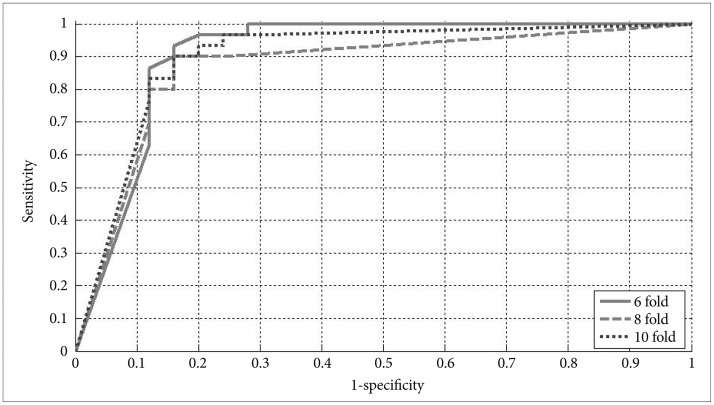
The ANN classification identified responders to rTMS treatment with a sensitivity of 93.33%, and its overall accuracy reached to 89.09%. Area under Receiver Operating Characteristic (ROC) curve (AUC) value for responder detection using 6, 8 and 10 fold cross validation were 0.917, 0.823 and 0.894 respectively.
Potential utility of ANN approach method can be used as a clinical tool in administering rTMS therapy to a targeted group of subjects suffering from MDD. This methodology is more potentially useful to the clinician as prediction is possible using EEG data collected before this treatment process is initiated. It is worth using feature selection algorithms to raise the sensitivity and accuracy values.
重复经颅磁刺激(rTMS)是一种非药物治疗形式,可用于治疗重度抑郁症(MDD),结合脑电图(EEG)是研究大脑功能连接的有价值的工具。本研究旨在通过人工智能方法——人工神经网络(ANN)来探讨 MDD 患者治疗前额叶定量脑电图(QEEG)协调性是否与 rTMS 治疗反应相关。
采用人工神经网络对 55 例 MDD 患者的治疗前额叶 QEEG 协调性进行分类,以确定 rTMS 治疗的反应者或非反应者。采用 K 折交叉验证评估分类性能。
ANN 分类可识别 rTMS 治疗的反应者,其敏感性为 93.33%,总准确性达到 89.09%。使用 6、8 和 10 倍交叉验证时,用于反应者检测的接收器操作特性(ROC)曲线下面积(AUC)值分别为 0.917、0.823 和 0.894。
ANN 方法的潜在效用可作为一种临床工具,用于对患有 MDD 的特定人群进行 rTMS 治疗。这种方法对于临床医生来说更有用,因为可以在开始治疗过程之前使用 EEG 数据进行预测。值得使用特征选择算法来提高敏感性和准确性值。