Mannino David M, Higuchi Keiko, Yu Tzy-Chyi, Zhou Huanxue, Li Yangyang, Tian Haijun, Suh Kangho
University of Kentucky College of Public Health, Lexington, KY.
Novartis Pharmaceuticals Corporation, East Hanover, NJ.
Chest. 2015 Jul;148(1):138-150. doi: 10.1378/chest.14-2434.
The morbidity and mortality associated with COPD exacts a considerable economic burden. Comorbidities in COPD are associated with poor health outcomes and increased costs. Our objective was to assess the impact of comorbidities on COPD-associated costs in a large administrative claims dataset.
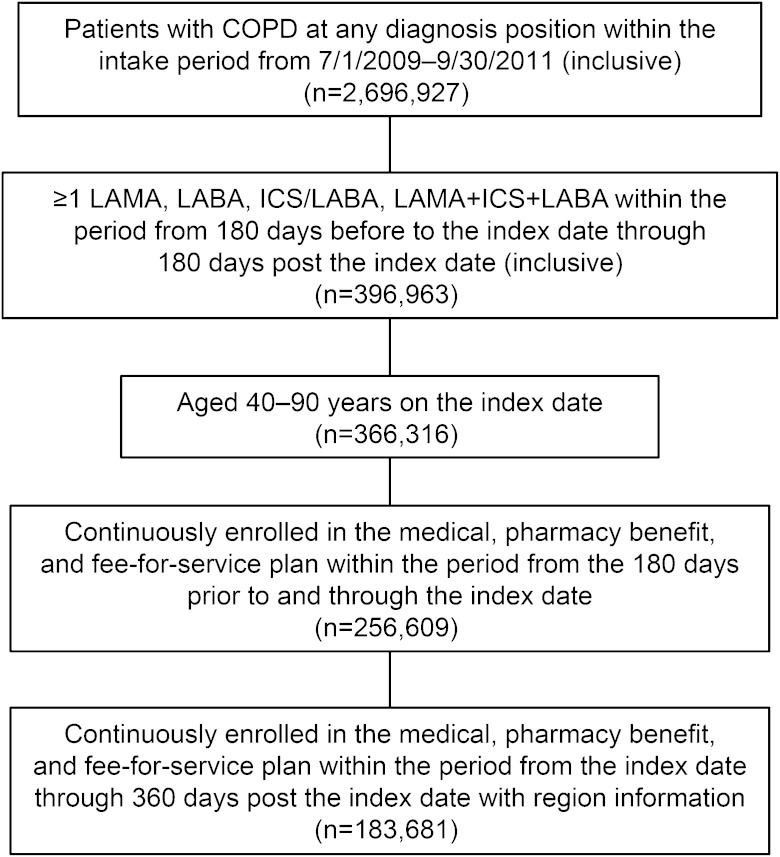
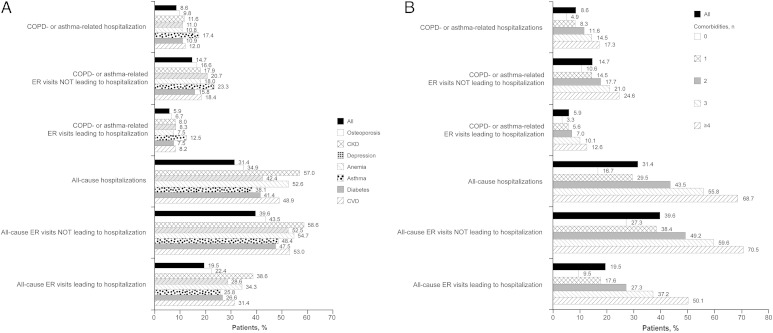
This was a retrospective observational study of data from the Truven Health MarketScan Commercial Claims and Encounters and the MarketScan Medicare Supplemental Databases from January 1, 2009, to September 30, 2012. Resource consumption was measured from the index date (date of first occurrence of non-rule-out COPD diagnosis) to 360 days after the index date. Resource use (all-cause and disease-specific [ie, COPD- or asthma-related] ED visits, hospitalizations, office visits, other outpatient visits, and total length of hospital stay) and health-care costs (all-cause and disease-specific costs for ED visits, hospitalizations, office visits, and other outpatient visits and medical, prescription, and total health-care costs) were assessed. Generalized linear models were used to evaluate the impact of comorbidities on total health-care costs, adjusting for age, sex, geographic location, baseline health-care use, employment status, and index COPD medication.
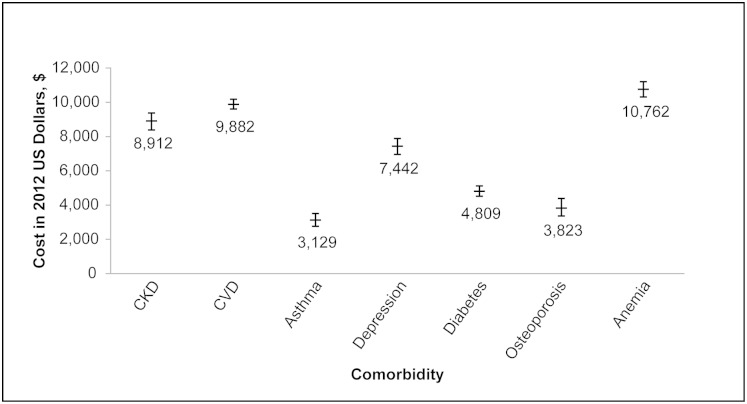
Among 183,681 patients with COPD, the most common comorbidities were cardiovascular disease (34.8%), diabetes (22.8%), asthma (14.7%), and anemia (14.2%). Most patients (52.8%) had one or two comorbidities of interest. The average all-cause total health-care costs from the index date to 360 days after the index date were highest for patients with chronic kidney disease ($41,288) and anemia ($38,870). The impact on total health-care costs was greatest for anemia ($10,762 more, on average, than a patient with COPD without anemia).
Our analysis demonstrated that high resource use and costs were associated with COPD and multiple comorbidities.
慢性阻塞性肺疾病(COPD)相关的发病率和死亡率带来了相当大的经济负担。COPD的合并症与健康状况不佳和成本增加相关。我们的目的是在一个大型行政索赔数据集中评估合并症对COPD相关成本的影响。
这是一项对2009年1月1日至2012年9月30日期间来自Truven Health MarketScan商业索赔与病历数据库以及MarketScan医疗保险补充数据库的数据进行的回顾性观察研究。从索引日期(首次出现非排除性COPD诊断的日期)到索引日期后的360天测量资源消耗。评估资源使用情况(全因和疾病特异性[即与COPD或哮喘相关的]急诊就诊、住院、门诊就诊、其他门诊就诊以及住院总时长)和医疗保健成本(急诊就诊、住院、门诊就诊和其他门诊就诊的全因和疾病特异性成本以及医疗、处方和总医疗保健成本)。使用广义线性模型评估合并症对总医疗保健成本的影响,并对年龄、性别、地理位置、基线医疗保健使用情况、就业状况和索引COPD药物进行调整。
在183,681例COPD患者中,最常见的合并症是心血管疾病(34.8%)、糖尿病(22.8%)、哮喘(14.7%)和贫血(14.2%)。大多数患者(52.8%)有一或两种感兴趣的合并症。从索引日期到索引日期后360天,慢性肾病患者的平均全因总医疗保健成本最高(41,288美元),贫血患者次之(38,870美元)。贫血对总医疗保健成本的影响最大(平均比无贫血的COPD患者多10,762美元)。
我们的分析表明,高资源使用和成本与COPD及多种合并症相关。