Mehta Supriya D, Donovan Brock, Weber Kathleen M, Cohen Mardge, Ravel Jacques, Gajer Pawel, Gilbert Douglas, Burgad Derick, Spear Greg T
Division of Epidemiology and Biostatistics, University of Illinois at Chicago, School of Public Health, Chicago, Illinois, United States of America.
Department of Bioengineering, University of Illinois at Chicago, College of Medicine, Chicago, Illinois, United States of America.
PLoS One. 2015 Feb 12;10(2):e0116894. doi: 10.1371/journal.pone.0116894. eCollection 2015.
We identified predominant vaginal microbiota communities, changes over time, and how this varied by HIV status and other factors in a cohort of 64 women.
Bacterial DNA was extracted from reposited cervicovaginal lavage samples collected annually over an 8-10 year period from Chicago Women's Interagency HIV Study participants: 22 HIV-negative, 22 HIV-positive with stable infection, 20 HIV-positive with progressive infection. The vaginal microbiota was defined by pyrosequencing of the V1/V2 region of the 16S rRNA gene. Scheduled visits included Bacterial vaginsosis (BV) screening; clinically detected cases were referred for treatment. Hierarchical clustering identified bacterial community state types (CST). Multinomial mixed effects modeling determined trends over time in CST, by HIV status and other factors.
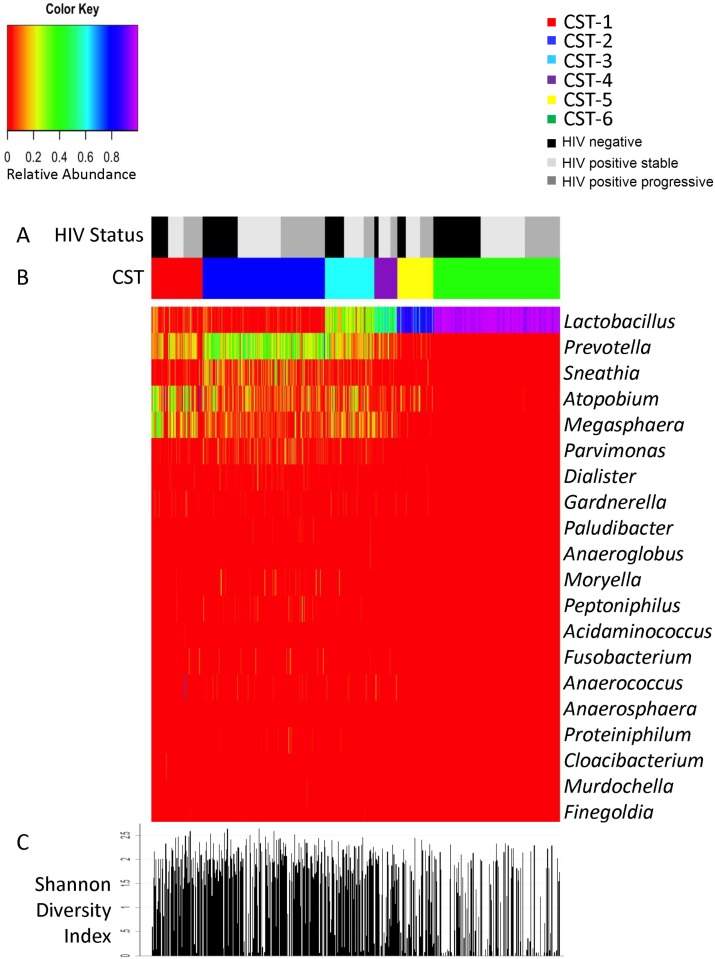
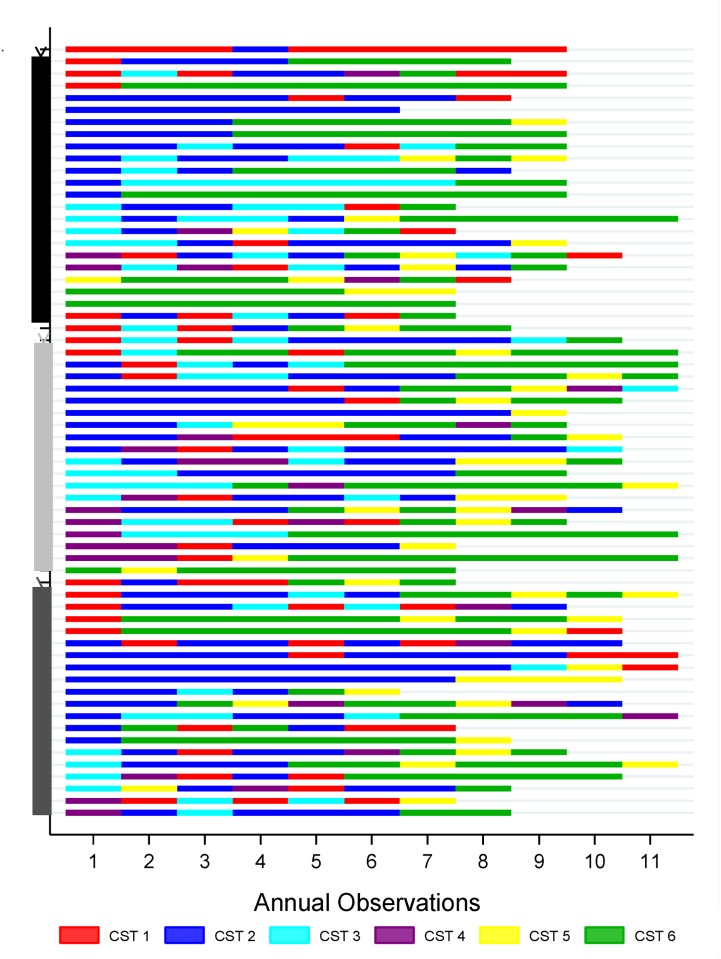
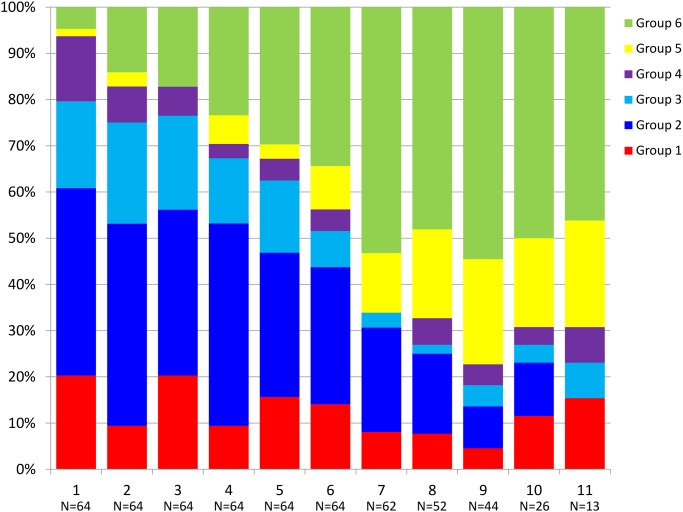
The median follow-up time was 8.1 years (range 5.5-15.3). Six CSTs were identified. The mean relative abundance (RA) of Lactobacillus spp. by CST (with median number of bacterial taxa) was: CST-1-25.7% (10), CST-2-27.1% (11), CST-3-34.6% (9), CST-4-46.8% (9), CST-5-57.9% (4), CST-6-69.4% (2). The two CSTs representing the highest RA of Lactobacillus and lowest diversity increased with each additional year of follow-up (CST-5, adjusted odds ratio (aOR) = 1.62 [95% CI: 1.34-1.94]; CST-6, aOR = 1.57 [95 CI: 1.31-1.89]), while the two CSTs representing lowest RA of Lactobacillus and higher diversity decreased with each additional year (CST-1, aOR = 0.89 [95% CI: 0.80-1.00]; CST-2, aOR = 0.86 [95% CI: 0.75-0.99]). There was no association between HIV status and CST at baseline or over time. CSTs representing lower RA of Lactobacillus were associated with current cigarette smoking.
The vaginal microbial community significantly improved over time in this cohort of women with HIV and at high risk for HIV who had regular detection and treatment referral for BV.
我们在64名女性队列中确定了主要的阴道微生物群群落、随时间的变化,以及这种变化如何因艾滋病毒感染状况和其他因素而有所不同。
从芝加哥妇女跨部门艾滋病毒研究参与者在8 - 10年期间每年收集的保存宫颈阴道灌洗样本中提取细菌DNA:22名艾滋病毒阴性者、22名艾滋病毒阳性且感染稳定者、20名艾滋病毒阳性且感染进展者。通过对16S rRNA基因V1/V2区域进行焦磷酸测序来定义阴道微生物群。定期访视包括细菌性阴道病(BV)筛查;临床检测到的病例会被转诊接受治疗。层次聚类确定细菌群落状态类型(CST)。多项混合效应模型确定了CST随时间的趋势,按艾滋病毒感染状况和其他因素分类。
中位随访时间为8.1年(范围5.5 - 15.3年)。确定了六种CST。按CST分类的乳酸杆菌属的平均相对丰度(RA)(以及细菌分类群的中位数)为:CST - 1 - 25.7%(10个),CST - 2 - 27.1%(11个),CST - 3 - 34.6%(9个),CST - 4 - 46.8%(9个),CST - 5 - 57.9%(4个),CST - 6 - 69.4%(2个)。代表乳酸杆菌属最高RA和最低多样性的两种CST随随访时间每增加一年而增加(CST - 5,调整优势比(aOR)= 1.62 [95%置信区间:1.34 - 1.94];CST - 6,aOR = 1.57 [95%置信区间:1.31 - 1.89]),而代表乳酸杆菌属最低RA和较高多样性的两种CST随随访时间每增加一年而减少(CST - 1,aOR = 0.89 [95%置信区间:0.80 - 1.00];CST - 2,aOR = 0.86 [95%置信区间:0.75 - 0.99])。在基线或随访期间,艾滋病毒感染状况与CST之间没有关联。代表乳酸杆菌属较低RA的CST与当前吸烟有关。
在这个有艾滋病毒感染且有感染艾滋病毒高风险的女性队列中,她们定期接受BV检测和转诊治疗,阴道微生物群落随时间显著改善。