Zhou Tie, Zhang Wei, Chen Qi, Li Lei, Cao Huan, Xu Chuan-Liang, Chen Guang-Hua, Sun Ying-Hao
Department of Urology, Changhai Hospital, The Second Military Medical University, Shanghai 200433, China.
Asian J Androl. 2015 Nov-Dec;17(6):1012-6. doi: 10.4103/1008-682X.148075.
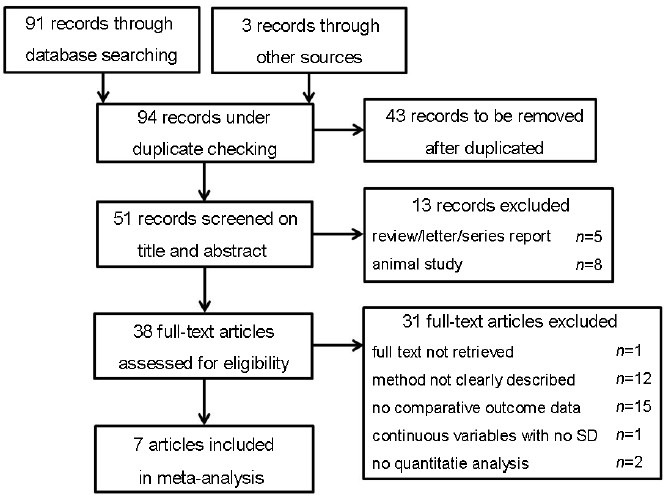
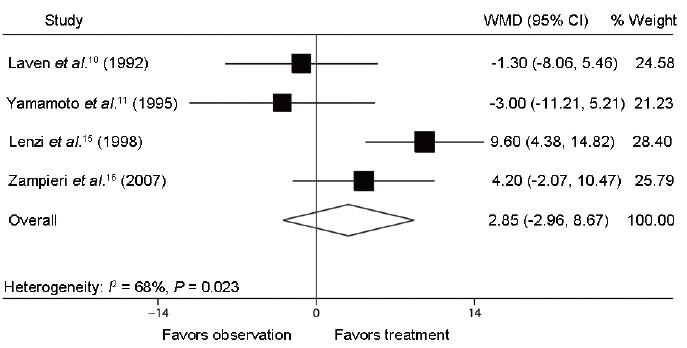
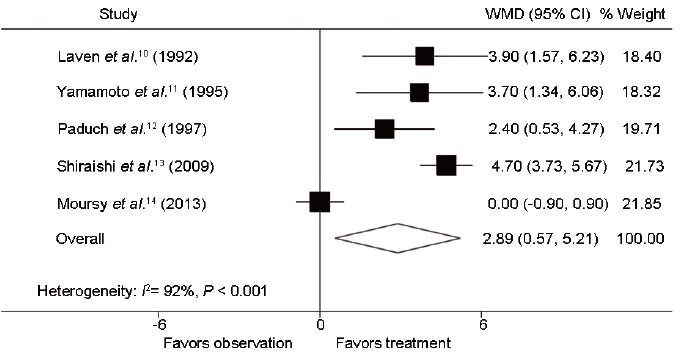
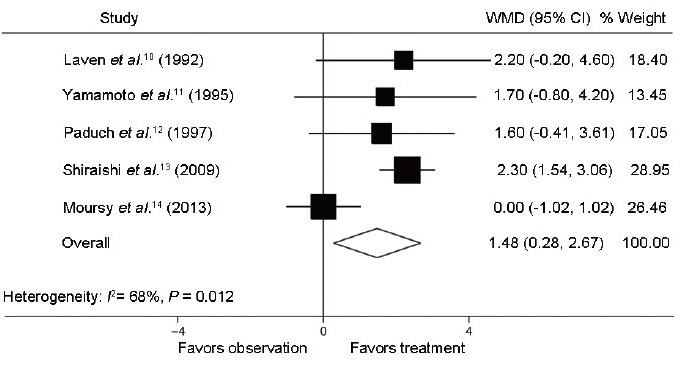
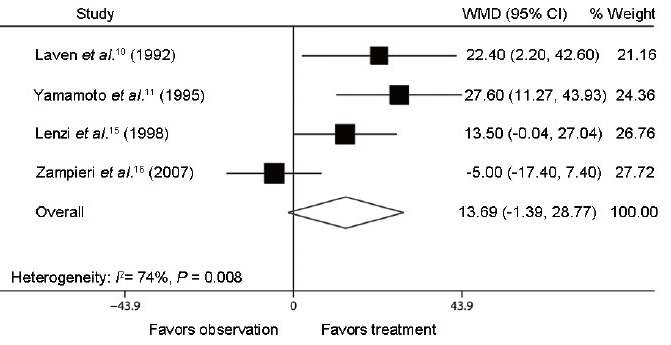
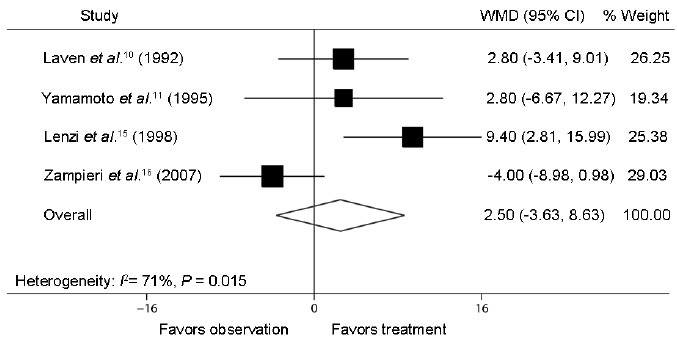
Varicocele repair in adolescent remains controversial. Our aim is to identify and combine clinical trials results published thus far to ascertain the efficacy of varicocelectomy in improving testis volume and semen parameters compared with nontreatment control. A literature search was performed using Medline, Embase and Web of Science, which included results obtained from meta-analysis, randomized and nonrandomized controlled studies. The study population was adolescents with clinically palpable varicocele with or without the testicular asymmetry or abnormal semen parameters. Cases were allocated to treatment and observation groups, and testis volume or semen parameters were adopted as outcome measures. As a result, seven randomized controlled trials (RCTs) and nonrandomized controlled trials studying bilateral testis volume or semen parameters in both treatment and observation groups were identified. Using a random effect model, mean difference of testis volume between the treatment group and the observation group was 2.9 ml (95% confidence interval [CI]: 0.6, 5.2; P< 0.05) for the varicocele side and 1.5 ml (95% CI: 0.3, 2.7; P< 0.05) for the healthy side. The random effect model analysis demonstrated that the mean difference of semen concentration, total semen motility, and normal morphology between the two groups was 13.7 × 10 6 ml-1 (95% CI: -1.4, 28.8; P = 0.075), 2.5% (95% CI: -3.6, 8.6; P= 0.424), and 2.9% (95% CI: -3.0, 8.7; P= 0.336) respectively. In conclusion, although varicocelectomy significantly improved bilateral testis volume in adolescents with varicocele compared with observation cases, semen parameters did not have any statistically significant difference between two groups. Well-planned, properly conducted RCTs are needed in order to confirm the above-mentioned conclusion further and to explore whether varicocele repair in adolescents could improve subsequently spontaneous pregnancy rates.
青少年精索静脉曲张修复术仍存在争议。我们的目的是识别并汇总迄今已发表的临床试验结果,以确定与未治疗的对照组相比,精索静脉结扎术在改善睾丸体积和精液参数方面的疗效。使用Medline、Embase和Web of Science进行文献检索,其中包括从荟萃分析、随机和非随机对照研究中获得的结果。研究人群为临床上可触及精索静脉曲张的青少年,伴有或不伴有睾丸不对称或精液参数异常。将病例分为治疗组和观察组,并采用睾丸体积或精液参数作为观察指标。结果,共识别出7项研究治疗组和观察组双侧睾丸体积或精液参数的随机对照试验(RCT)和非随机对照试验。采用随机效应模型,精索静脉曲张侧治疗组与观察组睾丸体积的平均差异为2.9ml(95%置信区间[CI]:0.6,5.2;P<0.05),健康侧为1.5ml(95%CI:0.3,2.7;P<0.05)。随机效应模型分析表明,两组间精液浓度、精液总活力和正常形态的平均差异分别为13.7×10⁶/ml(95%CI:-1.4,28.8;P = 0.075)、2.5%(95%CI:-3.6,8.6;P = 0.424)和2.9%(95%CI:-3.0,8.7;P = 0.336)。总之,与观察组相比,精索静脉结扎术虽显著改善了青少年精索静脉曲张患者的双侧睾丸体积,但两组间精液参数无统计学显著差异。需要精心设计、妥善实施的随机对照试验,以进一步证实上述结论,并探索青少年精索静脉曲张修复术是否能提高随后的自然妊娠率。