Hamilton Jessica L, Kleiman Evan M, Rubenstein Liza M, Stange Jonathan P, Flynn Megan, Abramson Lyn Y, Alloy Lauren B
Department of Psychology, Temple University, 1701 N. 13th St., Philadelphia, PA, 19122, USA.
Department of Psychology, Harvard University, William James Hall, 33 Kirkland Street, Cambridge, MA, USA.
J Youth Adolesc. 2016 Jan;45(1):183-94. doi: 10.1007/s10964-015-0260-x. Epub 2015 Feb 14.
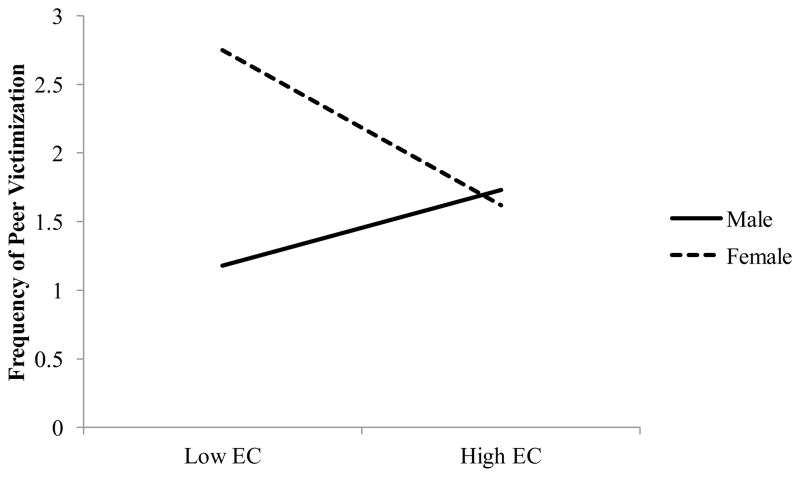
Peer victimization is a significant risk factor for a range of negative outcomes during adolescence, including depression and anxiety. Recent research has evaluated individual characteristics that heighten the risk of experiencing peer victimization. However, the role of emotional clarity, or the ability to understand one's emotions, in being the target of peer victimization remains unclear. Thus, the present study evaluated whether deficits in emotional clarity increased the risk of experiencing peer victimization, particularly among adolescent girls, which, in turn, contributed to prospective levels of depressive and anxiety symptoms. In the present study, 355 early adolescents (ages 12-13; 53% female; 51% African American) who were part of the Adolescent Cognition and Emotion project completed measures of emotional clarity, depressive symptoms, and anxiety symptoms at baseline, and measures of peer victimization, depressive symptoms, and anxiety symptoms at follow-up. Moderation analyses indicated that deficits in emotional clarity predicted greater peer victimization among adolescent girls, but not adolescent boys. Moderated mediation analyses revealed that deficits in emotional clarity contributed to relational peer victimization, which, in turn, predicted prospective levels of depressive and anxiety symptoms among adolescent girls, but not boys. These findings indicate that deficits in emotional clarity represent a significant risk factor for adolescent girls to experience relational peer victimization, which, in turn, contributed to prospective levels of internalizing symptoms. Thus, prevention programs should target deficits in emotional clarity to prevent peer victimization and subsequent internalizing symptoms among adolescent girls.
同伴侵害是青少年时期一系列负面结果的重要风险因素,包括抑郁和焦虑。最近的研究评估了增加遭受同伴侵害风险的个体特征。然而,情绪清晰度,即理解自身情绪的能力,在成为同伴侵害目标方面所起的作用仍不明确。因此,本研究评估了情绪清晰度的缺陷是否会增加遭受同伴侵害的风险,尤其是在青少年女孩中,而这反过来又会导致抑郁和焦虑症状的预期水平。在本研究中,作为青少年认知与情感项目一部分的355名青少年早期参与者(年龄在12 - 13岁;53%为女性;51%为非裔美国人)在基线时完成了情绪清晰度、抑郁症状和焦虑症状的测量,在随访时完成了同伴侵害、抑郁症状和焦虑症状的测量。调节分析表明,情绪清晰度的缺陷预示着青少年女孩中会有更多的同伴侵害,但在青少年男孩中并非如此。调节中介分析显示,情绪清晰度的缺陷导致了关系型同伴侵害,而这反过来又预示着青少年女孩而非男孩的抑郁和焦虑症状的预期水平。这些发现表明,情绪清晰度的缺陷是青少年女孩经历关系型同伴侵害的一个重要风险因素,而这反过来又导致了内化症状的预期水平。因此,预防项目应针对情绪清晰度的缺陷,以防止青少年女孩遭受同伴侵害及随后出现内化症状。