Li Jie, Nakayasu Ernesto S, Overall Christopher C, Johnson Rudd C, Kidwai Afshan S, McDermott Jason E, Ansong Charles, Heffron Fred, Cambronne Eric D, Adkins Joshua N
J Proteome Res. 2015 Apr 3;14(4):1716-26. doi: 10.1021/pr5010423. Epub 2015 Feb 27.
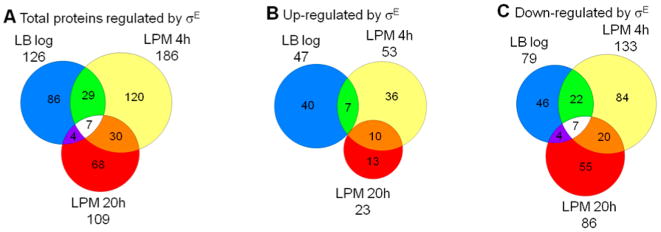
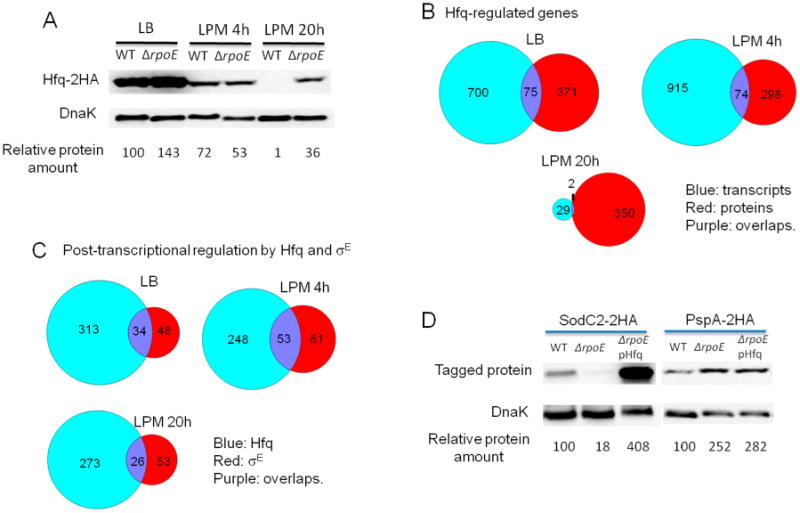
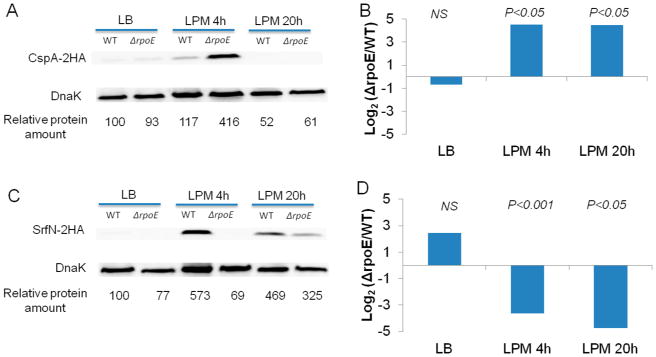
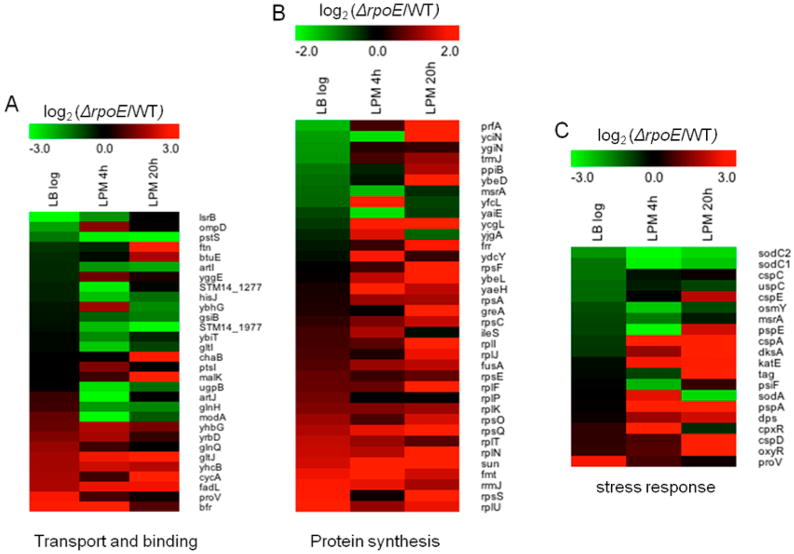
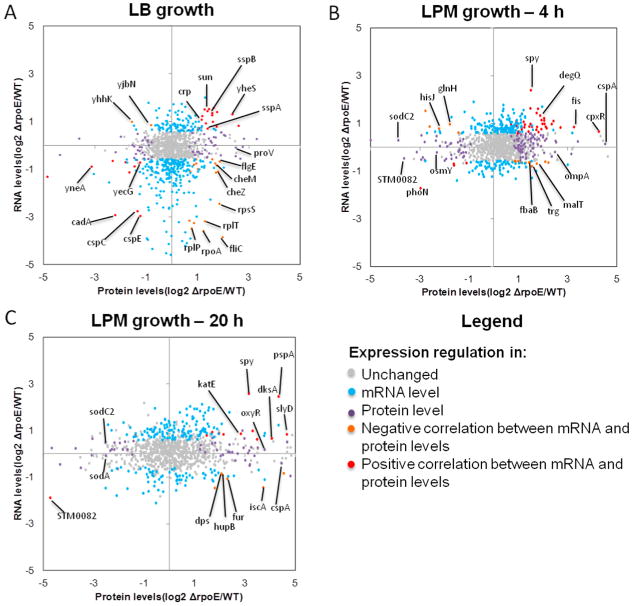
The alternative sigma factor E (σ(E)) is critical for response to extracytoplasmic stress in Salmonella. Extensive studies have been conducted on σ(E)-regulated gene expression, particularly at the transcriptional level. Increasing evidence suggests however that σ(E) may indirectly participate in post-transcriptional regulation. In this study, we conducted sample-matched global proteomic and transcriptomic analyses to determine the level of regulation mediated by σ(E) in Salmonella. Samples were analyzed from wild-type and isogenic rpoE mutant Salmonella cultivated in three different conditions: nutrient-rich and conditions that mimic early and late intracellular infection. We found that 30% of the observed proteome was regulated by σ(E) combining all three conditions. In different growth conditions, σ(E) affected the expression of a broad spectrum of Salmonella proteins required for miscellaneous functions. Those involved in transport and binding, protein synthesis, and stress response were particularly highlighted. By comparing transcriptomic and proteomic data, we identified genes post-transcriptionally regulated by σ(E) and found that post-transcriptional regulation was responsible for a majority of changes observed in the σ(E)-regulated proteome. Further, comparison of transcriptomic and proteomic data from hfq mutant of Salmonella demonstrated that σ(E)-mediated post-transcriptional regulation was partially dependent on the RNA-binding protein Hfq.
替代西格玛因子E(σ(E))对于沙门氏菌应对胞外应激至关重要。针对σ(E)调控的基因表达,尤其是转录水平的表达,已经开展了广泛研究。然而,越来越多的证据表明,σ(E)可能间接参与转录后调控。在本研究中,我们进行了样本匹配的全局蛋白质组学和转录组学分析,以确定σ(E)在沙门氏菌中介导的调控水平。分析了在三种不同条件下培养的野生型和同基因rpoE突变型沙门氏菌的样本:营养丰富的条件以及模拟早期和晚期细胞内感染的条件。我们发现,综合所有三种条件,观察到的蛋白质组中有30%受σ(E)调控。在不同生长条件下,σ(E)影响了多种功能所需的广泛沙门氏菌蛋白质的表达。那些参与转运和结合、蛋白质合成以及应激反应的蛋白质尤其受到关注。通过比较转录组学和蛋白质组学数据,我们鉴定出受σ(E)转录后调控的基因,并发现转录后调控是σ(E)调控的蛋白质组中观察到的大多数变化的原因。此外,对沙门氏菌hfq突变体的转录组学和蛋白质组学数据的比较表明,σ(E)介导的转录后调控部分依赖于RNA结合蛋白Hfq。