McDermott Jason E, Yoon Hyunjin, Nakayasu Ernesto S, Metz Thomas O, Hyduke Daniel R, Kidwai Afshan S, Palsson Bernhard O, Adkins Joshua N, Heffron Fred
Computational Biology and Bioinformatics Group, Pacific Northwest National Laboratory Richland, WA, USA.
Front Microbiol. 2011 Jun 2;2:121. doi: 10.3389/fmicb.2011.00121. eCollection 2011.
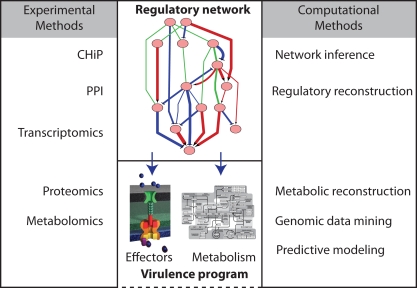
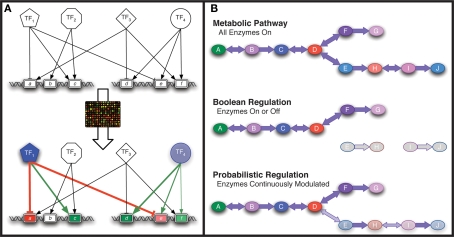
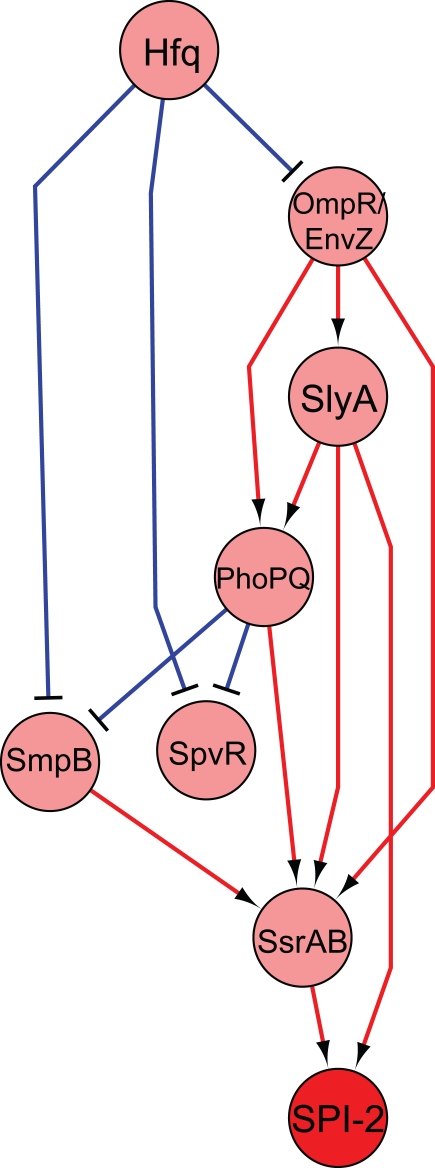
Salmonella is a primary cause of enteric diseases in a variety of animals. During its evolution into a pathogenic bacterium, Salmonella acquired an elaborate regulatory network that responds to multiple environmental stimuli within host animals and integrates them resulting in fine regulation of the virulence program. The coordinated action by this regulatory network involves numerous virulence regulators, necessitating genome-wide profiling analysis to assess and combine efforts from multiple regulons. In this review we discuss recent high-throughput analytic approaches used to understand the regulatory network of Salmonella that controls virulence processes. Application of high-throughput analyses have generated large amounts of data and necessitated the development of computational approaches for data integration. Therefore, we also cover computer-aided network analyses to infer regulatory networks, and demonstrate how genome-scale data can be used to construct regulatory and metabolic systems models of Salmonella pathogenesis. Genes that are coordinately controlled by multiple virulence regulators under infectious conditions are more likely to be important for pathogenesis. Thus, reconstructing the global regulatory network during infection or, at the very least, under conditions that mimic the host cellular environment not only provides a bird's eye view of Salmonella survival strategy in response to hostile host environments but also serves as an efficient means to identify novel virulence factors that are essential for Salmonella to accomplish systemic infection in the host.
沙门氏菌是多种动物肠道疾病的主要病因。在进化为病原菌的过程中,沙门氏菌获得了一个复杂的调控网络,该网络能对宿主动物体内的多种环境刺激做出反应,并将这些刺激整合起来,从而对毒力程序进行精细调控。这个调控网络的协同作用涉及众多毒力调节因子,因此需要进行全基因组分析,以评估多个调控子的作用并将它们的作用结合起来。在这篇综述中,我们讨论了最近用于了解控制沙门氏菌毒力过程的调控网络的高通量分析方法。高通量分析的应用产生了大量数据,因此需要开发用于数据整合的计算方法。因此,我们还介绍了用于推断调控网络的计算机辅助网络分析,并展示了如何利用基因组规模的数据构建沙门氏菌致病机制的调控和代谢系统模型。在感染条件下受多种毒力调节因子协同控制的基因对致病机制更可能具有重要意义。因此,重建感染期间或至少在模拟宿主细胞环境的条件下的全局调控网络,不仅能让我们全面了解沙门氏菌在应对恶劣宿主环境时的生存策略,还能作为一种有效的手段来识别新型毒力因子,这些因子对于沙门氏菌在宿主体内实现全身感染至关重要。