Martin Jason A, Ramsay Jill, Hughes Christopher, Peters Derek M, Edwards Martin G
Functional Neuroimaging Group, Department of Radiology, University Hospital Bonn, Sigmund-Freud Str. 25, 53127, Bonn, Germany; Division of Neuropsychology, Hertie-Institute for Clinical Brain Research, Centre for Integrative Neuroscience, Eberhard Karls University, Hoppe-Seyler-Str. 3, 72076, Tübingen, Germany.
School of Health and Population Sciences, University of Birmingham, Birmingham, United Kingdom.
PLoS One. 2015 Feb 17;10(2):e0117598. doi: 10.1371/journal.pone.0117598. eCollection 2015.
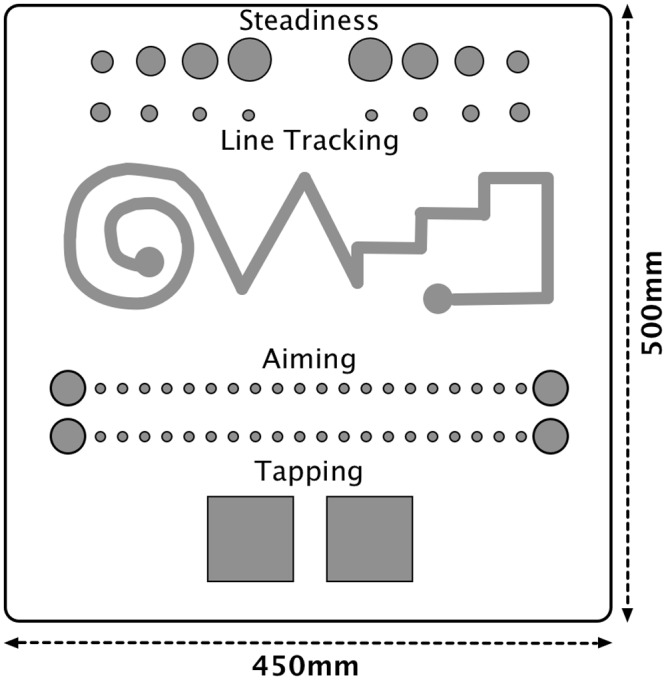
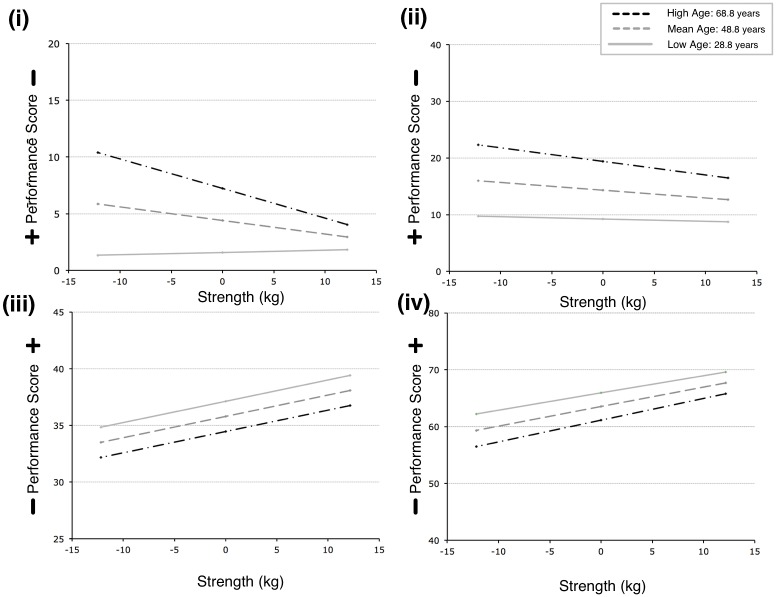
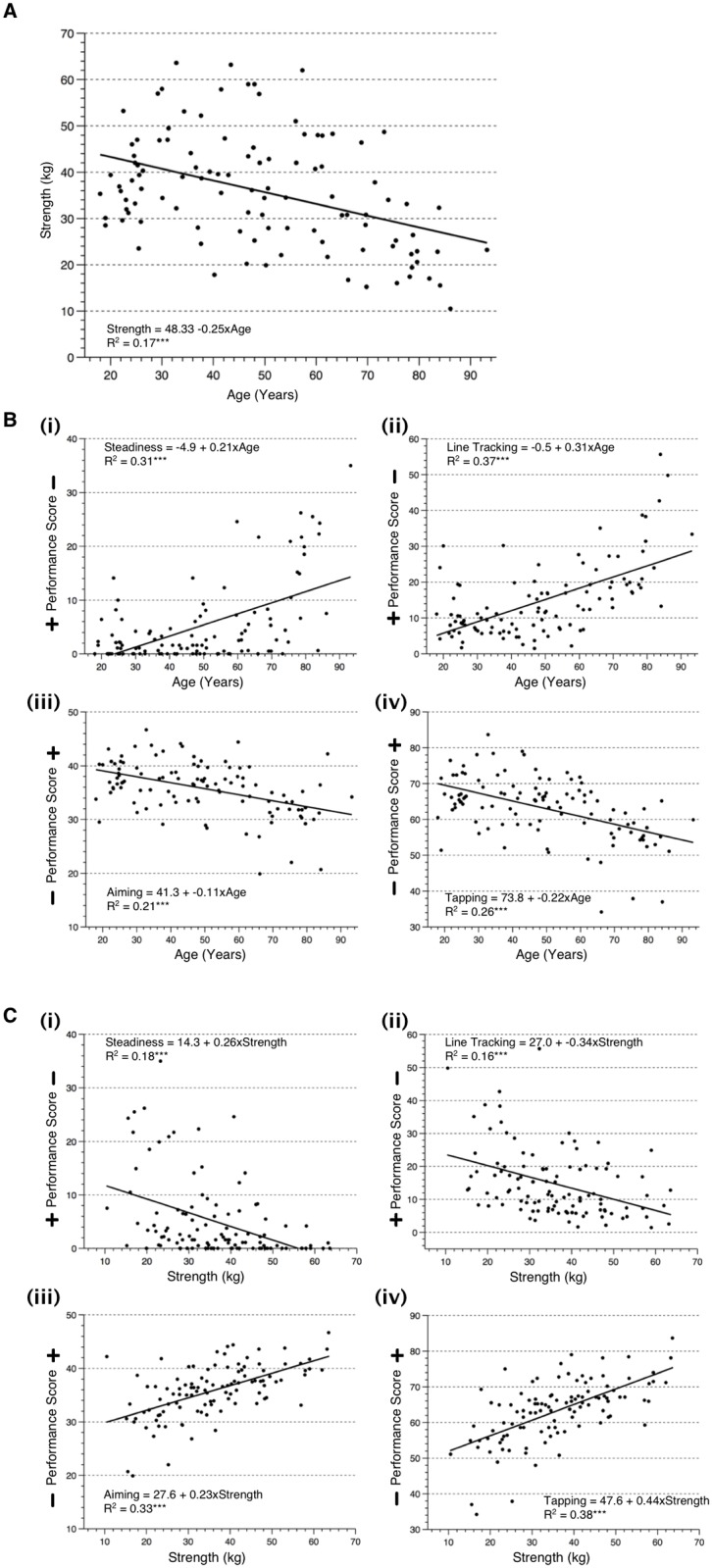
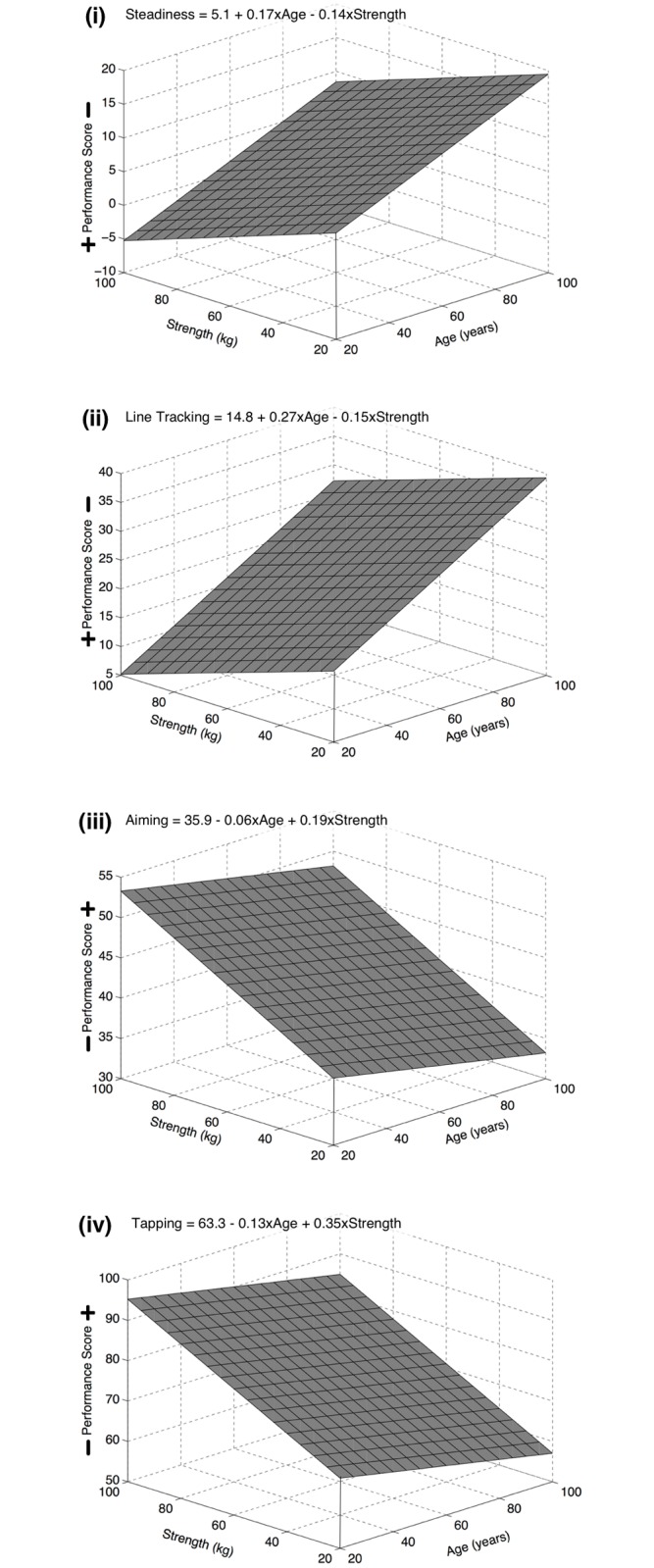
In the scientific literature, there is much evidence of a relationship between age and dexterity, where increased age is related to slower, less nimble and less smooth, less coordinated and less controlled performances. While some suggest that the relationship is a direct consequence of reduced muscle strength associated to increased age, there is a lack of research that has systematically investigated the relationships between age, strength and hand dexterity. Therefore, the aim of this study was to examine the associations between age, grip strength and dexterity. 107 adults (range 18-93 years) completed a series of hand dexterity tasks (i.e. steadiness, line tracking, aiming, and tapping) and a test of maximal grip strength. We performed three phases of analyses. Firstly, we evaluated the simple relationships between pairs of variables; replicating the existing literature; and found significant relationships of increased age and reduced strength; increased age and reduced dexterity, and; reduced strength and reduced dexterity. Secondly, we used standard Multiple Regression (MR) models to determine which of the age and strength factors accounted for the greater variance in dexterity. The results showed that both age and strength made significant contributions to the data variance, but that age explained more of the variance in steadiness and line tracking dexterity, whereas strength explained more of the variance in aiming and tapping dexterity. In a third phase of analysis, we used MR analyses to show an interaction between age and strength on steadiness hand dexterity. Simple Slopes post-hoc analyses showed that the interaction was explained by the middle to older aged adults showing a relationship between reduced strength and reduced hand steadiness, whereas younger aged adults showed no relationship between strength and steadiness hand dexterity. The results are discussed in terms of how age and grip strength predict different types of hand dexterity in adults.
在科学文献中,有许多证据表明年龄与灵活性之间存在关联,即年龄增长与表现变慢、不够灵活、不够流畅、协调性和控制性降低有关。虽然有人认为这种关系是年龄增长导致肌肉力量下降的直接结果,但缺乏系统研究年龄、力量和手部灵活性之间关系的研究。因此,本研究的目的是探讨年龄、握力和灵活性之间的关联。107名成年人(年龄范围为18至93岁)完成了一系列手部灵活性任务(即稳定性、线条追踪、瞄准和敲击)以及最大握力测试。我们进行了三个阶段的分析。首先,我们评估了变量对之间的简单关系;重复现有文献的研究;发现年龄增长与力量下降、年龄增长与灵活性降低以及力量下降与灵活性降低之间存在显著关系。其次,我们使用标准多元回归(MR)模型来确定年龄和力量因素中哪一个对手部灵活性的方差解释更大。结果表明,年龄和力量都对数据方差有显著贡献,但年龄对手部稳定性和线条追踪灵活性的方差解释更多,而力量对瞄准和敲击灵活性的方差解释更多。在第三阶段的分析中,我们使用MR分析来显示年龄和力量在手部稳定性灵活性上的相互作用。简单斜率事后分析表明,这种相互作用可以解释为中年至老年成年人中力量下降与手部稳定性降低之间存在关系,而年轻成年人中力量与手部稳定性灵活性之间没有关系。我们从年龄和握力如何预测成年人不同类型的手部灵活性方面对结果进行了讨论。