Vilisaar Janek, Kawabe Kiyokazu, Braitch Manjit, Aram Jehan, Furtun Yasemin, Fahey Angela J, Chopra Mark, Tanasescu Radu, Tighe Patrick J, Gran Bruno, Pothoulakis Charalabos, Constantinescu Cris S
Division of Clinical Neurology, University of Nottingham, Nottingham, UK.
J Neuroimmune Pharmacol. 2015 Sep;10(3):457-67. doi: 10.1007/s11481-015-9589-x. Epub 2015 Feb 18.
The neuropeptide substance P (SP) exhibits cytokine-like properties and exerts different effects in autoimmune inflammation. Various immune cells express SP and its neurokinin-1 receptor (NK1R) isoforms. A role for SP has been demonstrated in a number of autoimmune conditions, including multiple sclerosis (MS). In this work, we studied the role of SP and NK1R in human immune cells with a focus on their relationship with IL-12/IL-23 family cytokines and the associated IFN-γ/IL-17.
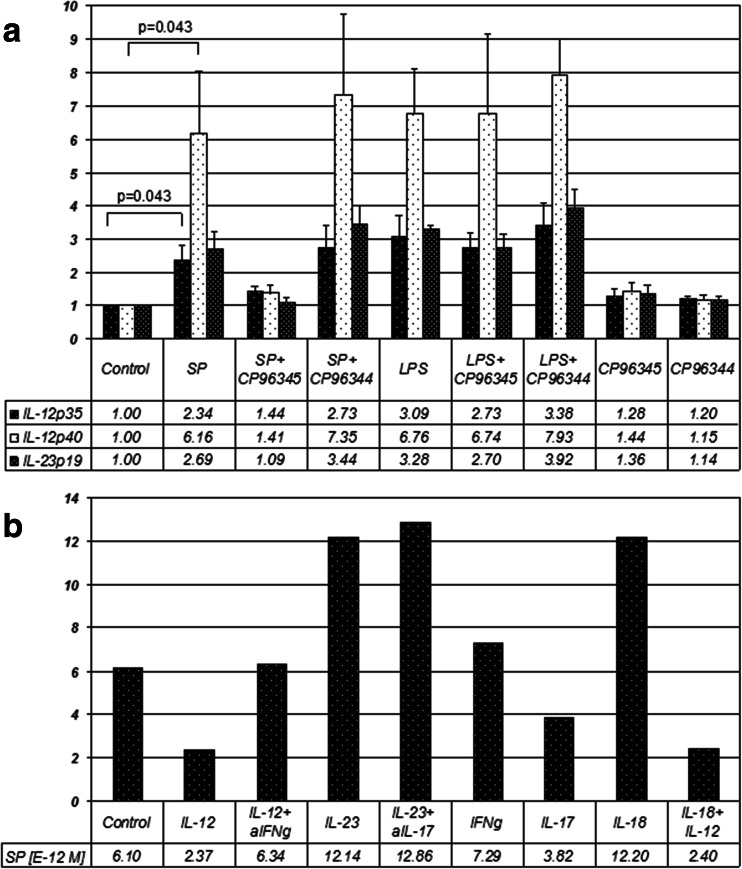
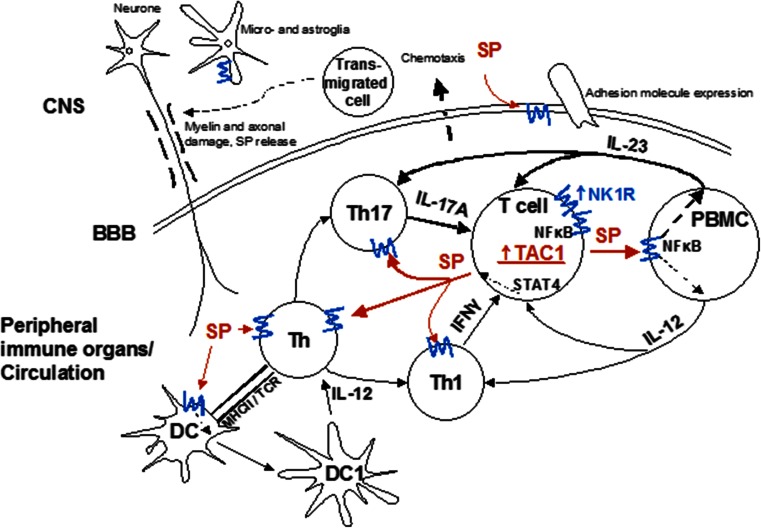
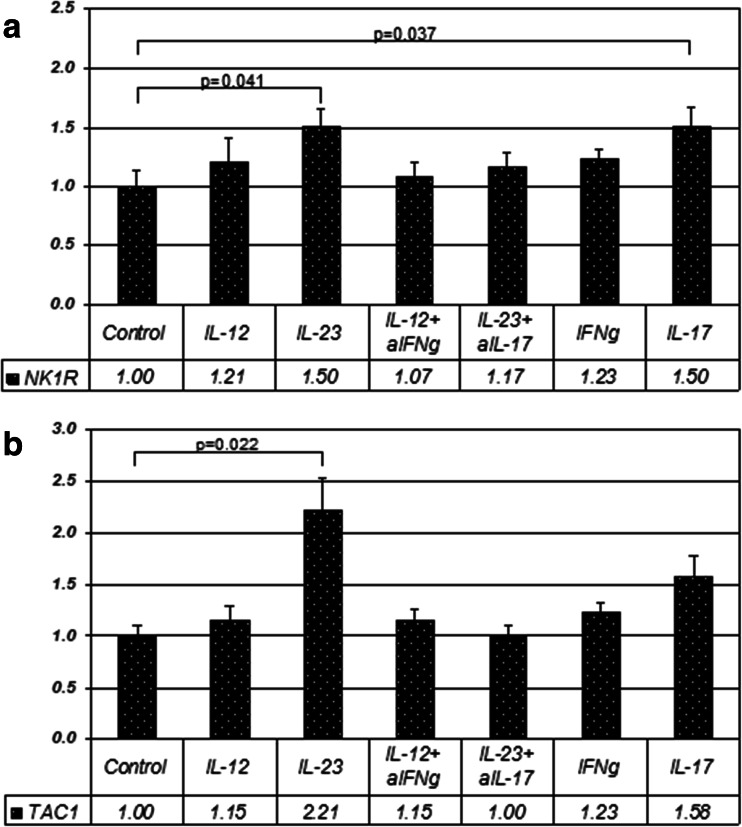
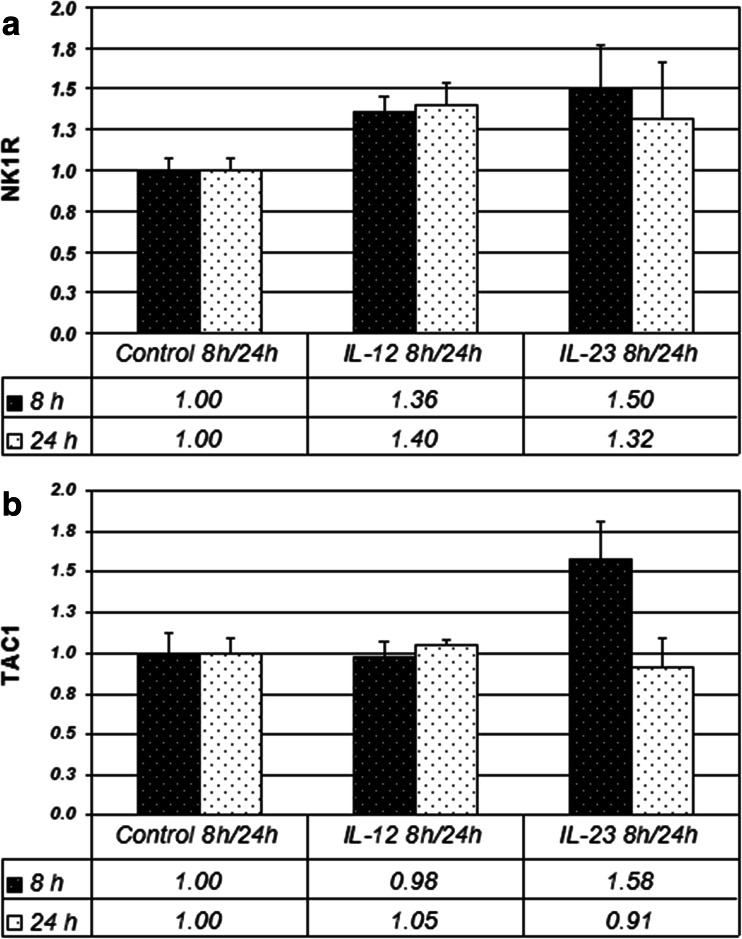
(1) To determine the role of SP mediated effects on induction of various inflammatory cytokines in peripheral blood mononuclear cells (PBMC); (2) to investigate the expression of SP and its receptor in T cells and the effects of stimulation with IL-12 and IL-23. Quantitative real-time PCR, flow cytometry, ELISA, promoter studies on PBMC and primary T cells from healthy volunteers, and Jurkat cell line. Treatment with SP significantly increased the expression of IL-12/IL-23 subunit p40, IL-23 p19 and IL-12 p35 mRNA in human PBMC. Expression of NK1R and SP in T cells was upregulated by IL-23 but a trend was observed with IL-12. The IL-23 effect likely involves IL-17 production that additionally mediates IL-23 effects. Mutual interactions exist with SP enhancing the cytokines IL-23 and IL-12, and SP and NK1R expression being differentially but potentially synergistically regulated by these cytokines. These findings suggest a proinflammatory role for SP in autoimmune inflammation. We propose a model whereby immunocyte derived SP stimulates Th1 and Th17 autoreactive cells migrating to the central nervous system (CNS), enhances their crossing the blood brain barrier and perpetuates inflammation in the CNS by being released from damaged nerves and activating both resident glia and infiltrating immune cells. SP may be a therapeutic target in MS.
神经肽P物质(SP)具有细胞因子样特性,并在自身免疫性炎症中发挥不同作用。多种免疫细胞表达SP及其神经激肽-1受体(NK1R)亚型。SP在包括多发性硬化症(MS)在内的多种自身免疫性疾病中已被证明具有作用。在这项研究中,我们研究了SP和NK1R在人免疫细胞中的作用,重点关注它们与IL-12/IL-23家族细胞因子以及相关的IFN-γ/IL-17的关系。
(1)确定SP介导的对外周血单核细胞(PBMC)中各种炎性细胞因子诱导作用的作用;(2)研究SP及其受体在T细胞中的表达以及IL-12和IL-23刺激的影响。对健康志愿者的PBMC和原代T细胞以及Jurkat细胞系进行定量实时PCR、流式细胞术、ELISA、启动子研究。用SP处理显著增加了人PBMC中IL-12/IL-23亚基p40、IL-23 p19和IL-12 p35 mRNA的表达。IL-23上调了T细胞中NK1R和SP的表达,但IL-12观察到一种趋势。IL-23的作用可能涉及IL-17的产生,其额外介导IL-23的作用。SP与IL-23和IL-12之间存在相互作用,并且SP和NK1R的表达受到这些细胞因子的差异但可能协同调节。这些发现表明SP在自身免疫性炎症中具有促炎作用。我们提出了一个模型,即免疫细胞衍生的SP刺激迁移到中枢神经系统(CNS)的Th1和Th17自身反应性细胞,增强它们穿过血脑屏障的能力,并通过从受损神经释放并激活驻留神经胶质细胞和浸润免疫细胞来使CNS中的炎症持续存在。SP可能是MS的治疗靶点。