Department of Immunobiology, Biomedical Primate Research Centre, Rijswijk, The Netherlands.
J Neuroimmune Pharmacol. 2012 Mar;7(1):253-65. doi: 10.1007/s11481-011-9320-5. Epub 2011 Oct 20.
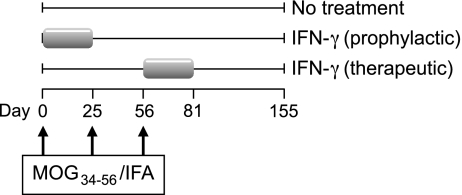
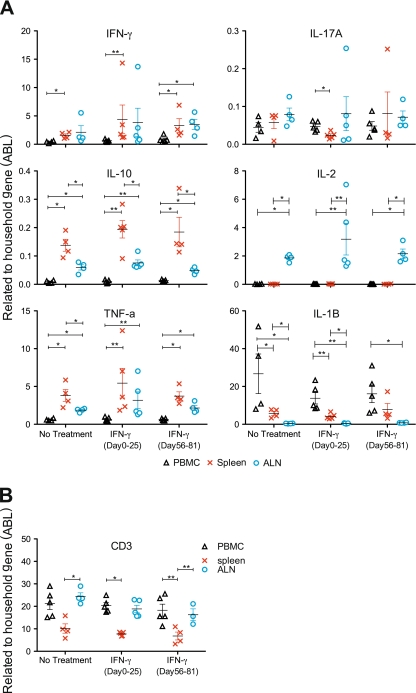
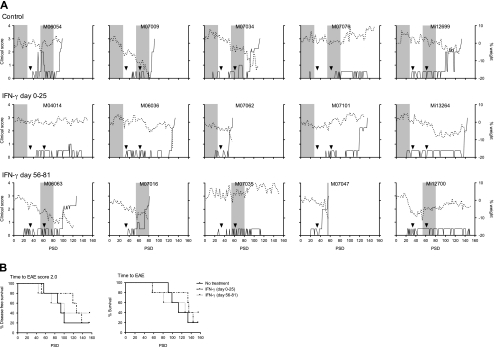
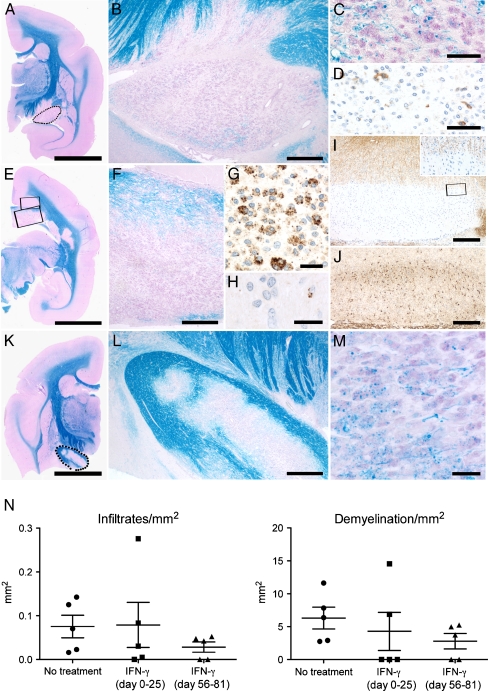
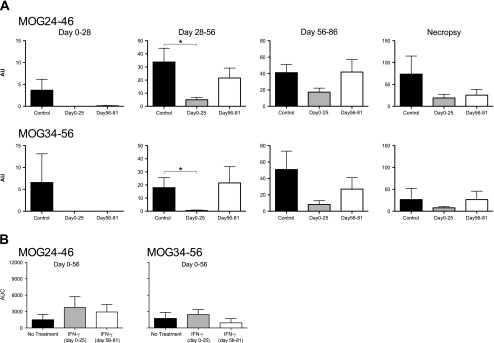
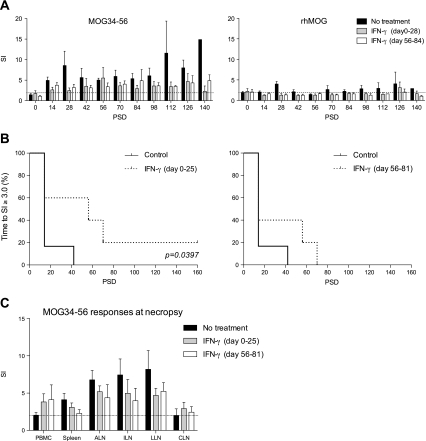
The core pathogenic process in the common marmoset model of multiple sclerosis (MS) is the activation of memory-like T cells specific for peptide 34 to 56 derived from the extracellular domain of myelin/oligodendrocyte glycoprotein (MOG(34-56)). Immunization with MOG(34-56) in incomplete Freund's adjuvant is a sufficient stimulus for in vivo activation of these T cells, together with the induction of MS-like disease and CNS pathology. Ex vivo functional characteristics of MOG(34-56) specific T cells are specific cytolysis of peptide pulsed target cells and high IL-17A production. To indentify possible functions in this new model of T helper 1 cells, which play a central pathogenic role in MS models induced with complete Freund's adjuvant, we tested the effect of human interferon-γ (IFNγ) administration during disease initiation of the disease (day 0-25) and around the time of disease expression (psd 56-81). The results show a clear modulatory effect of early IFNγ treatment on humoral and cellular autoimmune parameters, but no generalized mitigating effect on the disease course. These results argue against a prominent pathogenic role of T helper 1 cells in this new marmoset EAE model.
多发性硬化症(MS)常见绒猴模型中的核心致病过程是针对髓鞘/少突胶质细胞糖蛋白(MOG)(34-56)胞外域衍生肽 34-56 具有记忆样 T 细胞的激活。不完全弗氏佐剂中的 MOG(34-56)免疫接种是这些 T 细胞体内激活的充分刺激因素,同时诱导 MS 样疾病和中枢神经系统病理学。MOG(34-56)特异性 T 细胞的体外功能特征是对肽脉冲靶细胞的特异性细胞溶解和高 IL-17A 产生。为了确定在完全弗氏佐剂诱导的 MS 模型中发挥中心致病作用的这种新型 T 辅助 1 细胞中的可能功能,我们在疾病起始(第 0-25 天)和疾病表达时(psd56-81)期间测试了人干扰素-γ(IFNγ)给药的效果。结果表明,早期 IFNγ 治疗对体液和细胞自身免疫参数具有明显的调节作用,但对疾病过程没有普遍的缓解作用。这些结果表明,在这种新型绒猴 EAE 模型中,T 辅助 1 细胞没有突出的致病作用。