Park Sang O, Yoo Young Bum, Kim Yong Hun, Baek Kwang Je, Yang Jung-Hyun, Choi Pil Cho, Lee Jeong Hun, Lee Kyeong Ryong, Park Kyoung Sik
Department of Emergency Medicine, Konkuk University Medical Center, Konkuk University School of Medicine, Seoul, Korea.
Department of Surgery, Konkuk University Medical Center, Konkuk University School of Medicine, Seoul, Korea.
Ann Surg Treat Res. 2015 Feb;88(2):55-62. doi: 10.4174/astr.2015.88.2.55. Epub 2015 Jan 27.
The anticancer property and cytoprotective role of selenium in chemotherapy have been reported. However, the combination effects of selenium on chemotherapy for advanced breast cancer have not yet been clearly defined. The purpose of this study was to investigate the combined effects of selenium on chemotherapy using docetaxel on breast cancer cell lines.
Under adherent culture conditions, two breast cancer cell lines, MDA-MB-231 and MCF-7, were treated with docetaxel at 500pM and selenium at 100nM, 1µM, or 10µM. Changes in cell growth, cell cycle duration, and degree of apoptosis after 72 hours in each treated group were evaluated.
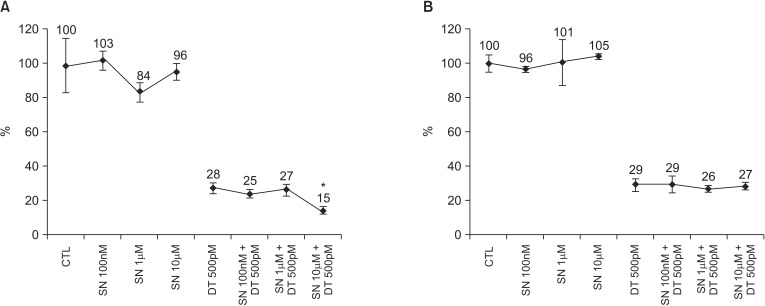
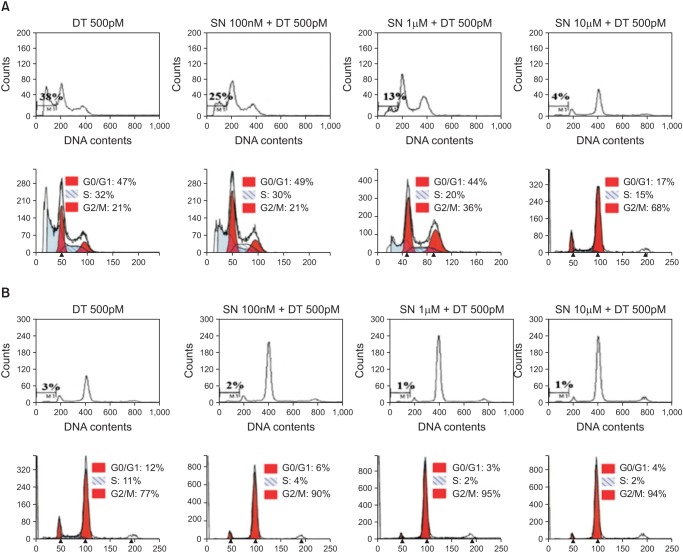
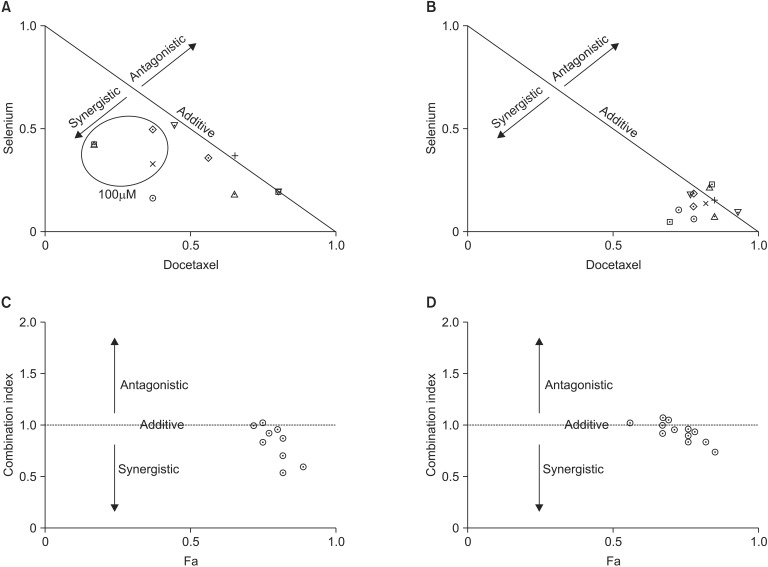
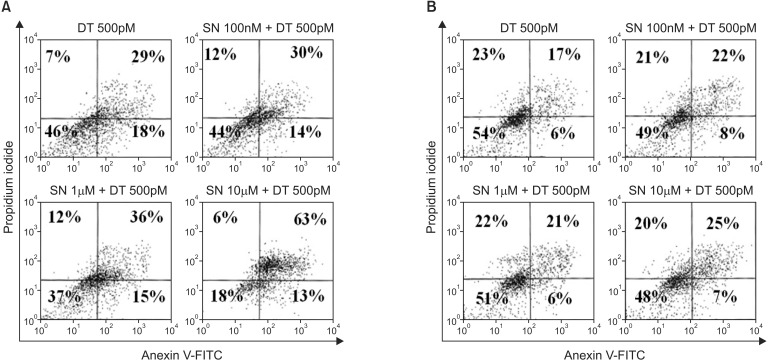
In the MDA-MB-231 cells, the combination therapy group (docetaxel at 500pM plus selenium at 10µM) showed a significantly decreased percentage of cell growth (15% vs. 28%; P = 0.004), a significantly increased percentage of late apoptosis (63% vs. 26%; P = 0.001), and an increased cell cycle arrest in the G2/M phase (P = 0.001) compared with the solitary docetaxel therapy group. Isobologram analysis demonstrated the synergistic effect of the combination therapy in the MDA-MB-231 cells. However, in the MCF-7 cells, no significant differences in the percentage of cell growth apoptosis, the percentage of apoptosis, and the pattern of cell cycle arrest were noted between the combination therapy groups and the solitary docetaxel therapy group.
Our in vitro study indicated that the combination of selenium with docetaxel inhibits cell proliferation through apoptosis and cell arrest in the G2/M phase in MDA-MB-231 breast cancer cells.
硒在化疗中的抗癌特性和细胞保护作用已有报道。然而,硒对晚期乳腺癌化疗的联合效应尚未明确界定。本研究的目的是探讨硒联合多西他赛对乳腺癌细胞系化疗的联合效应。
在贴壁培养条件下,用500pM的多西他赛和100nM、1µM或10µM的硒处理两种乳腺癌细胞系MDA-MB-231和MCF-7。评估各处理组72小时后细胞生长、细胞周期持续时间和凋亡程度的变化。
在MDA-MB-231细胞中,联合治疗组(500pM多西他赛加10µM硒)与单独多西他赛治疗组相比,细胞生长百分比显著降低(15%对28%;P = 0.004),晚期凋亡百分比显著增加(63%对26%;P = 0.001),G2/M期细胞周期阻滞增加(P = 0.001)。等效线图分析表明联合治疗在MDA-MB-231细胞中有协同作用。然而,在MCF-7细胞中,联合治疗组与单独多西他赛治疗组之间在细胞生长凋亡百分比、凋亡百分比和细胞周期阻滞模式方面未观察到显著差异。
我们的体外研究表明,硒与多西他赛联合可通过诱导MDA-MB-231乳腺癌细胞凋亡和G2/M期细胞阻滞来抑制细胞增殖。