Czaczkes Tomer J, Heinze Jürgen, Ruther Joachim
Biologie I, Universität Regensburg, Regensburg, Bavaria, Germany.
PLoS One. 2015 Feb 18;10(2):e0118376. doi: 10.1371/journal.pone.0118376. eCollection 2015.
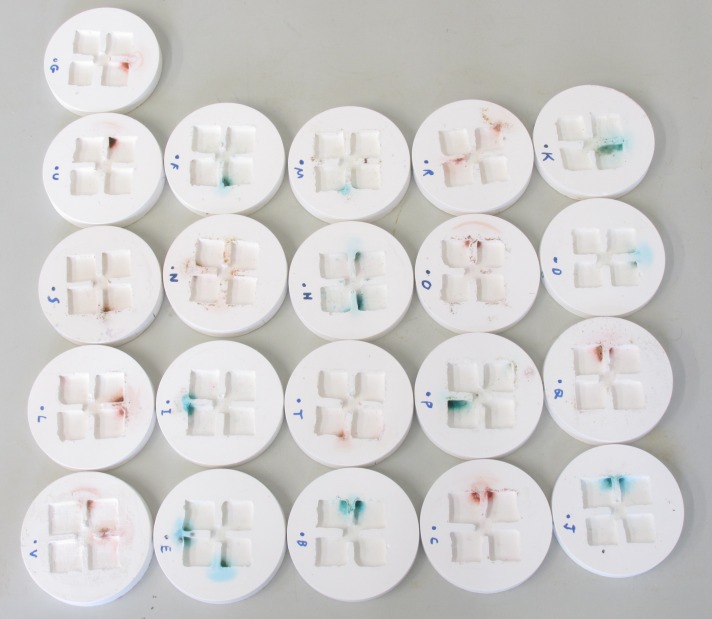
Sanitary behaviour is an important, but seldom studied, aspect of social living. Social insects have developed several strategies for dealing with waste and faecal matter, including dumping waste outside the nest and forming specialised waste-storage chambers. In some cases waste material and faeces are put to use, either as a construction material or as a long-lasting signal, suggesting that faeces and waste may not always be dangerous. Here we examine a previously undescribed behaviour in ants - the formation of well-defined faecal patches. Lasius niger ants were housed in plaster nests and provided with coloured sucrose solution. After two months, 1-4 well defined dark patches, the colour of the sucrose solution, formed within each of the plaster nests. These patches never contained other waste material such as uneaten food items, or nestmate corpses. Such waste was collected in waste piles outside the nest. The coloured patches were thus distinct from previously described 'kitchen middens' in ants, and are best described as 'toilets'. Why faeces is not removed with other waste materials is unclear. The presence of the toilets inside the nest suggests that they may not be an important source of pathogens, and may have a beneficial role.
卫生行为是社会生活中一个重要但很少被研究的方面。群居昆虫已经发展出了几种处理废物和粪便的策略,包括将废物倾倒在巢穴外以及形成专门的废物储存室。在某些情况下,废料和粪便会被用作建筑材料或持久信号,这表明粪便和废物可能并不总是危险的。在此,我们研究了蚂蚁一种此前未被描述的行为——形成界限分明的粪便斑块。将黑蚁饲养在石膏巢中,并提供有色蔗糖溶液。两个月后,在每个石膏巢内形成了1至4个界限分明的深色斑块,其颜色与蔗糖溶液相同。这些斑块中从不包含其他废物,如未食用的食物或蚁巢同伴的尸体。此类废物被收集在巢穴外的垃圾堆中。因此,这些有色斑块与此前描述的蚂蚁“厨房 midden”不同,最好将其描述为“厕所”。粪便为何不与其他废物一起被清除尚不清楚。巢穴内存在这些厕所表明它们可能不是病原体的重要来源,且可能具有有益作用。