Zhang Li, Fang Cheng, Xu Xianqun, Li Anling, Cai Qing, Long Xinghua
Zhongnan Hospital of Wuhan University, Wuhan 430071, China.
Hubei University of Chinese Medicine, Wuhan 430061, China.
Biomed Res Int. 2015;2015:357485. doi: 10.1155/2015/357485. Epub 2015 Jan 28.
More and more evidences demonstrate that androgen receptor (AR), epidermal growth factor receptor (EGFR), and breast cancer susceptibility gene 1 (BRCA1) have unique clinical implications for targeted therapy or prognosis in triple-negative breast cancer (TNBC). Therefore, we conducted a meta-analysis to summarize the possible associations.
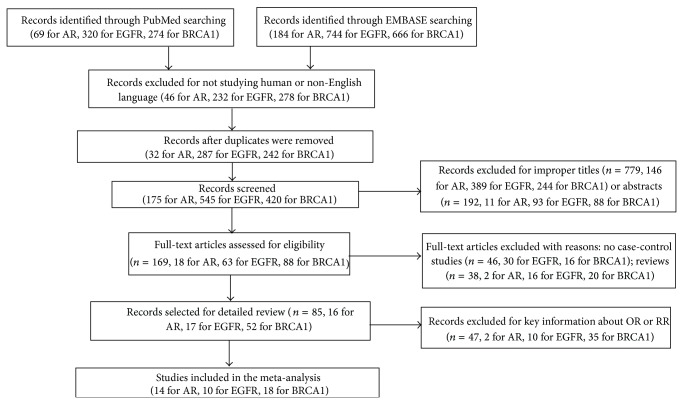
We retrieved published articles about AR, EGFR, and BRCA1 in TNBC from PubMed and EMBASE. The analysis was performed with Rev-Man 5.2 software.
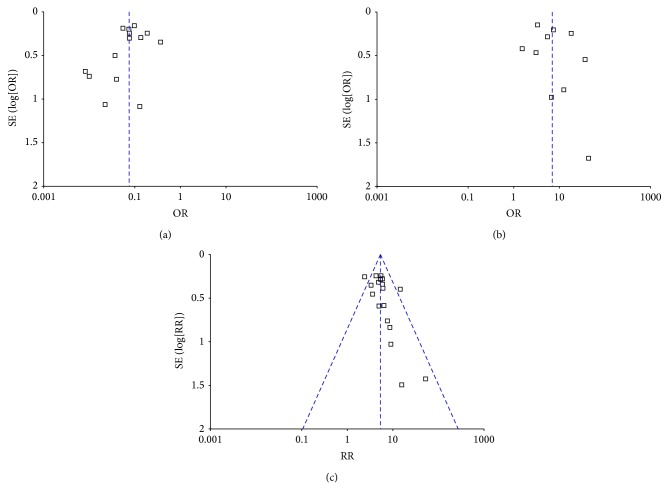
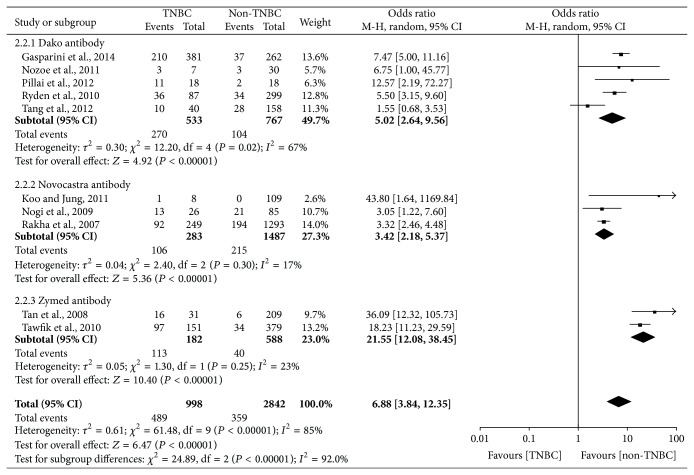
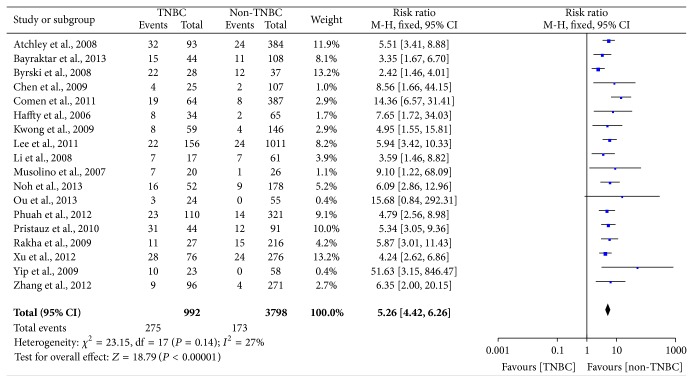
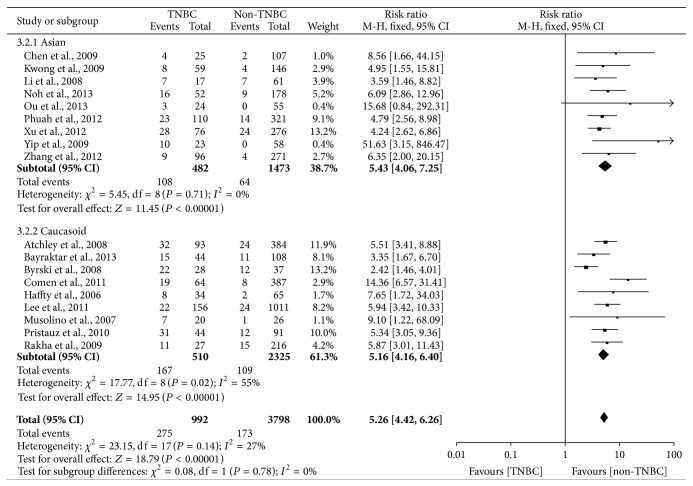
A total of 38 articles were eligible for the meta-analysis. Our study showed that the expression level of EGFR (OR = 6.88, P < 0.00001) and the prevalence of BRCA1 mutation (RR = 5.26, P < 0.00001) were higher in TNBC than non-TNBC. In contrast, the expression level of AR was lower in TNBC than non-TNBC (OR = 0.07, P < 0.00001). In the subgroup related to EGFR expression, the level of EGFR expression was significantly increased in Asians (OR = 9.60) compared with Caucasians (OR = 5.53) for TNBC patients. Additionally, the prevalence of BRCA1 mutation in Asians (RR = 5.43, P < 0.00001) was higher than that in Caucasians (RR = 5.16, P < 0.00001).
The distinct expression of AR and EGFR and the prevalence of BRCA1 mutation indicated that AR, EGFR, and BRCA1 might be unique biomarkers for targeted therapy and prognosis in TNBC.
越来越多的证据表明,雄激素受体(AR)、表皮生长因子受体(EGFR)和乳腺癌易感基因1(BRCA1)在三阴性乳腺癌(TNBC)的靶向治疗或预后方面具有独特的临床意义。因此,我们进行了一项荟萃分析以总结可能的关联。
我们从PubMed和EMBASE检索了关于TNBC中AR、EGFR和BRCA1的已发表文章。使用Rev-Man 5.2软件进行分析。
共有38篇文章符合荟萃分析的条件。我们的研究表明,TNBC中EGFR的表达水平(OR = 6.88,P < 0.00001)和BRCA1突变的发生率(RR = 5.26,P < 0.00001)高于非TNBC。相比之下,TNBC中AR的表达水平低于非TNBC(OR = 0.07,P < 0.00001)。在与EGFR表达相关的亚组中,TNBC患者中亚洲人的EGFR表达水平(OR = 9.60)比高加索人(OR = 5.53)显著升高。此外,亚洲人BRCA1突变的发生率(RR = 5.43,P < 0.00001)高于高加索人(RR = 5.16,P < 0.00001)。
AR和EGFR的不同表达以及BRCA1突变的发生率表明,AR、EGFR和BRCA1可能是TNBC靶向治疗和预后的独特生物标志物。