Strazielle Nathalie, Ghersi-Egea Jean-François
Brain-i Lyon, France ; Oncoflam Team, Lyon Neuroscience Research Center, INSERM, U1028, CNRS, UMR5292, Université Lyon 1 Lyon, France.
Oncoflam Team, Lyon Neuroscience Research Center, INSERM, U1028, CNRS, UMR5292, Université Lyon 1 Lyon, France ; BIP Platform, Lyon Neuroscience Research Center, INSERM, U1028, CNRS, UMR5292, Université Lyon 1 Lyon, France.
Front Neurosci. 2015 Feb 5;9:21. doi: 10.3389/fnins.2015.00021. eCollection 2015.
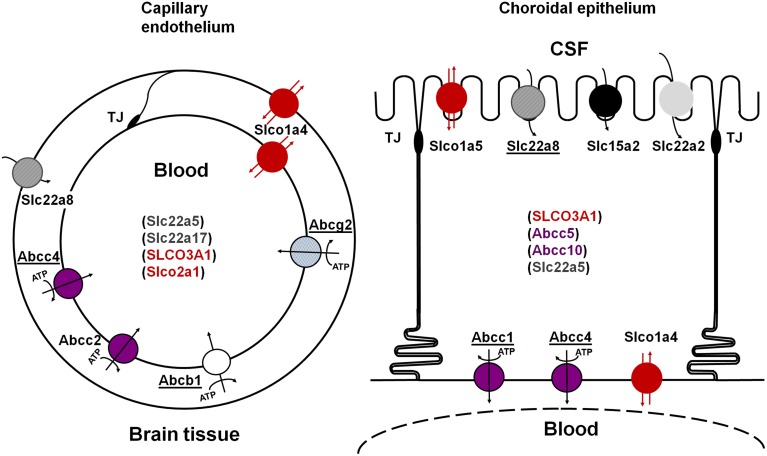
The cerebral microvessel endothelium forming the blood-brain barrier (BBB) and the epithelium of the choroid plexuses forming the blood-CSF barrier (BCSFB) operate as gatekeepers for the central nervous system. Exposure of the vulnerable developing brain to chemical insults can have dramatic consequences for brain maturation and lead to life-long neurological diseases. The ability of blood-brain interfaces to efficiently protect the immature brain is therefore an important pathophysiological issue. This is also key to our understanding of drug entry into the brain of neonatal and pediatric patients. Non-specific paracellular diffusion through barriers is restricted early during development, but other neuroprotective properties of these interfaces differ between the developing and adult brains. This review focuses on the developmental expression and function of various classes of efflux transporters. These include the multispecific transporters of the ATP-binding cassette transporter families ABCB, ABCC, ABCG, the organic anion and cation transporters of the solute carrier families SLC21/SLCO and SLC22, and the peptide transporters of the SLC15 family. These transporters play a key role in preventing brain entry of blood-borne molecules such as drugs, environmental toxicants, and endogenous metabolites, or else in increasing the clearance of potentially harmful organic ions from the brain. The limited data available for laboratory animals and human highlight transporter-specific developmental patterns of expression and function, which differ between blood-brain interfaces. The BCSFB achieves an adult phenotype earlier than BBB. Efflux transporters at the BBB appear to be regulated by various factors subsequently secreted by neural progenitors and astrocytes during development. Their expression is also modulated by oxidative stress, inflammation, and exposure to xenobiotic inducers. A better understanding of these regulatory pathways during development, in particular the signaling pathways triggered by oxidative stress and xenobiotics, may open new opportunities to therapeutic manipulation in view to improve or restore neuroprotective functions of the blood-brain interfaces in the context of perinatal injuries.
构成血脑屏障(BBB)的脑微血管内皮细胞和构成血脑脊液屏障(BCSFB)的脉络丛上皮细胞,作为中枢神经系统的守门人发挥作用。发育中的脆弱大脑暴露于化学损伤下,可能会对大脑成熟产生重大影响,并导致终身神经疾病。因此,血脑界面有效保护未成熟大脑的能力是一个重要的病理生理问题。这也是我们理解药物进入新生儿和儿科患者大脑的关键。发育早期,通过屏障的非特异性细胞旁扩散就受到限制,但这些界面的其他神经保护特性在发育中的大脑和成年大脑之间存在差异。本综述聚焦于各类外排转运蛋白的发育表达及功能。这些转运蛋白包括ATP结合盒转运体家族ABCB、ABCC、ABCG的多特异性转运体,溶质载体家族SLC21/SLCO和SLC22的有机阴离子和阳离子转运体,以及SLC15家族的肽转运体。这些转运蛋白在阻止血液中诸如药物、环境毒物和内源性代谢物等分子进入大脑,或者在增加从大脑清除潜在有害有机离子方面发挥关键作用。实验室动物和人类的现有有限数据突出了转运蛋白特异性的发育表达和功能模式,这些模式在血脑界面之间存在差异。BCSFB比BBB更早达到成年表型。BBB处的外排转运蛋白似乎受到神经祖细胞和星形胶质细胞在发育过程中随后分泌的各种因素的调节。它们的表达也受到氧化应激、炎症以及接触外源性诱导剂的调节。更好地理解发育过程中的这些调节途径,特别是氧化应激和外源性物质触发的信号通路,可能会为治疗干预带来新机遇,以期在围产期损伤的背景下改善或恢复血脑界面的神经保护功能。