Sharkey Rachel J, Karama Sherif, Dagher Alain
McConnell Brain Imaging Centre, Montreal Neurological Institute, McGill University Montreal, QC, Canada.
McConnell Brain Imaging Centre, Montreal Neurological Institute, McGill University Montreal, QC, Canada ; Douglas Mental Health University Institute, McGill University Montreal, QC Canada.
Front Neurosci. 2015 Feb 4;9:24. doi: 10.3389/fnins.2015.00024. eCollection 2015.
Several studies report an association between body mass index (BMI) and cortical thickness in adults. Some studies demonstrate diffuse cortical thinning in obesity, while others report effects in areas that are associated with self-regulation, such as lateral prefrontal cortex.
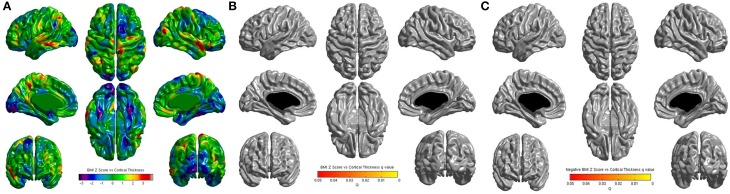
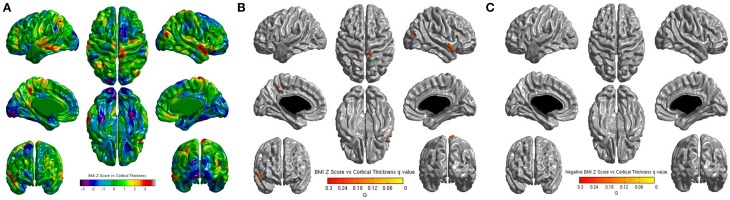
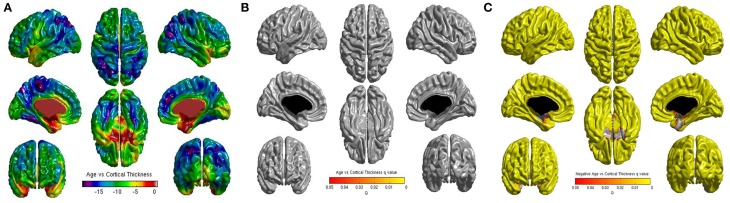
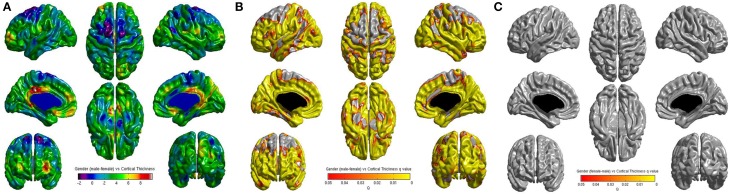
This study used multilevel modeling of data from the NIH Pediatric MRI Data Repository, a mixed longitudinal and cross-sectional database, to examine the relationship between cortical thickness and body weight in children. Cortical thickness was computed at 81,942 vertices of 716 MRI scans from 378 children aged between 4 and 18 years. Body mass index Z score for age was computed for each participant. We performed vertex-wise statistical analysis of the relationship between cortical thickness and BMI, accounting for age and gender. In addition, cortical thickness was extracted from regions of interest in prefrontal cortex and insula.
No significant association between cortical thickness and BMI was found, either by statistical parametric mapping or by region of interest analysis. RESULTS remained negative when the analysis was restricted to children aged 12-18.
The correlation between BMI and cortical thickness was not found in this large pediatric sample. The association between BMI and cortical thinning develops after adolescence. This has implications for the nature of the relationship between brain anatomy and weight gain.
多项研究报告了成人体重指数(BMI)与皮质厚度之间的关联。一些研究表明肥胖者存在弥漫性皮质变薄,而另一些研究则报告了在与自我调节相关的区域(如外侧前额叶皮质)出现的影响。
本研究使用了美国国立卫生研究院儿科MRI数据存储库中的数据进行多水平建模,该数据库是一个混合的纵向和横断面数据库,用于研究儿童皮质厚度与体重之间的关系。在来自378名4至18岁儿童的716次MRI扫描的81,942个顶点处计算皮质厚度。为每个参与者计算年龄别BMI Z评分。我们对皮质厚度与BMI之间的关系进行了逐顶点统计分析,同时考虑了年龄和性别。此外,从额叶前皮质和脑岛的感兴趣区域提取皮质厚度。
通过统计参数映射或感兴趣区域分析,均未发现皮质厚度与BMI之间存在显著关联。当分析仅限于12至18岁的儿童时,结果仍然为阴性。
在这个大型儿科样本中未发现BMI与皮质厚度之间的相关性。BMI与皮质变薄之间的关联在青春期后出现。这对脑解剖结构与体重增加之间关系的性质具有启示意义。